Simon Rattle - Mahler: Symphony No. 8 (2005)
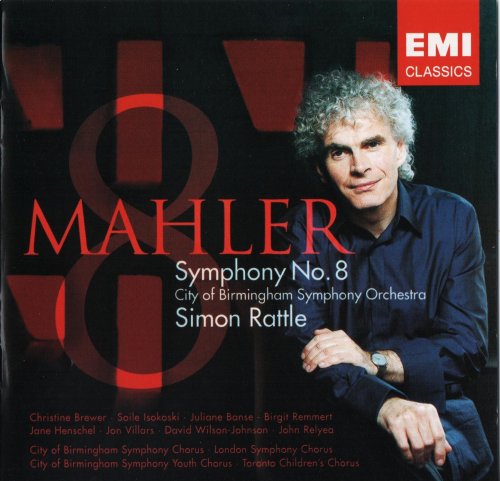
Artist: Simon Rattle
Title: Mahler: Symphony No. 8
Year Of Release: 2005
Label: EMI Classics
Genre: Classical
Quality: FLAC (image+.cue,log,scans)
Total Time: 77:38
Total Size: 389 Mb
WebSite: Album Preview
Tracklist: Title: Mahler: Symphony No. 8
Year Of Release: 2005
Label: EMI Classics
Genre: Classical
Quality: FLAC (image+.cue,log,scans)
Total Time: 77:38
Total Size: 389 Mb
WebSite: Album Preview
Gustav Mahler (1860-1911)
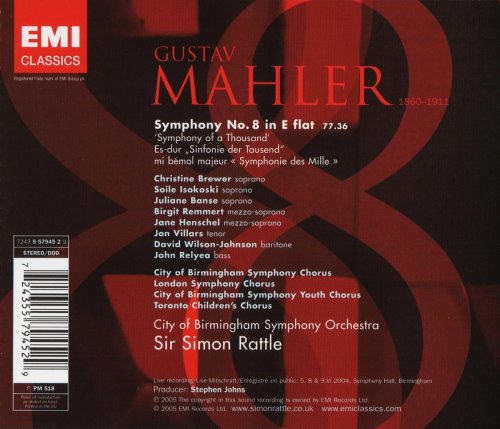
Symphony No.8 in E flat major "Symphony of a Thousand"
01. Veni, creator spiritus [0:01:25.49]
02. Imple superna gratia [0:03:41.13]
03. Infirma nostri corporis [0:02:47.24]
04. Tempo I (Allegro, etwas hastig) [0:01:25.57]
05. Infirma nostri corporis [0:03:08.69]
06. Accende lumen sensibus [0:05:27.56]
07. Qui Paraclitus diceris [0:03:25.09]
08. Gloria Patri Domino [0:02:24.69]
09. Poco adagio [0:06:41.26]
10. Più mosso (Allegro moderato) [0:03:02.32]
11. Waldung, sie schwankt heran (Chor und Echo) [0:04:45.73]
12. Ewiger Wonnebrand (Pater Ecstaticus) [0:01:26.57]
13. Wie Felsenabgrund mir zu Füssen (Pater Profundus) [0:04:10.08]
14. Gerettet ist das edle Glied (Engel) [0:02:35.08]
15. Uns bleibt ein Erdenrest (Engel) [0:02:22.32]
16. Ich spür' soeben (Die jüngeren Engel) [0:01:02.02]
17. Höchste Herrscherin der Welt (Doctor Marianus) [0:03:49.25]
18. Dir, der Unberührbaren (Chor) [0:03:03.02]
19. Bei der Liebe, die den Füssen (Magna Peccatrix) [0:04:34.59]
20. Neige, neige, du Ohnegleiche (Una Poenitentium - Gretchen) [0:01:38.14]
21. Er überwächst uns schon (Chor seliger - Knaben) [0:02:28.48]
22. Komm! Hebe dich zu höhern Spären! (Mater Gloriosa und Chor) [0:01:08.24]
23. Blicket auf zum Retterblick (Doctor Marianus und chor) [0:04:31.70]
24. Alles Vergängliche (Chorus mysticus) [0:04:21.03]
25. Alles Vergängliche (Chorus mysticus) [0:02:08.17]
Performers:
Christine Brewer - soprano
Soile Isokoski - soprano
Juliane Banse - soprano
Birgit Remmert - mezzo-soprano
Jane Henschel - mezzo-soprano
Jon Villars - tenor
David Wilson-Johnson - baritone
John Relyea - bass
City of Birmingham Symphony Chorus
London Symphony Chorus
City of Birmingham Symphony Youth Chorus
Toronto Children's Chorus
City of Birmingham Symphony Orchestra
Sir Simon Rattle - conductor
With this release Sir Simon Rattle completes his cycle of the Mahler symphonies for EMI. It’s been a long journey, one that started back in 1980 when he made his first recording of Deryck Cooke’s performing version of the Tenth Symphony – a score that, like the Resurrection Symphony, has always been especially close to Rattle’s heart. It’s been pointed out several times how carefully Rattle has built his career. There’s been a great deal of calculation on his part ... and I do not use that term pejoratively. He stayed in Birmingham for 18 years, building his career and the orchestra when it would have been so easy for him to have taken one of the plum posts undoubtedly offered to him over the years.
So, too, it has been with Mahler. He has been patient in his preparation of these scores and has not rushed his fences. For example, he first performed the Fifth a good number of years ago, by his own admission didn’t do it very well and so put it to one side until he judged he was ready to have another go.
The Eighth was the last of the symphonies to be taken into his repertoire. I was lucky enough to be present in Symphony Hall on the night in August 2002 that he performed it for the very first time. Many of those performers feature on this recording too. Only one soloist has changed: Juliane Banse replaces Rosemary Joshua. But there has been one very important change. Back in 2002 the orchestra was the National Youth Orchestra of Great Britain (who performed superbly for Rattle) but now he has his old orchestra, the CBSO, at his command.
With a work as complex and unique as Mahler’s Eighth it’s impossible to suggest a "best buy," I think. Indeed, it could almost be an impertinence. We are lucky indeed that three such fine recordings, albeit very different ones, are available. Mahler enthusiasts will want to hear all three for each sheds fresh light on this amazing score.
Though one may not agree with every detail, this new recording is a formidable achievement and a fitting culmination to Sir Simon Rattle’s recorded survey of the Mahler symphonies. Like Solti’s version was for three decades (and in many ways still remains) this new recording will, I suspect, become a benchmark. It’s not the last word on Mahler’s Eighth (there never can be a "last word" on this piece, nor on any work of performing art) but it’s a recording by one of the most thought-provoking Mahlerians of our day and one that demands to be heard.
Superbly performed by all concerned and expertly recorded by EMI’s engineers, I recommend this CD with great enthusiasm.
So, too, it has been with Mahler. He has been patient in his preparation of these scores and has not rushed his fences. For example, he first performed the Fifth a good number of years ago, by his own admission didn’t do it very well and so put it to one side until he judged he was ready to have another go.
The Eighth was the last of the symphonies to be taken into his repertoire. I was lucky enough to be present in Symphony Hall on the night in August 2002 that he performed it for the very first time. Many of those performers feature on this recording too. Only one soloist has changed: Juliane Banse replaces Rosemary Joshua. But there has been one very important change. Back in 2002 the orchestra was the National Youth Orchestra of Great Britain (who performed superbly for Rattle) but now he has his old orchestra, the CBSO, at his command.
With a work as complex and unique as Mahler’s Eighth it’s impossible to suggest a "best buy," I think. Indeed, it could almost be an impertinence. We are lucky indeed that three such fine recordings, albeit very different ones, are available. Mahler enthusiasts will want to hear all three for each sheds fresh light on this amazing score.
Though one may not agree with every detail, this new recording is a formidable achievement and a fitting culmination to Sir Simon Rattle’s recorded survey of the Mahler symphonies. Like Solti’s version was for three decades (and in many ways still remains) this new recording will, I suspect, become a benchmark. It’s not the last word on Mahler’s Eighth (there never can be a "last word" on this piece, nor on any work of performing art) but it’s a recording by one of the most thought-provoking Mahlerians of our day and one that demands to be heard.
Superbly performed by all concerned and expertly recorded by EMI’s engineers, I recommend this CD with great enthusiasm.
![Noel McKay - Songs About Bad People (2026) [Hi-Res]](https://img.israbox.com/img/2026-09/25/nxf8m3t6d1fmsqf6yxa9rd38t.jpg "Noel McKay - Songs About Bad People (2026) [Hi-Res]")
![Dino Siani - Classic Strings (2026) [Hi-Res]](https://img.israbox.com/img/2026-09/26/2n6j4qycki63cwebflfzs7ns6.jpg "Dino Siani - Classic Strings (2026) [Hi-Res]")
![Audrey Powne - Bodies of Water (2026) [Hi-Res]](https://www.dibpic.com/uploads/posts/2026-09/1790174071_1.jpg "Audrey Powne - Bodies of Water (2026) [Hi-Res]")
![Achim Seifert Project - Woven Strings (2026) [Hi-Res]](https://img.israbox.com/img/2026-09/24/7zcwxc6d08s8v9e6b1hq4wve2.jpg "Achim Seifert Project - Woven Strings (2026) [Hi-Res]")
![Carla Marciano - DAYDREAMING My Beloved Father GIOVANNI (2026) [Hi-Res]](https://img.israbox.com/img/2026-09/25/f7t3j7sz6kh3siah4cno3bapl.jpg "Carla Marciano - DAYDREAMING My Beloved Father GIOVANNI (2026) [Hi-Res]")