Bruce Ford, Laura Claycomb, Ralf Lukas, Franz Hawlata, Roger Norrington - Berlioz: Benvenuto Cellini (2006)
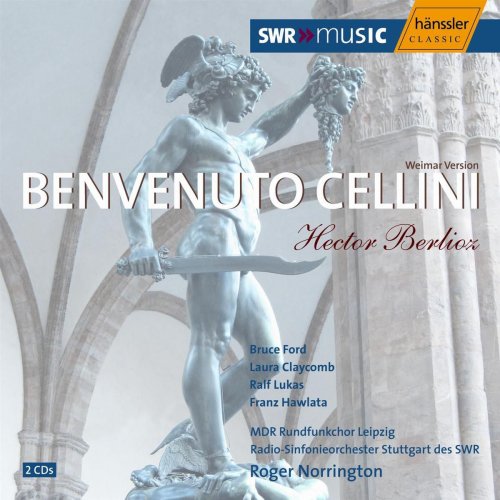
Artist: Bruce Ford, Laura Claycomb, Ralf Lukas, Franz Hawlata, Roger Norrington, MDR Rundfunkchor Leipzig, Radio Sinfonieorchester Stuttgart
Title: Berlioz: Benvenuto Cellini
Year Of Release: 2006
Label: Hänssler
Genre: Classical
Quality: FLAC (tracks)
Total Time: 2:44:44
Total Size: 685 MB
WebSite: Album Preview
Tracklist:Title: Berlioz: Benvenuto Cellini
Year Of Release: 2006
Label: Hänssler
Genre: Classical
Quality: FLAC (tracks)
Total Time: 2:44:44
Total Size: 685 MB
WebSite: Album Preview
01. Overture (Weimar Version)
02. Introduction. Teresa!…Mais ou peut-elle etre? (Balducci) [Weimar Version]
03. Enfin il est sorti (Teresa, Choir and Cellini, Bernardino, Francesco) [Weimar Version]
04. Recitative. Les belles fleurs! (Teresa) [Weimar Version]
05. Cavatine: Entre l'amour et le devoir (Teresa) [Weimar Version]
06. Duet and Trio. Cellini! Teresa! (Teresa, Cellini, Fieramosca) [Weimar Version]
07. Recitative. Ciel! Nous sommes perdus (Teresa, Cellini, Fieramosca, Balducci) [Weimar Version]
08. Finale. A nous, voisines et servantes! (Teresa, Fieramosca, Balducci, Chorus) [Weimar Version]
09. Recitative. Une heure encore (Cellini) [Weimar Version]
10. Romance. La gloire etait ma seule idole (Cellini) [Weimar Version]
11. Scene and Chorus. A boire, a boire, a boire! (Weimar Version)
12. Chant des cisseleurs: Si la terre aux beaux jours se couronne (Cellini, Francesco, Bernardino, Cabaretier, Chorus) [Weimar Version]
13. Aria. Cette somme t'est due (Ascanio, Cellini, Francesco, Bernardino, Cabaretier, Chorus) [Weimar Version]
14. Recitative. C'est trop fort! (Fieramosca, Pompeo) [Weimar Version]
15. Aria. Ah! Qui pourrait me resister? (Fieramosca) [Weimar Version]
16. Finale. Vous voyez, j'espere (Balducci, Teresa, Ascanio, Cellini, Fieramosca, Pompeo, Chorus) [Weimar Version]
17. Overture of the Pantomime: Ah! Ah! Bravo! (Chorus) [Weimar Version]
18. Pantomime of King Midas: Voici maitre Arlequin (Chorus, Balducci) [Weimar Version]
19. Ariette d'Arlequin: Regardons bien maitre Arlequin (Chorus) [Weimar Version]
20. Cavatine of Pasquarello: Il palit fort (Balducci, Chorus) [Weimar Version]
21. Entract and Scene (Weimar Version)
22. A l'atelier (Chorus) [Weimar Version]
23. Il n'a pas reparu! (Teresa, Ascanio) [Weimar Version]
24. Bienheureux les matelots (Ascanio, Cellini, Chorus) [Weimar Version]
25. Aria. Mais qu'ai-je donc? (Ascanio) [Weimar Version]
26. Recitative. Ah! Qu'est-il devenue (Teresa, Ascanio, Chorus) [Weimar Version]
27. Recitative. Teresa! Cellini! (Teresa, Ascanio, Cellini) [Weimar Version]
28. Duet. Quand des sommets de las montagne (Teresa, Cellini) [Weimar Version]
29. Recitative. Ah! Maitre (Teresa, Ascanio, Cellini) [Weimar Version]
30. Quintet: Ah! Je te trouve enfin (Teresa, Ascanio, Cellini, fieramosca, Balducci) [Weimar Version]
31. Sextet: Le pape ici! (Teresa, Ascanio, Cellini, Fieramosca, the Pope, Balducci, Chorus) [Weimar Version]
32. Recitative and Aria. Seul pour lutter (Cellini) - Scene 12: Scene. Son Eminence attend [an officer, the Pope] [Weimar Version]
33. Finale. Du metal! Du metal! (Teresa, Ascanio, Cellini, Fieramosca, the Pope, Balducci, Francesco, Bernadino, Chorus) [Weimar Version]
Berlioz's opera Benvenuto Cellini had a difficult genesis. Although it's a comedy, it was produced in 1838 at the Paris Opéra rather than at l'Opéra Comique, which would have been a more suitable venue had its directors not rejected the piece. It was greeted with hostility by both its performers and the audience and was quickly dropped. Liszt offered the composer the opportunity for a production at Weimar and Berlioz revised the work after that production, reducing the four acts to three, which is the version recorded here. The opera is so attractive that it's difficult to understand the furor and resistance that the work aroused at its premiere, as well as its relative obscurity today. The plot, which strays far afield from the facts of Cellini's life, is no more far-fetched than that of many nineteenth century operas, and the characters are disarmingly personable, due largely to Berlioz's skill at musical characterization. He also reveals himself to be the rare composer with the ability to write comedy; the opera is humorous not because of an especially witty libretto, but because the music is subversively, slyly funny. Berlioz's fertile imagination keeps the music consistently intriguing, surprising, and compellingly lyrical. The opera receives a lively and propulsive performance from Roger Norrington, who conducts the SWR Radio-Sinfonieorchester Stuttgart and the MDR Rundfunkchor Leipzig, and an excellent team of soloists. Tenor Bruce Ford as Cellini, soprano Laura Claycomb as Teresa, bass Franz Hawlata as Balducci, mezzo Monica Groop as Ascanio, and baritone Christopher Maltman are standouts as singing actors who put the story forward with conviction and humor. The sound of the live recording is bright and clean.
![Allan Hirt - Not Live at Budokan Volume I (2026) [Hi-Res]](https://www.dibpic.com/uploads/posts/2026-08/1785731679_cover.jpg "Allan Hirt - Not Live at Budokan Volume I (2026) [Hi-Res]")
![Nat Birchall Unity Ensemble - Spiritual Progressions (2022) [Hi-Res]](https://www.dibpic.com/uploads/posts/2026-08/1785645607_cover.png "Nat Birchall Unity Ensemble - Spiritual Progressions (2022) [Hi-Res]")
![Queen Djenny Djella, Halme Prospekt - Music Is My Truth (2026) [Hi-Res]](https://img.israbox.com/img/2026-08/05/2o3f7yoq45wkepmbunkq1sjkb.jpg "Queen Djenny Djella, Halme Prospekt - Music Is My Truth (2026) [Hi-Res]")
![Booker Stardrum & Evan Shornstein - OOPS! (2026) [Hi-Res]](https://img.israbox.com/img/2026-08/03/hj7qma2sbm925xqdpab9ltdh5.jpg "Booker Stardrum & Evan Shornstein - OOPS! (2026) [Hi-Res]")