Maria Kliegel, Royal Philharmonic Orchestra, Michael Halasz - Dvorak & Elgar: Cello Concertos (1992)
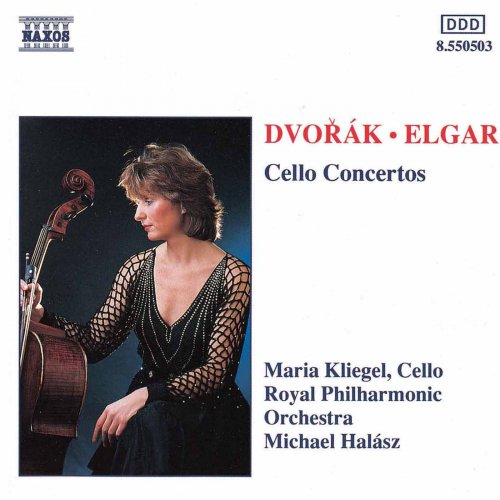
Artist: Maria Kliegel, Royal Philharmonic Orchestra, Michael Halasz
Title: Dvorak & Elgar: Cello Concertos
Year Of Release: 1992
Label: Naxos
Genre: Classical
Quality: FLAC (tracks)
Total Time: 01:13:09
Total Size: 268 Mb
WebSite: Album Preview
Tracklist:Title: Dvorak & Elgar: Cello Concertos
Year Of Release: 1992
Label: Naxos
Genre: Classical
Quality: FLAC (tracks)
Total Time: 01:13:09
Total Size: 268 Mb
WebSite: Album Preview
Cello Concerto in B minor, Op. 104, B. 191 (Antonín Dvořák)
1. I. Allegro 16:14
2. II. Adagio ma non troppo 12:26
3. III. Finale: Allegro moderato - Andante - Allegro vivo 13:49
Cello Concerto in E minor, Op. 85 (Edward Elgar)
4. I. Adagio - Moderato 08:53
5. II. Lento - Allegro molto 04:38
6. III. Adagio 05:07
7. IV. Allegro - Moderato - Allegro ma non troppo 12:02
Performers:
Maria Kliegel (cello)
Royal Philharmonic Orchestra
Michael Halasz
The technical accomplishment of Kliegel's playing is balanced by a richness of musical insight that won't disappoint. The boldness of the opening soliloquy recalls du Pré at her finest, and yet Kliegel shares a yet deeper cup of grief in the world-weariness of the main first subject, carried with noble conviction. She takes a more improvisatory view in the lilting second group than du Pré.
The Scherzo is brilliantly done, and at a very fast tempo, but the conductor Michael Halász overlooks Elgar's precisely noted A tempo indication in response to the soloist's cantabile largamente statements at the end of each main section.
The effect isn't only tedious, but is quite the reverse of the composer's intention, clearly stated in the score. The Adagio is thoughtfully played, avoiding unwelcome posturing or empty affectation, though Kliegel is, if anything, a little too cool and dispassionate here.
The finale is superbly paced, with the rumbustious militarism of the orchestration never allowed to dominate. The recording was made at Henry Wood Hall, and is full bodied and emphatic in major tuttis, yet one might have wished the overall balance to favour the soloist more than it does.
The Scherzo is brilliantly done, and at a very fast tempo, but the conductor Michael Halász overlooks Elgar's precisely noted A tempo indication in response to the soloist's cantabile largamente statements at the end of each main section.
The effect isn't only tedious, but is quite the reverse of the composer's intention, clearly stated in the score. The Adagio is thoughtfully played, avoiding unwelcome posturing or empty affectation, though Kliegel is, if anything, a little too cool and dispassionate here.
The finale is superbly paced, with the rumbustious militarism of the orchestration never allowed to dominate. The recording was made at Henry Wood Hall, and is full bodied and emphatic in major tuttis, yet one might have wished the overall balance to favour the soloist more than it does.
![Nicole McCabe & Savannah Harris - All Together Now (2026) [Hi-Res]](https://img.israbox.com/img/2026-09/18/6vf0n06ga14htic30tmun3rgh.jpg "Nicole McCabe & Savannah Harris - All Together Now (2026) [Hi-Res]")
![New York Mary - A Piece Of The Apple (1976) [Hi-Res]](https://img.israbox.com/img/2026-09/18/1jtykd5eu8tq5om1vcniuink9.jpg "New York Mary - A Piece Of The Apple (1976) [Hi-Res]")
![WOBBLE8 - The Moon Is Not There When Nobody Looks (2026) [Hi-Res]](https://www.dibpic.com/uploads/posts/2026-09/1789486919_folder.jpg "WOBBLE8 - The Moon Is Not There When Nobody Looks (2026) [Hi-Res]")
![Enzo Favata - Ritornare (2026) [Hi-Res]](https://www.dibpic.com/uploads/posts/2026-09/1789547045_1.jpg "Enzo Favata - Ritornare (2026) [Hi-Res]")
![re#encounter - Angels & demons at play (2026) [Hi-Res]](https://img.israbox.com/img/2026-09/19/wo1caqpkz78cxiv5c248mo3j9.jpg "re#encounter - Angels & demons at play (2026) [Hi-Res]")
![Horace Silver Quintet - Further Explorations (1958) [1997 The Blue Note Collection]](https://www.dibpic.com/uploads/posts/2020-01/1579625971_folder.jpg "Horace Silver Quintet - Further Explorations (1958) [1997 The Blue Note Collection]")