Michael Korstick, Constantin Trinks, Deutsches Symphonie-Orchester Berlin - Brahms: The Piano Concertos (2024) [Hi-Res]
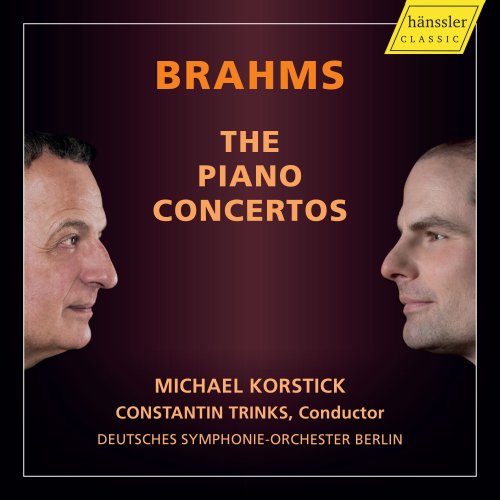
Artist: Michael Korstick, Constantin Trinks, Deutsches Symphonie-Orchester Berlin
Title: Brahms: The Piano Concertos
Year Of Release: 2024
Label: haenssler CLASSIC
Genre: Classical
Quality: flac lossless (tracks) / flac 24bits - 96.0kHz
Total Time: 01:40:33
Total Size: 429 mb / 1.57 gb
WebSite: Album Preview
TracklistTitle: Brahms: The Piano Concertos
Year Of Release: 2024
Label: haenssler CLASSIC
Genre: Classical
Quality: flac lossless (tracks) / flac 24bits - 96.0kHz
Total Time: 01:40:33
Total Size: 429 mb / 1.57 gb
WebSite: Album Preview
01. Piano Concerto No. 1 in D Minor, Op. 15: I. Maestoso
02. Piano Concerto No. 1 in D Minor, Op. 15: II. Adagio
03. Piano Concerto No. 1 in D Minor, Op. 15: III. Rondo. Allegro non troppo
04. Piano Concerto No. 2 in B-Flat Major, Op. 83: I. Allegro non troppo
05. Piano Concerto No. 2 in B-Flat Major, Op. 83: II. Allegro appassionato
06. Piano Concerto No. 2 in B-Flat Major, Op. 83: III. Andante
07. Piano Concerto No. 2 in B-Flat Major, Op. 83: IV. Allegretto grazioso
The two piano concertos by Johannes Brahms occupy an uncontested place in the pantheon of the greatest works of this genre. At the same time they play a unique role in the development of the concerto form in the 19th century, particularly in view of their uneven history of reception. When the young Brahms started out searching the limelight in the early 1850s with his first major composition he was facing a musical world torn apart by ideological wars about questions of form, harmony, and the role of programme music. In this decade, two irreconcilable parties emerged, on one side the so-called "conservatives" who centre was the Leipzig Conservatory (founded by Felix Mendelssohn-Bartholdy), with figureheads like Clara Schumann and Joseph Joachim, on the other side the group of self-proclaimed "heralds of the future" led by Franz Liszt and Richard Wagner who would become known as the "Neudeutsche Schule" in 1859, a term coined by Franz Brendel. Brahms, not even twenty years old, was an ambitious pianist coming from a humble background in Hamburg, and these aesthetic quarrels didn't concern him at all. His official first works, the Piano Sonatas Opus 1 and 2 and the Scherzo, op.4, are with all their individuality somewhat indebted to Beethoven and firmly rooted in classical harmony while only their remarkably compact piano writing offers novel characteristics. To put it simply, the young composer was following his inner voice independently of any currents.
![Thomas Quendler & Motion - Continuum (2026) [Hi-Res]](https://img.israbox.com/img/2026-09/18/9mf8ziym3d0ioqnf38zsa5dsz.jpg "Thomas Quendler & Motion - Continuum (2026) [Hi-Res]")
![Jack Steffen and His Orchestra - Jazz Promenade (2026) [Hi-Res]](https://img.israbox.com/img/2026-09/17/kqltwzywpvks9qpi6z92k3n5i.jpg "Jack Steffen and His Orchestra - Jazz Promenade (2026) [Hi-Res]")
![Vince Guaraldi - It's A Mystery, Charlie Brown (Original Soundtrack Recording) [Guaraldi 75th Anniversary Extended Edition] (2026) [Hi-Res]](https://www.dibpic.com/uploads/posts/2026-08/1787081804_1.jpg "Vince Guaraldi - It's A Mystery, Charlie Brown (Original Soundtrack Recording) [Guaraldi 75th Anniversary Extended Edition] (2026) [Hi-Res]")