Nicola Boud & Anthony Romaniuk - Brahms: Clarinet Sonatas, Op. 120 & 3 Intermezzi, Op. 117 (2025) [Hi-Res]
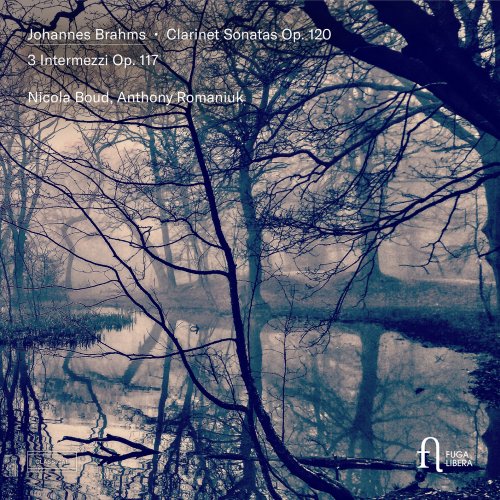
Artist: Nicola Boud, Anthony Romaniuk
Title: Brahms: Clarinet Sonatas, Op. 120 & 3 Intermezzi, Op. 117
Year Of Release: 2025
Label: Fuga Libera
Genre: Classical
Quality: FLAC (tracks) / 24bit-192kHz FLAC (tracks+booklet)
Total Time: 01:01:49
Total Size: 226 MB / 2.14 GB
WebSite: Album Preview
Tracklist:Title: Brahms: Clarinet Sonatas, Op. 120 & 3 Intermezzi, Op. 117
Year Of Release: 2025
Label: Fuga Libera
Genre: Classical
Quality: FLAC (tracks) / 24bit-192kHz FLAC (tracks+booklet)
Total Time: 01:01:49
Total Size: 226 MB / 2.14 GB
WebSite: Album Preview
1. Brahms: Clarinet Sonata No. 2, Op. 120 No. 2: I. Allegro amabile (8:32)
2. Brahms: Clarinet Sonata No. 2, Op. 120 No. 2: II. Allegro appassionato (5:16)
3. Brahms: Clarinet Sonata No. 2, Op. 120 No. 2: III. Andante con moto - Allegro (7:34)
4. Brahms: Three Intermezzi, Op. 117: No. 1, Andante moderato (4:35)
5. Brahms: Three Intermezzi, Op. 117: No. 2, Andante non troppe e con molto espressione (4:26)
6. Brahms: Three Intermezzi, Op. 117: No. 3, Andante con moto (5:58)
7. Brahms: Clarinet Sonata No. 1, Op. 120 No. 1: I. Allegro appassionato (8:04)
8. Brahms: Clarinet Sonata No. 1, Op. 120 No. 1: II. Andante un poco adagio (5:05)
9. Brahms: Clarinet Sonata No. 1, Op. 120 No. 1: III. Allegretto grazioso (4:29)
10. Brahms: Clarinet Sonata No. 1, Op. 120 No. 1: IV. Vivace (5:30)
11. Brahms: 5 Lieder, Op. 105: No. 1, Wie Melodien zieht es mir (Transcr. for Clarinet and Piano by Nicola Boud and Anthony Romaniuk) (2:23)
This recording brings together two late masterworks by Brahms: the Op. 120 Clarinet Sonatas and the Op. 117 Intermezzi for piano, written in the tranquil setting of Bad Ischl. The sonatas, full of tenderness and quiet intensity, were composed for clarinetist Richard Mühlfeld, whose warm, lyrical playing reignited Brahms’s desire to compose after a period of silence. This is music of dialogue, not declaration.
Nicola Boud and Anthony Romaniuk perform on instruments close to those Brahms and Mühlfeld would have known: a replica of Mühlfeld’s 19th-century boxwood clarinet and an 1875 Steinway piano. These choices bring a soft, transparent quality to the sound, inviting a more intimate listening experience. Expressive tools of 19th-century performance: rubato, flexibility, arpeggiation, are used not as effects, but as natural extensions of the music’s emotional landscape.
Brahms once called the Op. 117 Intermezzi “three lullabies of my grief.” These restrained yet luminous pieces distil his late style into elegiac monologues, offering quiet spaces where time feels suspended. Together, these warm, reflective and deeply emotional works offer a glimpse into Brahms' final years.
Nicola Boud and Anthony Romaniuk perform on instruments close to those Brahms and Mühlfeld would have known: a replica of Mühlfeld’s 19th-century boxwood clarinet and an 1875 Steinway piano. These choices bring a soft, transparent quality to the sound, inviting a more intimate listening experience. Expressive tools of 19th-century performance: rubato, flexibility, arpeggiation, are used not as effects, but as natural extensions of the music’s emotional landscape.
Brahms once called the Op. 117 Intermezzi “three lullabies of my grief.” These restrained yet luminous pieces distil his late style into elegiac monologues, offering quiet spaces where time feels suspended. Together, these warm, reflective and deeply emotional works offer a glimpse into Brahms' final years.
![Maria Emrik - The Good Life (2026) [Hi-Res]](https://www.dibpic.com/uploads/posts/2026-09/1788503068_cover.jpg "Maria Emrik - The Good Life (2026) [Hi-Res]")
![Hatka - Quartet (2026) [Hi-Res]](https://www.dibpic.com/uploads/posts/2026-08/1788155135_h8c312vapoy7p_600.jpg "Hatka - Quartet (2026) [Hi-Res]")
![Arnaud Roulin - Voyage Pentatonique (2026) [Hi-Res]](https://img.israbox.com/img/2026-08/31/phpyil5fgr16h6y5ogk9ompcg.jpg "Arnaud Roulin - Voyage Pentatonique (2026) [Hi-Res]")
![Runar Netland - First, everything (2026) [Hi-Res]](https://img.israbox.com/img/2026-09/04/dqmrowl27f6arnxv2d9pmzkng.jpg "Runar Netland - First, everything (2026) [Hi-Res]")
![Noah Abrahamse, The Mumbo Jumbo Combo - Días Latinos (2024) [Hi-Res]](https://www.dibpic.com/uploads/posts/2026-08/1788161626_rsa29i2goiilb_600.jpg "Noah Abrahamse, The Mumbo Jumbo Combo - Días Latinos (2024) [Hi-Res]")