Artist:
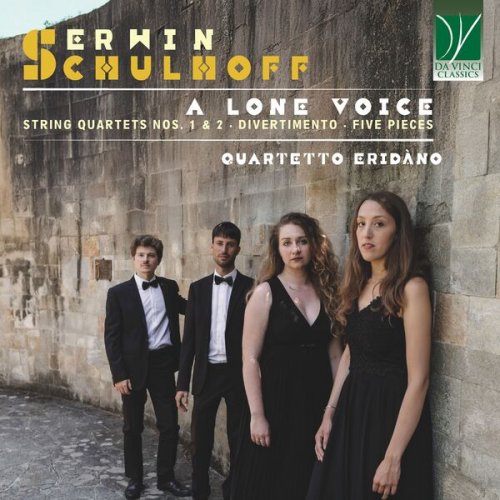
Quartetto Eridano
Title:
Erwin Schulhoff: A Lone Voice
Year Of Release:
2025
Label:
Da Vinci Classics
Genre:
Classical
Quality:
FLAC (tracks)
Total Time: 74:51 min
Total Size: 338 MB
WebSite:
Album Preview
Tracklist:01. Divertimento, Op. 14, WV 32: I. Lebhaft
02. Divertimento, Op. 14, WV 32: II. Cavatina. Ruhig fliessend
03. Divertimento, Op. 14, WV 32: III. Intermezzo. Nicht zu schnell
04. Divertimento, Op. 14, WV 32: IV. Romanza. Ruhig fliessend
05. Divertimento, Op. 14, WV 32: V. Rondo. Lebhaft
06. 5 Pieces for String Quartet, WV 43: No. 1, Alla valse viennese. Allegro
07. 5 Pieces for String Quartet, WV 43: No. 2, Alla serenata. Allegretto
08. 5 Pieces for String Quartet, WV 43: No. 3, Alla Czeca. Molto allegro
09. 5 Pieces for String Quartet WV 43: No. 4, Alla tango milonga. Andante
10. 5 Pieces for String Quartet, WV 43: No. 5, Alla tarantella. Prestissimo
11. 5 Pieces for String Quartet, WV 43: No. 6, Anhang. Alla Napoletana
12. String Quartet No. 1, Op. 8, WV 72: I. Presto con fuoco
13. String Quartet No. 1, Op. 8, WV 72: No. 2, Allegretto con moto e con malinconia grotesca
14. String Quartet No. 1, WV 72: III. Allegro giocoso alla Slovacca
15. String Quartet No. 1, WV 72: IV. Andante molto sostenuto
16. String Quartet No. 2, WV 77: I. Allegro agitato
17. String Quartet No. 2, WV 77: II. Tema con variazioni. Moderato
18. String Quartet No. 2, WV 77: III. Allegro gajo
19. String Quartet No. 2, WV 77: IV. Finale. Andante quasi introduzione
In the restless cultural ferment of early twentieth-century Europe, Erwin Schulhoff emerged as a lone voice singing boldly against the chorus of convention. A Czech composer of prodigious gifts, Schulhoff absorbed the voices of his era – the last echoes of Austro-German romanticism, the fiery dissonances of modernism, the irreverent laughter of Dada – and forged from them a musical language uniquely his own. The works gathered here speak with the undimmed clarity of an individual vision.
This collection of Schulhoff’s string quartets and kindred works traces a creative journey from youthful charm to post-war radicalism, all bound by the thread of a singular creative spirit. Each piece offers a window into a different facet of Schulhoff’s world, yet throughout, one senses the presence of the composer’s voice – by turns lyrical, defiant, wistful, and unbowed.
In 1914, barely twenty years of age and still honing his craft in Cologne under the tutelage of composers like Max Reger and briefly with Debussy, Schulhoff penned his Divertimento op. 14 WV 32 for string quartet. It is a work of disarming classical grace, a five-movement serenade that could almost have flowed from the pen of an earlier era. In its lively opening Lebhaft movement and sprightly finale Rondo, one hears a young composer tipping his hat to Haydn and Mozart – courtly dance rhythms and light-hearted hunting calls abound – yet even within this apparent neo-classical sunniness lies a deeper shadow. The middle movements, Cavatina and Romanza, with their songful violin lines and gently flowing pace, reveal a wistful heart. A poignant melancholy sings through these pages, as if a lone violin were murmuring a secret sorrow while the other instruments listen in hushed empathy. Written on the eve of the First World War, the Divertimento carries, in retrospect, the fragile beauty of a last twilight before darkness descends – the utterance of a youthful voice embracing tranquillity and charm, yet unafraid to infuse its tenderness with a hint of yearning.
The cataclysm of the Great War left an indelible mark on Schulhoff’s art. Returning from the trenches a changed man, he discarded the last vestiges of late-Romantic sentiment and flung himself into the modernist avant-garde. By the early 1920s in Prague, he had fallen in with Dadaists and jazz enthusiasts, delighting in tearing down musical orthodoxies. Yet even as he revelled in provocation, Schulhoff also sought to communicate more directly through pure sound. His Five pieces WV 68 for string quartet (1923) distil this anarchic spirit into a playful suite of dances – a brilliant kaleidoscope of styles that both charms and satirizes. Dedicated to the cosmopolitan composer Darius Milhaud, the five short movements seem to wink knowingly at the listener. An Alla valse viennese opens with a lilting Viennese waltz that sways gracefully but with mischievous twists; an Alla serenata, a quaint night-serenade with a droll twinkle; Alla czeca is a folk dance with boisterous Slavic rhythms and swirling fiddles; then an Alla tango milonga, oozing smoky cabaret sensuality; finally, Alla tarantella races to a finish, a whirl of Italian fire and humour that leaves an exclamation point on the set. Uniting these caricatures is Schulhoff’s razor-sharp wit and virtuoso command of the quartet voices. Notably, the composer had originally conceived a sixth piece, Alla napoletana, a spoof in lively Neapolitan guise that was withdrawn just before the premiere and only published long after his death. Perhaps this extra movement struck even Schulhoff as a lone laugh too many. In any case, the remaining five pieces succeeded in their Salzburg debut, offering the postwar public a delightfully irreverent breather – music that smiles and snickers yet never lapses into triviality. Beneath the bright masks of these dances, one senses the composer’s own voice enjoying a hard-won creative freedom, standing apart.
Schulhoff’s next foray into the string quartet would lift that mask to reveal far more tempestuous emotions. In 1924 he completed his String quartet no. 1 WV 72, a four-movement work that stands among his finest achievements. Here the composer’s voice speaks in a more ardent and exploratory tone, blending an instinct for drama with the experimental verve of the postwar zeitgeist. The first movement, Presto con fuoco, bursts forth with torrid energy – a headlong motion propelling jagged motifs and sudden dynamic surges. One can sense the last ties to tradition being shaken off in these feverish strains; soaring melodies give way to sharp rhythmic cells and chromatic flights. By contrast, the second movement, Allegretto con moto e con malinconia grotesca, presents a sly, shadowed interlude marked by grotesque melancholy; it waltzes between irony and nostalgia. A soft, tripping pulse and plucked chords set a stage where a solitary violin occasionally steps forward in a cabaret-like solo, only to dissolve again into the ensemble muted whisperings. This uneasy, twilight humour soon yields to earthier vigour in the third movement, Allegro giocoso alla slovacca. Here Schulhoff draws on his Bohemian roots, spinning a rustic Slovak dance brimming with folk colour and wild zest. A droning ostinato in the cello drives relentlessly while violins caper and duel in hearty folk fiddling. This vigorous scherzo hurtles by with infectious fire, clearing the air for the quartet unexpected denouement. In the final Andante molto sostenuto, time seems to slow to a nocturnal hush. The textures thin to the barest transparency; fragments of melody surface quietly, often led by a single violin voice singing into a vast silence. The effect is haunting and intimate. In these closing pages, Schulhoff’s quartet becomes a lone voice in the dark – the first violin’s high, pure phrases rise like a secret prayer, answered only by hushed breaths from its companions. The music finds repose not in grand resolution but in evanescence, fading away into an unresolved silence. After the fervour and wild humour that preceded it, the String quartet no. 1 concludes in a mood of poignant solitude, as if the composer, having spoken in so many tongues, finally allows one solitary song to linger in the ear.
Schulhoff’s String quartet no. 2 WV 77 followed in 1925, pushing his exploration of the quartet medium even further. In this work the composer’s multifarious influences coalesce into a style at once concise and strikingly bold. Once again, a single instrument sets the stage: the solo viola fires off a bristling opening gesture that triggers an engine of perpetual motion. The first movement, Allegro agitato, though barely four minutes long, is a tour de force of relentless drive – a churning motoric rhythm of tremolo figurations and chromatic runs that hardly relents for an instant. It is as if a modern machine-age spirit has seized the music, propelling it forward with fervent insistence. After this electrifying jolt, the second movement, Moderato, cast as a theme with variations and offers a contrast. The viola introduces a simple, pensive theme, tinged with folkloric warmth, which becomes the subject for a series of inventive transformations. Partway through, the variations take an unexpected turn: a burst of syncopation suddenly launches an early-jazz fox-trot in the quartet midst. This jaunty incursion is pure Schulhoff – a dash of cosmopolitan satire woven into the classical fabric. Yet the movement ends not with a laugh but a sigh. In the final variation, the cello ascends to a high, lyrical solo statement of the theme, a lone voice of nostalgia that gently evaporates into silence. The third movement, Allegro gajo – gajo being an old term for gaiety – is as spirited and whimsical as its title suggests. Lighter in mood, it flits by with playful grace. Snatches of melody and quicksilver exchanges between the instruments give it the character of a joyful intermezzo, which ends almost as soon as it begins, in a quick disappearing act. This light-hearted respite prepares the ground for the finale, where Schulhoff unleashes the full breadth of his palette. Marked Andante quasi introduzione, the last movement opens in a reflective vein: a slow, brooding introduction recalls the lyricism of the earlier theme, as if picking up a thread of memory. Gradually, a sense of determination builds until the music surges ahead Molto allegro, recapturing the fiery momentum of the quartet opening. This finale seems to carry both the weight of reminiscence and the thrill of forward motion – passionate surges are punctuated by pauses of bittersweet recollection. In the closing bars the music races to a decisive conclusion, ending the quartet with a triumphant flourish. It is a victory not without ghosts as echoes of the lone lyrical voice weave through the energetic tapestry. As the final chords resound, one has the impression of an exuberant dance haunted by its own melancholy tune.
In the years that followed these creations, Schulhoff’s path took a dramatic turn towards grander forms and political conviction, before the darkest of historical shadows overtook him. Branded a Jewish communist by the Nazi regime, he was to meet a tragic fate; in 1942 this vibrant voice was silenced in a concentration camp. Yet the works he left behind, born amid upheaval and innovation, still ring out with undiminished vitality. Across these works, one hears the humour and courage of a composer who stood apart, singing his own tune even as the world went mad around him. Nearly a century later, Schulhoff’s music re-emerges ardent, defiant, and poignantly human calling us to listen, to remember, and rejoice in its song.

![Miles Davis - The Man with the Horn (1981) [2002 SACD]](https://www.dibpic.com/uploads/posts/2023-03/1677772203_1521013895_mi0000751434.jpg "Miles Davis - The Man with the Horn (1981) [2002 SACD]")
![De-Phazz - belooped (MPS Remixed) (2026) [Hi-Res]](https://www.dibpic.com/uploads/posts/2026-07/1784642045_folder.jpg "De-Phazz - belooped (MPS Remixed) (2026) [Hi-Res]")
![The Brothers Nylon - Nylon Archives Vol. 3: Elevator Vibes (2026) [Hi-Res]](https://img.israbox.com/img/2026-07/23/2xm25exoxhg740xkr8cmc1ncu.jpg "The Brothers Nylon - Nylon Archives Vol. 3: Elevator Vibes (2026) [Hi-Res]")
![David Mash - Chapters (2026) [Hi-Res]](https://www.dibpic.com/uploads/posts/2026-07/1784723857_cover.jpg "David Mash - Chapters (2026) [Hi-Res]")