Leonardo Palacios - Guastavino: Guitar Works (2026) [Hi-Res]
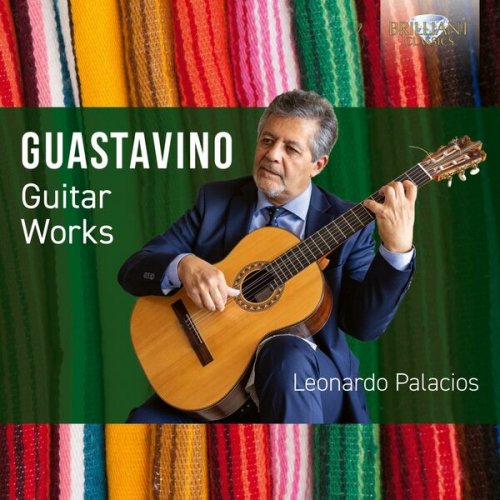
Artist: Leonardo Palacios
Title: Guastavino: Guitar Works
Year Of Release: 2026
Label: Brilliant Classics
Genre: Classical Guitar
Quality: flac lossless (tracks) / flac 24bits - 44.1kHz +Booklet
Total Time: 01:02:30
Total Size: 271 / 568 mb
WebSite: Album Preview
TracklistTitle: Guastavino: Guitar Works
Year Of Release: 2026
Label: Brilliant Classics
Genre: Classical Guitar
Quality: flac lossless (tracks) / flac 24bits - 44.1kHz +Booklet
Total Time: 01:02:30
Total Size: 271 / 568 mb
WebSite: Album Preview
01. Apegado a Mi (Cancion de Cuna) [Transcribed By Jorge Oraisón]
02. Sonata I (1967): I. Allegro Deciso e Molto Rítmico
03. Sonata I (1967): II. Andante
04. Sonata I (1967): III. Allegro Spiritoso
05. Vidala del Secadal (Transcribed By Jorge Oraisón)
06. Sonata II (1969): I.. Allegro Intimo Ed Espressivo
07. Sonata II (1969): II. Andante Sostenuto
08. Sonata II (1969): III. Presto
09. Cantilena (Santa Fe para Llorar, 1958)
11. Sonata III (1973): I. Allegro Preciso e Rítmico
12. Sonata III (1973): II. Adagio
13. Sonata III (1973): III. Allegro
14. Bailecito (Transcribed By Leonardo Palacios)
The guitar output of a landmark figure in Argentinean classical music, fusing national melodies and dances with European forms in a fusion of perennial appeal.
Carlos Guastavino (1912-2000) became internationally renowned, after the Second World War, for song-cycles and works for his own instrument, the piano, which refracted his Argentinean identity, and the culture of his home nation, through European classical idioms. Without plugging himself in to the current of modernism which coursed through the work of American contemporaries, from Copland and Carter in the US to Chavez and Revueltas in Mexico, and down to Brazilian composers such as Claudio Santoro, Guastavino nonetheless belonged to their age, and spoke of his time through his music.
Composed between 1967 and 1973, his three sonatas for the guitar embody sonata form in both the progress of their individual movements and their larger, three-movement structures. The First Sonata is dedicated to his brother, José Amadeo, who played the guitar as an amateur, and inspired Carlos to write for the instrument. José Amadeo died by his own hand while Carlos was at work on the sonata, and its central movement is an elegy to his memory. The Second, more Romantic in tone, deploys native rhythms such as the Zampa as well as jazzy harmonies. The Third returns to the Zampa but in a more intricately worked style. Here, the central movement is a smoky Milonga, evoking a mood more familiar from the tangos of Astor Piazzolla.
Leonardo Palacios sets the sonatas in their context with transcriptions of five short pieces originally conceived for piano: Apegado a mi, Vidala del Secadal, Santa Fé para llorar, the seventh of Guastavino’s Cantos Populares and finally the Bailecito (Little Dance) which established his fame worldwide. As a Uruguayan guitarist with decades of experience as a performer and teacher, Palacios brings both technical refinement and idiomatic sensitivity to Guastavino’s music: he also contributes the booklet note to this album, giving the listener an invaluable sense of the composer’s place in his world.
![Manu Dibango - King Makossa (2026) [Hi-Res]](https://img.israbox.com/img/2026-07/23/n1yskl3rx8vrtvmovelx891b7.jpg "Manu Dibango - King Makossa (2026) [Hi-Res]")
![The Mood Mosaic - Blue Glow Lust (2026) [Hi-Res]](https://www.dibpic.com/uploads/posts/2026-07/1784822564_cover.jpg "The Mood Mosaic - Blue Glow Lust (2026) [Hi-Res]")
![Joe Pass - Behind Better Days (1971/2024) [Vinyl]](https://www.dibpic.com/uploads/posts/2026-07/1785076354_r-30823554-1722773064-4918.jpg "Joe Pass - Behind Better Days (1971/2024) [Vinyl]")