Christopher Marks - Discoveries (2005)
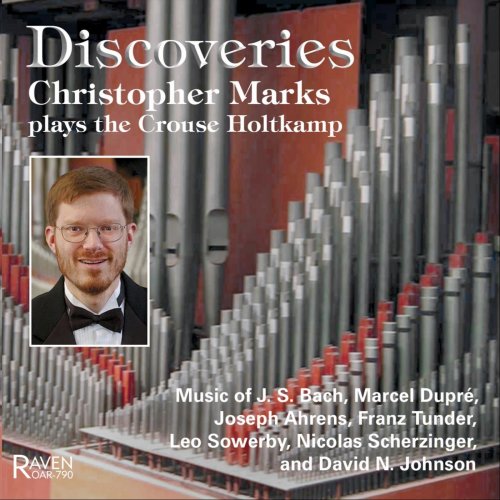
Artist: Christopher Marks
Title: Discoveries
Year Of Release: 2005
Label: Raven
Genre: Classical
Quality: FLAC (tracks)
Total Time: 1:12:45
Total Size: 249 MB
WebSite: Album Preview
Tracklist:Title: Discoveries
Year Of Release: 2005
Label: Raven
Genre: Classical
Quality: FLAC (tracks)
Total Time: 1:12:45
Total Size: 249 MB
WebSite: Album Preview
1. Christopher Marks – Fugue à la Gigue (05:07)
2. Christopher Marks – Jesus Christus, unser Heiland, BWV 688 (03:31)
3. Christopher Marks – In dich hab ich gehoffet, Herr (06:25)
4. Christopher Marks – Prelude in G Major, BWV 550 (03:29)
5. Christopher Marks – Fugue in G Major, BWV 550 (03:56)
6. Christopher Marks – Five Pieces for Solo Organ: I. — (02:00)
7. Christopher Marks – Five Pieces for Solo Organ: II. — (03:50)
8. Christopher Marks – Five Pieces for Solo Organ: III. — (01:09)
9. Christopher Marks – Five Pieces for Solo Organ: IV. — (04:05)
10. Christopher Marks – Five Pieces for Solo Organ: V. — (02:09)
11. Christopher Marks – Veni Creator Spiritus: I. Veni Creator (00:44)
12. Christopher Marks – Veni Creator Spiritus: II. Qui diceris Paraclitus (00:38)
13. Christopher Marks – Veni Creator Spiritus: III. Tu septiformis munere (01:08)
14. Christopher Marks – Veni Creator Spiritus: IV. Accende lumen sensibus (00:58)
15. Christopher Marks – Veni Creator Spiritus: V. Hostem repellas longius (01:39)
16. Christopher Marks – Veni Creator Spiritus: VI. Per te sciamus da Patrem (00:27)
17. Christopher Marks – Veni Creator Spiritus: VII. Deo Patri sit gloria (01:14)
18. Christopher Marks – Veni Creator Spiritus: VIII. Amen (01:32)
19. Christopher Marks – Suite Bretonne, Op. 21: I. Berceuse (04:38)
20. Christopher Marks – Suite Bretonne, Op. 21: II. Fileuse (03:38)
21. Christopher Marks – Suite Bretonne, Op. 21: III. Les cloches de Perros-Guirec (07:04)
22. Christopher Marks – Symphony for Organ: III. Passacaglia (13:14)
Christopher Marks, University Organist at Syracuse University 1999-2006 and now at the University of Nebraska, Lincoln, presents his discoveries of lesser-known and new works on the famous 1950 Holtkamp 3-73 incorporating much of the pipework of the previous Roosevelt organ at Crouse College Auditorium.
David Johnson, composer and Syracuse University Organist 1967-69, captures in written form the spirit of his prodigious improvisatory skills in the Fugue à la Gigue, composed during his tenure.
Nicolas Scherzinger composed these five short works for a 2003 concert series at Syracuse, where he is on the faculty, and they were premiered by Christopher Marks. As Scherzinger’s first pieces for organ, they are pleasantly unusual, each using the sounds and capabilities of the instrument in a different way. Each is a world unto itself, often taking two or three simple musical ideas and combining them to make a more complex structure.
Joseph Ahrens (1904-1999), an extremely prolific composer, seems all but unknown outside his native Germany. This charming set of variations on the well-known Pentecost hymn was written in 1947 and is clearly grounded in the modality of Gregorian chant, the linear nature of which was of particular interest to Ahrens. The austere, spacious, and deeply spiritual nature of these settings is true to the Gregorian origins of the melody while existing within a modern idiom.
Lesser known works of better known composers complete the very interesting program.
David Johnson, composer and Syracuse University Organist 1967-69, captures in written form the spirit of his prodigious improvisatory skills in the Fugue à la Gigue, composed during his tenure.
Nicolas Scherzinger composed these five short works for a 2003 concert series at Syracuse, where he is on the faculty, and they were premiered by Christopher Marks. As Scherzinger’s first pieces for organ, they are pleasantly unusual, each using the sounds and capabilities of the instrument in a different way. Each is a world unto itself, often taking two or three simple musical ideas and combining them to make a more complex structure.
Joseph Ahrens (1904-1999), an extremely prolific composer, seems all but unknown outside his native Germany. This charming set of variations on the well-known Pentecost hymn was written in 1947 and is clearly grounded in the modality of Gregorian chant, the linear nature of which was of particular interest to Ahrens. The austere, spacious, and deeply spiritual nature of these settings is true to the Gregorian origins of the melody while existing within a modern idiom.
Lesser known works of better known composers complete the very interesting program.
![Bernd Lhotzky, Émile Parisien, Frédéric Couderc, Henning Sieverts, Eric Schaefer - Jazz at Berlin Philharmonic XVIII: Jazz Goes Baroque (2026) [Hi-Res]](https://www.dibpic.com/uploads/posts/2026-07/1785249127_folder.jpg "Bernd Lhotzky, Émile Parisien, Frédéric Couderc, Henning Sieverts, Eric Schaefer - Jazz at Berlin Philharmonic XVIII: Jazz Goes Baroque (2026) [Hi-Res]")
![Terri Lyne Carrington & Social Science - Trip the Night Fantastic (2026) [Hi-Res]](https://www.dibpic.com/uploads/posts/2026-07/1785243964_folder.jpg "Terri Lyne Carrington & Social Science - Trip the Night Fantastic (2026) [Hi-Res]")
![Isaiah Collier - JOY (2026) [Hi-Res]](https://www.dibpic.com/uploads/posts/2026-07/1785475369_pmwehr0rydwbv_600.jpg "Isaiah Collier - JOY (2026) [Hi-Res]")


![Shelly Manne - 2-3-4 (2026) [Hi-Res]](https://img.israbox.com/img/2026-07/31/livic8uz86s5340ce0xbrhu0l.jpg "Shelly Manne - 2-3-4 (2026) [Hi-Res]")