Oleg Kaskiv, Alexander Grytsayenko, Eli Karanfilova, Valentyna Pryshlyak, Pablo de Naverán - Mozart: The String Quintets (2026) [Hi-Res]
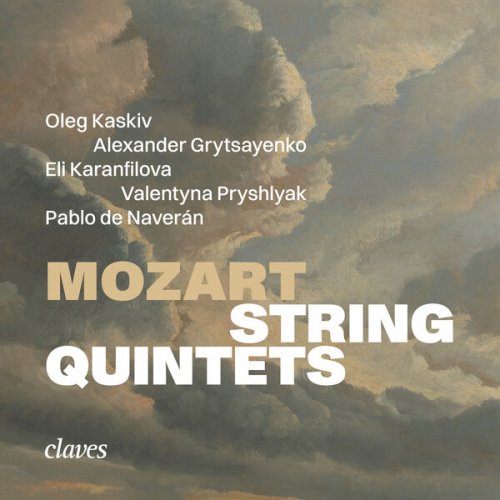
Artist: Oleg Kaskiv, Alexander Grytsayenko, Eli Karanfilova, Valentyna Pryshlyak, Pablo de Naverán
Title: Mozart: The String Quintets
Year Of Release: 2026
Label: Claves Records
Genre: Classical
Quality: flac lossless (tracks) / flac 24bits - 96.0kHz +Booklet
Total Time: 02:45:56
Total Size: 797 mb / 3.0 gb
WebSite: Album Preview
TracklistTitle: Mozart: The String Quintets
Year Of Release: 2026
Label: Claves Records
Genre: Classical
Quality: flac lossless (tracks) / flac 24bits - 96.0kHz +Booklet
Total Time: 02:45:56
Total Size: 797 mb / 3.0 gb
WebSite: Album Preview
CD1
01. String Quintet No. 1 in B-Flat Major, K. 174: I. Allegro moderato
02. String Quintet No. 1 in B-Flat Major, K. 174: II. Adagio
03. String Quintet No. 1 in B-Flat Major, K. 174: III. Menuetto
04. String Quintet No. 1 in B-Flat Major, K. 174: IV. Allegro
05. String Quintet No. 2 in C Major, K. 515: I. Allegro
06. String Quintet No. 2 in C Major, K. 515: II. Andante
07. String Quintet No. 2 in C Major, K. 515: III. Menuetto
08. String Quintet No. 2 in C Major, K. 515: IV. Allegro
CD2
01. String Quintet No. 3 in G Minor, K. 516: I. Allegro
02. String Quintet No. 3 in G Minor, K. 516: II. Menuetto
03. String Quintet No. 3 in G Minor, K. 516: III. Adagio ma non troppo
04. String Quintet No. 3 in G Minor, K. 516: IV. Adagio-Allegro
05. String Quintet No. 4 in C Minor, K. 406: I. Allegro
06. String Quintet No. 4 in C Minor, K. 406: II. Andante
07. String Quintet No. 4 in C Minor, K. 406: III. Menuetto
08. String Quintet No. 4 in C Minor, K. 406: IV. Allegro
CD3
01. String Quintet No. 5 in D Major, K. 593: I. Larghetto-Allegro
02. String Quintet No. 5 in D Major, K. 593: II. Adagio
03. String Quintet No. 5 in D Major, K. 593: III. Menuetto. Allegretto
04. String Quintet No. 5 in D Major, K. 593: IV. Allegro
05. String Quintet No. 6 in E-Flat Major, K. 614: I. Allegro di molto
06. String Quintet No. 6 in E-Flat Major, K. 614: II. Andante
07. String Quintet No. 6 in E-Flat Major, K. 614: III. Menuetto
08. String Quintet No. 6 in E-Flat Major, K. 614: IV. Allegro
While the string quartet underwent its well-known development from the 1760s onwards, the string quintet – perhaps created by Michael Haydn in 1773 – remained somewhat marginal. The young Wolfgang Amadeus, then seventeen, discovered the genre on his return from Italy. This was enough to inspire the teenager, who loved playing the viola part when performing quartets. After Mozart’s six quintets with two violas, this scoring remained uncommon – Boccherini composed over a hundred quintets, but with two cellos, as did Schubert – perhaps because the genre struggled to distinguish itself from entertainment music. Michael Haydn entitled his first quintet Notturno, while Mozart wrote his first quintet in the style of a divertimento.
The first Quintet K. 174, in B-flat major, was a product of the creative explosion of 1773, an extremely fertile year, alongside Mozart’s piano concerto in D major, three symphonies, and six quartets dedicated to Joseph Haydn. After a first version composed in the spring, the piece underwent extensive revisions during December. The Allegro, in sonata form, features a dialogue between the first violin and first viola; the ensuing development discloses a dramatic mood that contrasts with the recapitulation. Mutes give the Adagio its nocturnal feel, in a sonata form virtually devoid of development, which is reduced to a few bars. The Minuetto is a joyful and straightforward movement that revives the dialogue between the first violin and first viola. The Finale occupies almost half the duration of the whole work; this disproportionate movement is nevertheless “one of the most ambitious and elaborate sonata forms conceived by the young Mozart” (H. Halbreich). The exposition presents a first theme in repeated quavers, to which the cello responds with a semiquaver motif that is also woven into the development. This leads first to a “false recapitulation” of the kind Haydn favoured in his quartets. After a highly modulating passage, the true recapitulation finally comes forth. Despite his youth, the 17-year-old Mozart is already a master of the genre.
Following this initial quintet, the next two were composed only fourteen years later. They were written in 1787, after the success of The Marriage of Figaro in Prague and before the premiere of Don Giovanni. These two extensive works – composed respectively in a solemn and serene C major and an anguished G minor – are remarkable masterpieces from the composer’s mature period. Their creation has been linked to a letter Mozart wrote to his father, who was then seriously ill and would die less than two weeks later.
“As death (strictly considered ) is the true ultimate destination of our life, I have therefore, over the past few years, made myself so familiar with this true, best friend of man that its image not only no longer holds anything terrifying for me, but has also a great deal that calms and comforts! And I thank my God that He has granted me the good fortune to create the opportunity (you understand me) to come to know it as the key to our true blessedness. I never lay myself down to sleep without recollecting that perhaps (young though I may be) I may no longer exist the next day – and surely none of all those who know me will be able to say that I am sullen or sad in my comportment – and for this blessedness I thank my creator every day and wish the same to all my fellow men.”
The Quintet in C major (K. 515) begins with an expansive dialogue between the cello and first violin, which occupies most of the extensive exposition, and moves towards bold keys such as D-flat major before a second theme emerges in the dominant key. The highly modulating development displays the composer’s complete mastery. The melancholic Andante is reminiscent of song and opera, contrasting with the “graceful nonchalance” of the Minuetto (Henri Ghéon), which nonetheless retains some of the nostalgia of the previous movement in its trio. Finally, the vast Rondo concludes the work in a mood of serenity and peace.
This serenity contrasts with the anguished atmosphere in the Quintet in G minor (K. 516), written in a key the composer rarely used and invariably associated with tragedy. The opening theme establishes an intense emotion whose “agitation betrays an irrepressible anxiety, which only intensifies after each vain attempt to escape the fateful G minor” (H. Halbreich). Cast in sonata form, the Allegro engages in a new development episode in the recapitulation. “The originality of the first movement – in its approach, its colour, its expressive value, its sobbing – is such that it exhausts our emotion, our admiration and our surprise”, wrote Henri Ghéon. Such an emotion persists in the Menuetto, with its jagged, syncopated rhythm, and whose trio finally reveals a glimmer of light in a G major key of overwhelming simplicity. The American musicologist Alfred Einstein described the wonderful Adagio, played with mutes, as an ineffable “prayer of an isolated soul surrounded by abysses”, so peacefully does its theme rise in a profoundly religious E-flat major, soon engulfed by the anxious calls of the viola. Then comes, quite unexpectedly, a new Adagio, this time without mutes, in which the first violin sings a long lament. The final Allegro then suddenly bursts forth in G major and a 6/8 time signature. This movement was much criticised in Mozart’s time, but this overlooks the fact that one can experience the most intense suffering and still yearn to emerge from it and seek a little joy.
The exact date of composition of the Quintet in C minor (K. 406) is uncertain. It is a transcription of Mozart’s Serenade for Wind Octet, composed in 1782. According to the biographers Brigitte and Jean Massin, Mozart transcribed his serenade for strings out of financial necessity; this would have then inspired the quintets of 1787 and thereafter. The Allegro opens with a unison arpeggio, which soon gives way to a somewhat rhythmic aggressiveness, contrasting with the Andante in the relative major key; this peaceful 3/8 movement displays Mozart’s richly inventive melodic gift. The astonishing Minuetto is a canon between the first violin and the cello, with a mirror canon in the trio! It is followed by a martial and energetic Finale comprising a theme and a set of seven variations.
The conciseness of this quintet brings it closer to the last two, composed just a few months apart. When Mozart wrote his Quintet in D major (K. 593), in 1790, he had composed virtually nothing for several months, following a disastrous journey to Frankfurt and an ever-worsening financial situation, which was further compounded by a political campaign against Freemasonry. This work was probably commissioned by the Freemason and amateur violinist Johann Tost, who had already commissioned several quartets from Haydn. Its slow introduction – a somewhat unusual practice in Mozart’s chamber music production – returns unexpectedly at the end of the movement. The exposition is built on a single theme, whose contrapuntal richness is then developed throughout the dialogue with the first viola. The Adagio in G major continues to win the admiration of music lovers: “It is unbelievable that such a wealth of musical and human richness can be condensed into barely a hundred bars!” praised Harry Halbreich. But in Mozart’s output, the most sublime beauty is combined with simplicity. The Menuetto is evocative of rural life, particularly in its central Ländler. Finally, the theme of the Finale is a descending chromatic scale, according to a study of the manuscript – a foreign hand having altered several notes in the most commonly used version. This highlights the chromatic audacity of the piece and the assets of its development, which includes a fugato and numerous contrapuntal audacities: how can one still doubt that after the sterility of 1790, Mozart’s energy had not returned? This Quintet was followed by several works, including the composer’s final Piano Concerto and The Magic Flute, which was written at the same time as the last quintet.
Equally commissioned by Johann Tost, like its predecessor, the Quintet K. 614 declares its Masonic intent through its E-flat major key signature. Whereas the previous work was contrapuntal, this one draws on popular inspiration and genuine optimism. “Is this a spiritual enlightenment [...] or [...] the dawn of a new era hailed by all the European great minds steeped in Enlightenment philosophy?” wonder B. and J. Massin. The ternary Allegro di molto evokes a rural landscape, a hunt, with its themes marked by carefreeness – or is it wisdom? This dual atmosphere reappears in the theme and variations of the Andante, which is at once transparent, simple and poignantly serene. This is followed by a thoroughly Haydnesque Menuetto. The final Allegro seems to synthesise the sonata and rondo forms through the frequent return of its theme, before a contrapuntal development that modulates into very remote and rarely used keys. Mozart once again demonstrates in this quartet his unique gift for “transfiguring the ordinary” (H. Ghéon).
![The Sky Is a Suitcase - El Jardín (2026) [Hi-Res]](https://img.israbox.com/img/2026-07/20/520h31cbqeuoxdzsgcg3moi01.jpg "The Sky Is a Suitcase - El Jardín (2026) [Hi-Res]")

![David Mash - The Lost Book of David Mash (2026 Remaster) (2026) [Hi-Res]](https://www.dibpic.com/uploads/posts/2026-07/1784721592_the-lost-book-of-david-mash.jpg "David Mash - The Lost Book of David Mash (2026 Remaster) (2026) [Hi-Res]")

![David Mash - Colors, Textures, Moods (2026) [Hi-Res]](https://www.dibpic.com/uploads/posts/2026-07/1784723161_jgm70mpp0afoz_600.jpg "David Mash - Colors, Textures, Moods (2026) [Hi-Res]")