Luca Sartore - Morandi: Complete Organ Works, vol. 8 (2026) [Hi-Res]
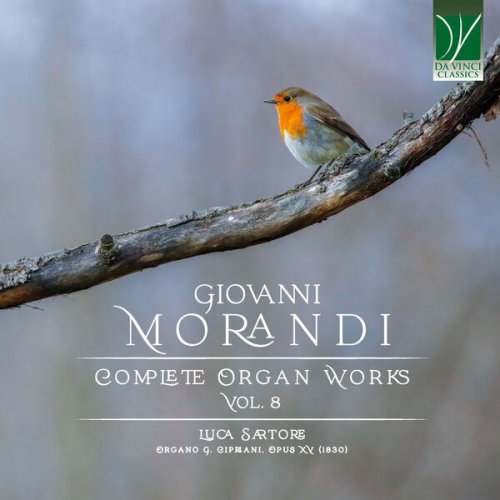
Artist: Luca Sartore
Title: Morandi: Complete Organ Works, vol. 8
Year Of Release: 2026
Label: Da Vinci Classics
Genre: Classical Organ
Quality: flac lossless (tracks) / flac 24bits - 96.0kHz
Total Time: 01:06:53
Total Size: 317 mb / 1.05 gb
WebSite: Album Preview
TracklistTitle: Morandi: Complete Organ Works, vol. 8
Year Of Release: 2026
Label: Da Vinci Classics
Genre: Classical Organ
Quality: flac lossless (tracks) / flac 24bits - 96.0kHz
Total Time: 01:06:53
Total Size: 317 mb / 1.05 gb
WebSite: Album Preview
01. Pastorale per gli organi moderni da eseguirsi nella ricorrenza del S. Natale
02. Nona raccolta di Sonate per gli organi moderni, Op. 26: No. 1, Offertorio
03. Nona raccolta di Sonate per gli organi moderni, Op. 26: No. 2, Elevazione
04. Nona raccolta di Sonate per gli organi moderni, Op. 26: No. 3, Postcommunio
05. Nuova Pastorale pel SS. Natale composta per organo
06. Decima raccolta di Sonate per gli organi moderni, Op. 28: No. 1, Offertorio
07. Decima raccolta di Sonate per gli organi moderni, Op. 28: No. 2, Elevazione
08. Decima raccolta di Sonate per gli organi moderni, Op. 28: No. 3, Postcommunio
09. Sinfonia in Pastorale del SS. Natale composta per organo
The early nineteenth-century Italian organ stands in a poised equilibrium between liturgical office, theatrical taste and organological renewal. It is precisely this triangulation – repertoire, context and technique – that unlocks the present pages, which belong to that constellation of works conceived for modern organs, with their expanded timbral palette, manuals in dialogue and a sonic conception imbued with orchestral sensibility. The horizon is the Mass: Offertory, Elevation and Postcommunion serve as formal and spiritual architraves; yet, within the fabric, there emerge occasional genres and emblematic images – above all the Christmas pastorale – by which devotion is translated into sonic emblems of affection, light and memory. From this perspective the theatre is no intruder, but a shared idiom submitted to liturgical discipline, whilst the grammar of the organ – broad Principals, soft flutes, the Echo and the Voce Umana – furnishes the instrumentarium for a rhetoric at once eloquent and composed.
The Pastorale per gli organi moderni da eseguirsi nella ricorrenza del S. Natale presents itself less as a picturesque vignette than as an interior landscape. The sustained drone evokes the continuity of breath and the shepherds’ progress; figuration in thirds gives voice to a collective song, elemental and tender. Within a tradition that Italian practice has preserved with judicious restraint, the pastorale is never mere colour: it is the musical icon of the Incarnation, an art of essentials that returns to the liturgy the measure of recollection. The undulating writing seeks not display but gentle suasion; registration should favour delicate shades – flutes on the Echo, Principale dolce, Voce Umana – so that contemplation may arise from an indirect and diffused light.
With the ninth collection of Sonate per gli organi moderni op. 26 the itinerary assumes the tripartite profile characteristic of much of Morandi’s output. In the Offertory in E flat major the discourse opens into a space of serene confidence: spacious periods, an architecture that accommodates introductory gestures and an evident symphonic vocation realised with measure rather than emphasis. The melody unfolds in ample phrases, supported by carefully husbanded modulations; harmony persuades more than it surprises, and oratorical rhetoric merges with a sense of procession naturally attendant upon the act of offering. In the Elevation in D major the lexicon is pared back and time turns inwards: the upper line, sustained by softly palpitating figures, asks for a sottovoce that discloses the quality of an inhabited silence. Here the Principal – alone or with the Voce Umana – traces a slow undulation, in which the slight wavering intimates the humble ardour of adoration. The triptych closes with the Postcommunion in F major: motion grows readier, with lucid designs and a contained mobility that returns to the assembly the industrious gratitude of setting out anew. Not triumph, but a luminous smile; not ceremony, but the step of daily life made whole again.
The Nuova Pastorale pel SS. Natale composta per organo reappears as a second gaze upon the same mystery. If the first pastorale functions as an icon, this is a narrative – more discursive, more colloquial, less abstract. The shepherds are not described; they are evoked through a harmonic fabric that alternates relaxations and gentle chiaroscuro, as though in subdued dialogues, replies, hints. Tradition speaks here as well: the drone is no artifice, but a stratum of memory ennobling the humble sound of the bagpipe and carrying it into the nave, where the rite – at Christmastide – admits a licence of sweetness and tenderness without forfeiting form.
The tenth collection of Sonate per gli organi moderni op. 28 refines and deepens the same order. The Offertory in F minor brings a gravitas that does not oppress but delves: a sharply profiled theme, disciplined dynamics, a severer eloquence, as if to recall that offering is first availability rather than largesse. The Elevation in E flat major opens once more towards light: the upper line sings with frank lyricism, while the accompaniment – discreet, regular – sustains the inward time. The Postcommunion in A minor returns to composed agility: crisp figuration, an elastic gait, sober imitative hints. It is a dismissal that does not close but sends forth, and it calls for a restrained choice of stops – no fireworks, rather clarity of design and cleanliness of cadence. The Offertory – Elevation – Postcommunion schema, so deeply inscribed in Morandi’s workshop, here reveals a double nature: at once the chronicle of the Mass and a rhetorical grammar enabling the articulation of affections, tempi and lights.
The Sinfonia in Pastorale del SS. Natale composta per organo embodies the eloquent intersection of two vocations – the symphonic and the pastoral – in a page that opens like a prelude and broadens into a fresco. The periodic phrasing is ample, with a theatrical breadth; the harmonic framework preserves classical transparency, yet the burgeoning of thematic material betrays a memory of song. The drone, or its figuration, confers unity upon the canvas; the planes of sound – Grand’Organo and Echo – afford contrasts and nuances that eschew description in favour of the logic of a spiritual itinerary: invocation, contemplation, praise. The pastoral never lapses into caricature; dance surfaces as interior rhythm, not rustic tableau. Christmas thus becomes a theology of nearness rendered in sound.
In situating these pages within Morandi’s catalogue, a methodological observation is apposite: the composer habitually conceives in triads and cycles, elaborating models that recall and answer one another. At times the first movement assumes the dimensions of a small symphony – an introduction, the exposition of distinct ideas, recapitulations of varying breadth – elsewhere a more linear and compact design prevails, shaped by rite rather than concert. The kinship with the theatre – palpable in the breath of the phrase, in harmony employed as light and shade, in the centrality of accompanied song – does not decant operatic material into the church, but informs writing that remains apt for the liturgy, discreet in registration and attentive to the implicit word of the assembly. The modernity of the organ – in the usage of the period – does not signify rupture, but a more conscious husbandry of timbres: the Voce Umana as meditative resource, the Principals as the sonic pillar of the community, the flutes as a caress of air, the pedal as foundation and breath.
Seen thus, the diptych of pastorales stands without contradiction – two focuses of the same ellipse. The first conserves the icon and a vigilant stillness; the second narrates and moves, like a visit that returns with new particulars. Between them are set the two liturgical cycles, which structure the believer’s experience within the time of celebration. The Offertory opens – and its symphonic eloquence does not overstep measure, because offering asks for clarity and nobility; the Elevation concentrates – and requests a sound that does not impose but sustains; the Postcommunion loosens and steadies at once, with restrained energy that prepares for the world. The Sinfonia in Pastorale closes by returning to the beginning.
In the end these pages describe a single arc. Two pastoral images frame two sacramental trilogies; a pastoral symphony leads the ear back to the source. Between them lie care for form, the art of timbre and an exact awareness of function. It is a sober architecture in which each element has its place and its rationale; a word that knows how to become song and a song that knows how to become prayer. Here one recognises the maturity of a writing that has learnt to unite – without confounding – the eloquence of language with the humility of service.
![Mike DiRubbo - Way Out Northwest (2026) [Hi-Res]](https://www.dibpic.com/uploads/posts/2026-07/1784136290_1.jpg "Mike DiRubbo - Way Out Northwest (2026) [Hi-Res]")
![Elena Stella, Ante Jeličić Sextet - Mačak u vreći (2026) [Hi-Res]](https://www.dibpic.com/uploads/posts/2026-07/1784196301_esmv500.jpg "Elena Stella, Ante Jeličić Sextet - Mačak u vreći (2026) [Hi-Res]")
![Bill Connors - Step It (1985) [Vinyl]](https://www.dibpic.com/uploads/posts/2026-07/1784135244_000001.jpg "Bill Connors - Step It (1985) [Vinyl]")
![Chris Cheek - Keepers of the Eastern Door (Extended Edition) (2026) [Hi-Res]](https://www.dibpic.com/uploads/posts/2026-07/1784223559_cover.jpg "Chris Cheek - Keepers of the Eastern Door (Extended Edition) (2026) [Hi-Res]")