VA - To a Green Thought in a Green Shade (2026) [Hi-Res]
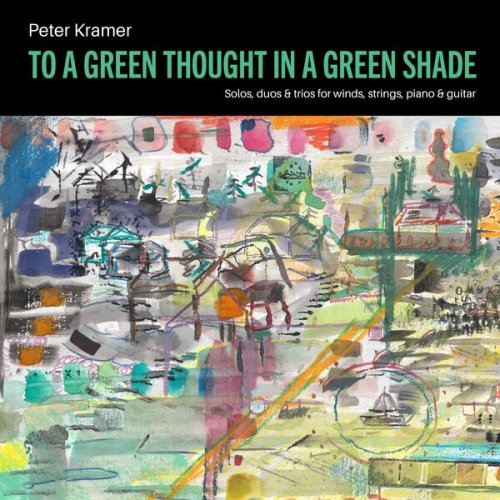
Artist: Various Artists, Zachary Good, Peter Kramer, Ben Roidl-Ward, Daniel Lippel, John Popham, Longleash
Title: To a Green Thought in a Green Shade
Year Of Release: 2026
Label: New Focus Recordings
Genre: Classical
Quality: FLAC (tracks + booklet) [96kHz/24bit]
Total Time: 56:20
Total Size: 872 / 199 MB
WebSite: Album Preview
Tracklist:Title: To a Green Thought in a Green Shade
Year Of Release: 2026
Label: New Focus Recordings
Genre: Classical
Quality: FLAC (tracks + booklet) [96kHz/24bit]
Total Time: 56:20
Total Size: 872 / 199 MB
WebSite: Album Preview
1. Zachary Good – Heights (Version for Alto Recorder) (03:05)
2. Ben Roidl-Ward – Copse of Trees (08:39)
3. Daniel Lippel – Still Life (05:45)
4. John Popham – In Miniature (01:29)
5. Longleash – Pietà (17:20)
6. Peter Krämer – 3 Children's Pieces: No. 1, Raining. Andantino con espressivo (02:56)
7. Peter Krämer – 3 Children's Pieces: No. 2, Fairy Tale. Poco allegro e dolcissimo (02:54)
8. Peter Krämer – 3 Children's Pieces: No. 3, New Places. Andante con moto (01:47)
9. John Popham – Limbo Tunes: I. Eclogue. Andante con moto (05:03)
10. John Popham – Limbo Tunes: II. Background Landscape (05:12)
11. Zachary Good – Heights (Version for Clarinet) (02:06)
"The mind, that ocean where each kind
Does straight its own resemblance find,
Yet it creates, transcending these,
Far other worlds, and other seas;
Annihilating all that’s made
To a green thought in a green shade."
- Andrew Marvell, poem "The Garden"
The seven compositions on this album, composed between 2017-2023, consist of material that has been grafted together from piece to piece. Kramer's compositional process borrows liberally from his own stock of draft material which he reworks and contextualizes within new pieces. In this sense, the overarching listening experience on this album can be understood as viewing the fruits of a carefully tended garden of musical ideas that Kramer has cultivated. In addition to his role as composer, Kramer is a featured performer on this album, joined by several close collaborators.
Heights was composed for clarinetist Zachary Good, and bookends the album in two possible performance versions; the opening track of the album was performed on doubled alto recorder and the final track of the album was performed on clarinet. Heights is an arrangement of a composition for harpsichord that Kramer had originally written for and dedicated to his professor Webb William Wiggins. The pitched material is entirely diatonic and references the kind of idioms and textures that one might hear in JS Bach’s suites for solo violin or cello.
Copse of Trees takes its name from a strikingly realistic drawing of nature by Leonardo Da Vinci and was composed for bassoonist Ben Roidl-Ward. The structure is that of a collage whereby each measure is culled from first and last measures of nearly every piece from Kramer’s complete catalogue of compositions. The first half of the piece is made up of an assortment of scales and triadic harmonies which meander through different tonalities. This harmonic labyrinth breaks down in the second half of the composition where the bassoon plays static multiphonic gestures separated by large swaths of silence, meanwhile the piano material collapses into an atonal meditation terminating in a fragmented chorale loosely based on the hymn “Schwing’ dich auf zu deinem Gott.”
Still Life was composed for guitarist Daniel Lippel and is dedicated to Kramer's good friend Louis Blair who gave him the guitar that the piece was written on. The work takes inspiration from the countryside of Virginia where Kramer met Blair, capturing the picturesque landscape with lush harmonies and gentle arpeggios.
In Miniature, for cello and piano, is a recomposition of a fragment Kramer composed while first learning to write for these instruments. It is a brief work, under two minutes in length, that strives for a significant emotional affect, performed here by Kramer and cellist John Popham. This material was originally intended as an exercise in 12 tone technique. However, during the recomposition of this work references to traditional tonality percolated and rose to the surface.
Pietà was composed for the Longleash piano trio. The title invokes Michelangelo’s famous sculpture of the same name. The work is arranged in the form of a triptych, a form commonly used in the visual arts to depict the Crucifixion or other divine epiphanies. Kramer writes, "For me, this three-part form evokes death and resurrection — the creative process itself — the birth and renewal of musical material from one composition to another." In this composition the three instruments move at different velocities, the violin being the fastest followed by the slower moving cello and the more sparsely heard piano. Think of moving through a landscape made-up of a foreground, middle-ground and background, or a sonification of the cascading fabric and raging inner voice of a mother holding her dead child as depicted in Michelangelo’s sculpture.
Three Children's Pieces is a composition that Kramer wrote for himself, with material that is based on old sketches that he saw potential in renewing. The work is dedicated to the Southwestern University of Finance and Economics (SWUFE) in Chengdu, China where Kramer taught during the fall semesters of 2024 and 2025. This is perhaps the most tonal work on the album, the trajectory of each movement points towards resolution to C major, a tonality traditionally associated with childlike emotions and affectations.
Limbo Tunes was composed for cellist John Popham and is based on several fragments from Kramer's preexisting compositions which can be heard in snatches throughout the two movements of this work. The accumulation of these fragments culminates in the second movement as a kind of hymn that is woven into the texture of the piece itself, a sort of cantus firmus or through-line, working as a counter balance to the fragmentary nature of the whole.
– Peter Kramer
Does straight its own resemblance find,
Yet it creates, transcending these,
Far other worlds, and other seas;
Annihilating all that’s made
To a green thought in a green shade."
- Andrew Marvell, poem "The Garden"
The seven compositions on this album, composed between 2017-2023, consist of material that has been grafted together from piece to piece. Kramer's compositional process borrows liberally from his own stock of draft material which he reworks and contextualizes within new pieces. In this sense, the overarching listening experience on this album can be understood as viewing the fruits of a carefully tended garden of musical ideas that Kramer has cultivated. In addition to his role as composer, Kramer is a featured performer on this album, joined by several close collaborators.
Heights was composed for clarinetist Zachary Good, and bookends the album in two possible performance versions; the opening track of the album was performed on doubled alto recorder and the final track of the album was performed on clarinet. Heights is an arrangement of a composition for harpsichord that Kramer had originally written for and dedicated to his professor Webb William Wiggins. The pitched material is entirely diatonic and references the kind of idioms and textures that one might hear in JS Bach’s suites for solo violin or cello.
Copse of Trees takes its name from a strikingly realistic drawing of nature by Leonardo Da Vinci and was composed for bassoonist Ben Roidl-Ward. The structure is that of a collage whereby each measure is culled from first and last measures of nearly every piece from Kramer’s complete catalogue of compositions. The first half of the piece is made up of an assortment of scales and triadic harmonies which meander through different tonalities. This harmonic labyrinth breaks down in the second half of the composition where the bassoon plays static multiphonic gestures separated by large swaths of silence, meanwhile the piano material collapses into an atonal meditation terminating in a fragmented chorale loosely based on the hymn “Schwing’ dich auf zu deinem Gott.”
Still Life was composed for guitarist Daniel Lippel and is dedicated to Kramer's good friend Louis Blair who gave him the guitar that the piece was written on. The work takes inspiration from the countryside of Virginia where Kramer met Blair, capturing the picturesque landscape with lush harmonies and gentle arpeggios.
In Miniature, for cello and piano, is a recomposition of a fragment Kramer composed while first learning to write for these instruments. It is a brief work, under two minutes in length, that strives for a significant emotional affect, performed here by Kramer and cellist John Popham. This material was originally intended as an exercise in 12 tone technique. However, during the recomposition of this work references to traditional tonality percolated and rose to the surface.
Pietà was composed for the Longleash piano trio. The title invokes Michelangelo’s famous sculpture of the same name. The work is arranged in the form of a triptych, a form commonly used in the visual arts to depict the Crucifixion or other divine epiphanies. Kramer writes, "For me, this three-part form evokes death and resurrection — the creative process itself — the birth and renewal of musical material from one composition to another." In this composition the three instruments move at different velocities, the violin being the fastest followed by the slower moving cello and the more sparsely heard piano. Think of moving through a landscape made-up of a foreground, middle-ground and background, or a sonification of the cascading fabric and raging inner voice of a mother holding her dead child as depicted in Michelangelo’s sculpture.
Three Children's Pieces is a composition that Kramer wrote for himself, with material that is based on old sketches that he saw potential in renewing. The work is dedicated to the Southwestern University of Finance and Economics (SWUFE) in Chengdu, China where Kramer taught during the fall semesters of 2024 and 2025. This is perhaps the most tonal work on the album, the trajectory of each movement points towards resolution to C major, a tonality traditionally associated with childlike emotions and affectations.
Limbo Tunes was composed for cellist John Popham and is based on several fragments from Kramer's preexisting compositions which can be heard in snatches throughout the two movements of this work. The accumulation of these fragments culminates in the second movement as a kind of hymn that is woven into the texture of the piece itself, a sort of cantus firmus or through-line, working as a counter balance to the fragmentary nature of the whole.
– Peter Kramer

![ELIMI - HUMAN MOSAIC (2026) [Hi-Res]](https://www.dibpic.com/uploads/posts/2026-07/1783912263_mdhyfhetjesc3_600.jpg "ELIMI - HUMAN MOSAIC (2026) [Hi-Res]")

![Henry Solomon - Solo Woodwind (2026) [Hi-Res]](https://www.dibpic.com/uploads/posts/2026-07/1783973663_nhur1blml85xk_600.jpg "Henry Solomon - Solo Woodwind (2026) [Hi-Res]")
![Weather Report - Mr. Gone (1978) [Vinyl]](https://www.dibpic.com/uploads/posts/2026-07/1783950555_0886443431522_600.jpg "Weather Report - Mr. Gone (1978) [Vinyl]")