Leonard Bernstein - Bernstein in the 1940s Vol. 2: His Debut (1943) [2018]
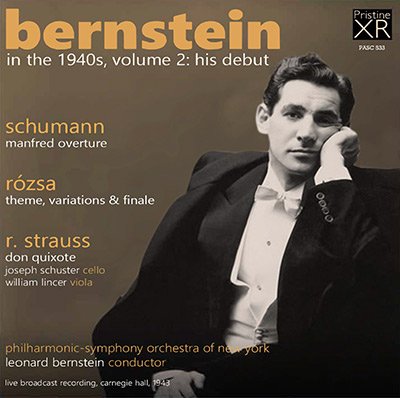
Artist: Leonard Bernstein
Title: Bernstein in the 1940s Vol. 2: His Debut
Year Of Release: 1943 [2018]
Label: Pristine [PASC533]
Genre: Classical
Quality: FLAC (*tracks) 24 Bit/44,1 kHz
Total Time: 01:14:26
Total Size: 704 mb (+3%rec.)
WebSite: Album Preview
There were times when I must have fantasized – you know, one of those days – "Someday, son, this will all be yours," as they say. But I never thought I would have to walk out there [the Carnegie Hall stage] on my own. When it came to the time – that very day – all I can remember is standing there in the wings shaking and being so scared. There was no rehearsal. I had just come from seeing Bruno Walter, who very sweetly and very quickly – wrapped up in blankets because he had the flu – went over the score of Don Quixote with me. He showed me a few tricky spots where he cut off here but didn't cut off there; here you give it an extra upbeat, and so on.Title: Bernstein in the 1940s Vol. 2: His Debut
Year Of Release: 1943 [2018]
Label: Pristine [PASC533]
Genre: Classical
Quality: FLAC (*tracks) 24 Bit/44,1 kHz
Total Time: 01:14:26
Total Size: 704 mb (+3%rec.)
WebSite: Album Preview
I called Mama and Daddy at the Barbizon to tell them and you [Burton]. And then I just had to hang around. I mean, I was all dressed; when it came to the crunch on that Sunday afternoon, I wore the one good suit that I had, a double-breasted suit. I had until 2:30 p.m. to kill before going to the hall in my sharkskin suit. In that hour or two, I sat in the drugstore [the Carnegie Hall Pharmacy, then located at the street level corner of the building]. I went in for some coffee. The druggist said, "What are you looking so pale about?" and he gave me two little pills, a green and red one. He said, "Look, before you go on, just pop these into your mouth. One will calm you down and the other will give you energy." I put them in my pocket.
The time seemed to hang heavy till 3:00 p.m., even though I had to go over some of the tricky spots in Don Quixote with the cello and viola soloists and the concertmaster. The thing that was obsessing me, possessing me, was the opening of the Schumann overture, which is very tricky because it starts with a rest – the downbeat is a rest. If they don't come in together, the whole concert is sunk. I mean, I can't once go 'bop, bop, bop,' and make sure they can do it. So, this was like a nightmare. I had to go on and do, untried, this thing of such difficulty. You know, I've heard other people come to grief in that opening bar. Then I finally went and talked with the guys and they said, "Good luck." Bruno Zirato said, "Hey, Lenny. Good luck baby." Oh, he was very fatherly and gave me big bear hugs. And that was about it.
As I was about to walk onstage, I remembered the pills. I took them out of my pocket, flung them as far away from me across the backstage as I could and said, "I'm going to do this on my own." I strode out and I don't remember a thing from that moment – I don't even remember intermission – until the sound of people standing and cheering and clapping.
The story of Leonard Bernstein's remarkable concert hall debut with the Philharmonic-Symphony Orchestra of New York on 14 November, 1943, crops up in many retellings. Yet it seems to have escaped any commercial release until now. The concert was broadcast live from Carnegie Hall by CBS radio, with Bernstein's triumphant stepping in for an ailing Bruno Walter at the very last minute, without rehearsal, making the front page of the following day's New York Times, alongside numerous war reports from around the world.
Bernstein knew Walter was unwell but only after spending the previous evening at a concert did he check over the scores before going to bed. The following morning the call came to say he would be taking the podium. There was no time to assemble the orchestra for any kind of run-through, so Bernstein had to settle for a visit and consultation with a blanket-wrapped Bruno Walter and a short time with the two soloists for Don Quixote, Joseph Schuster (cello) and William Lincer (viola).
As the New York Times reported, the concert was a huge success for the 25-year-old novice conductor, effectively launching his career on the world stage - and what a career that would go on to be.
Here we present the full radio broadcast, less the interval talk. Missing from the broadcast was the encore, but everything else has been preserved, including a very short summary of war news headlines that was included as part of the pay-off at the end of the broadcast.
The recording was made onto acetate discs from an off-air source, thus is of 1943 broadcast quality.
Some surface noise inevitably remains, and can be heard at different levels throughout the recording, parts of which are excellent considering the source, others less so. Overall this is good AM radio sound, and the listener will soon tune out of its shortcomings and become totally absorbed in this remarkable and truly historic performance.
Tracks:
SCHUMANN Manfred Overture
RÓZSA Theme, Variations and Finale
R. STRAUSS Don Quixote
Personnel:
Joseph Schuster, cello
William Lincer, viola
Philharmonic-Symphony Orchestra of New York
conducted by Leonard Bernstein
![Leonard Bernstein - Bernstein in the 1940s Vol. 2: His Debut (1943) [2018]](https://www.dibpic.com/uploads/posts/2026-03/1774467145_bb.jpg)
![Sarah McKinley Keller - Sunnyside (2026) [Hi-Res]](https://www.dibpic.com/uploads/posts/2026-10/1791219180_cover.jpg "Sarah McKinley Keller - Sunnyside (2026) [Hi-Res]")
![Dave Holland - Freedom Call: Prism - Freedom (2026) [Hi-Res]](https://www.dibpic.com/uploads/posts/2026-09/1790792374_1.jpg "Dave Holland - Freedom Call: Prism - Freedom (2026) [Hi-Res]")
![Tamar Osborn - VARIER: BERLIN (2026) [Hi-Res]](https://img.israbox.com/img/2026-10/03/fai4k813tw1f1mi2zfxu74f2l.jpg "Tamar Osborn - VARIER: BERLIN (2026) [Hi-Res]")
![Nicole Johänntgen - Henry IV (2026) [Hi-Res]](https://img.israbox.com/img/2026-10/03/51tihwjgxgjby7iykplnmlkai.jpg "Nicole Johänntgen - Henry IV (2026) [Hi-Res]")