Lukas Hasler - Gold (2026) [Hi-Res]
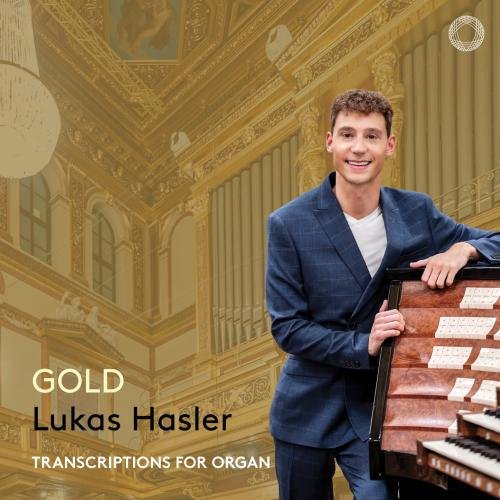
Artist: Lukas Hasler
Title: Gold
Year Of Release: 2026
Label: PentaTone
Genre: Classical Organ
Quality: flac lossless (tracks) / flac 24bits - 48.0kHz +Booklet
Total Time: 01:03:50
Total Size: 286 / 625 mb
WebSite: Album Preview
TracklistTitle: Gold
Year Of Release: 2026
Label: PentaTone
Genre: Classical Organ
Quality: flac lossless (tracks) / flac 24bits - 48.0kHz +Booklet
Total Time: 01:03:50
Total Size: 286 / 625 mb
WebSite: Album Preview
01. Cantata No. 29 (Arr. for Organ by Marcel Dupré): I. Sinfonia
02. 3 Romanzen, Op. 28: II. Einfach
03. Carmen: Prélude (Arr. for Organ by Edwin H. Lemare)
04. Piano Sonata No. 14, Op. 27 No. 2 (Arr. for Organ by Lukas Hasler): I. Adagio sostenuto
05. Symphony in D Minor 'Annullierte', WAB 100 (Arr. for Organ by Erwin Horn): Scherzo. Presto — Trio. Langsamer und ruhiger
06. Piano Sonata No. 5 in G Major, K.283/189h (Arr. for Organ by Lukas Hasler): I. Allegro
07. Piano Sonata No. 5 in G Major, K.283/189h (Arr. for Organ by Lukas Hasler): II. Andante
08. Piano Sonata No. 5 in G Major, K.283/189h (Arr. for Organ by Lukas Hasler): III. Presto
09. Prelude in G Minor, Op. 23/5 (Arr. for Organ by Gottfried H. Federlein): V. Alla marcia
10. Boléro de concert, Op. 166 (Arr. for Organ by Lukas Hasler)
11. Vienna Calling (Arr. for Organ by Alex Johansson & Lukas Hasler)
Organist Lukas Hasler presents Gold, a radiant debut album featuring his own transcriptions and arrangements for organ. What began five years ago with a fascination for Mozart’s G Major Sonata in Edvard Grieg’s two-piano version grew into an artistic journey into the transformative world of transcription. Hasler discovered in the organ an instrument capable not only of recreating orchestral and pianistic textures, but of reshaping them into something entirely new. To capture this vision, he turned to the iconic Golden Hall of the Musikverein in Vienna, whose expressive possibilities and glowing acoustics inspired both the selection of repertoire and the album’s title. Gold offers a rich spectrum of colours and styles, from the jubilant brilliance of Bach’s Sinfonia (in Dupré’s vibrant transcription) to the tender intimacy of Schumann’s Romance, recorded here for the first time on organ. Hasler brings theatrical flair to Lemare’s arrangement of Carmen Fantasy, profound stillness to Beethoven’s “Moonlight” Adagio, and symphonic vitality to Bruckner’s Nullte Scherzo, while Mozart’s G Major Sonata - filtered through Grieg’s imagination and Hasler’s own artistry - bridges Classical clarity and Romantic warmth. Rachmaninoff’s stormy Prelude, Lefébure- Wély’s sparkling Boléro, and the playful, genre-bending Vienna Calling complete a program that celebrates invention, personality, and the golden richness of the Viennese organ sound.
![David Chesky, Trio in the New Harmonic - Aural Paintings (2018) [Hi-Res]](https://www.dibpic.com/uploads/posts/2026-03/1774275153_uy38w0p37zcdb_600.jpg "David Chesky, Trio in the New Harmonic - Aural Paintings (2018) [Hi-Res]")
![Count Basie - Hall of Fame (Remastered Edition) (1959/2025) [Hi-Res]](https://www.dibpic.com/uploads/posts/2026-03/1774354007_cbhf500.jpg "Count Basie - Hall of Fame (Remastered Edition) (1959/2025) [Hi-Res]")
![Chris White - Marcus (2026) [Hi-Res]](https://www.dibpic.com/uploads/posts/2026-03/1774415769_cover.jpg "Chris White - Marcus (2026) [Hi-Res]")
![Dani Pérez, Horacio Fumero & Guillem Arnedo - Buddy Django (2026) [Hi-Res]](https://www.dibpic.com/uploads/posts/2026-03/1774230344_doax0no2g0dki_600.jpg "Dani Pérez, Horacio Fumero & Guillem Arnedo - Buddy Django (2026) [Hi-Res]")
![Chet Baker - Chet Baker Sings (1956) [2026 SACD]](https://www.dibpic.com/uploads/posts/2026-03/1774108560_essj-90321_main.jpg "Chet Baker - Chet Baker Sings (1956) [2026 SACD]")