Francine Kay - Satie, Ravel: Gymnopédies, Préludes, Jeux d’eau, Valses nobles et sentimentales (2006)
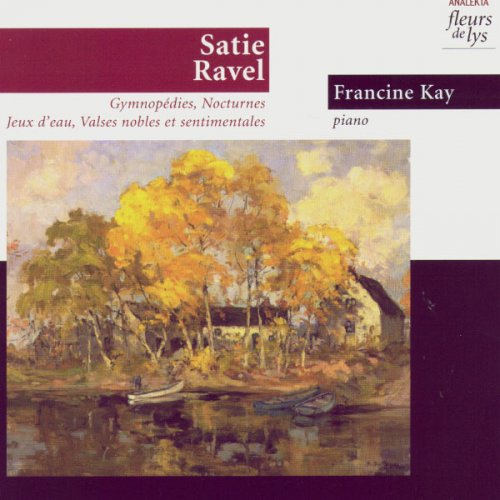
Artist: Francine Kay
Title: Satie, Ravel: Gymnopédies, Préludes, Jeux d’eau, Valses nobles et sentimentales
Year Of Release: 2006
Label: Analekta
Genre: Classical
Quality: FLAC (tracks)
Total Time: 1:11:56
Total Size: 267 MB
WebSite: Album Preview
Tracklist:Title: Satie, Ravel: Gymnopédies, Préludes, Jeux d’eau, Valses nobles et sentimentales
Year Of Release: 2006
Label: Analekta
Genre: Classical
Quality: FLAC (tracks)
Total Time: 1:11:56
Total Size: 267 MB
WebSite: Album Preview
1. Valses nobles et sentimentales: I. Modéré - très franc (01:29)
2. Valses nobles et sentimentales: II. Assez lent - avec une expression intense (02:45)
3. Valses nobles et sentimentales: III. Modéré (01:52)
4. Valses nobles et sentimentales: IV. Assez animé (01:26)
5. Valses nobles et sentimentales: V. Presque lent - dans un sentiment intime (01:58)
6. Valses nobles et sentimentales: VI. Vif (00:51)
7. Valses nobles et sentimentales: VII. Moins vif (03:30)
8. Valses nobles et sentimentales: VIII. Épilogue – lent (04:36)
9. Les Trois Valses distinguées du précieux dégoûté: I. Sa taille (01:15)
10. Les Trois Valses distinguées du précieux dégoûté: II. Son binocle (01:29)
11. Les Trois Valses distinguées du précieux dégoûté: III. Ses jambes (00:52)
12. Jeux d'eau (06:49)
13. Gymnopedie No. 1 (03:40)
14. Gymnopedie No. 2 (03:07)
15. Gymnopedie No. 3 (02:49)
16. Gnossienne No. 1 (04:22)
17. Gnossienne No. 2 (02:20)
18. Gnossienne No. 3 (03:17)
19. Nocturne No. 1 (03:53)
20. Nocturne No. 2 (02:31)
21. Nocturne No. 3 (03:54)
22. Nocturne No. 4 (03:03)
23. Nocturne No. 5 (02:29)
24. Alborada Del Gracioso (07:28)
The relationship between Satie and Ravel is an example of the extraordinary ferment of artistic life in Paris at the turn of the century. These two artists touched one another's lives at a time when the musical life was one of passions and politics, friendships and rivalries, inspiration and innovation.
Satie was a young man in his twenties, living the bohemian life in Montmartre during the 1890's. An eccentric individual and an unfettered artistic spirit, he was unknown and poverty-stricken, earning a living as a cabaret pianist. At the same time, he was creating his own unique spiritual life as the founder of his own personal religion, and composing his earliest works, the haunting and mystical Gymnopédies and the Gnossiennes among them.
At the same time, Ravel, a young boy of fourteen, enjoyed a comfortable home life, and was an accomplished pianist studying at the Conservatoire. He came across some of Satie's published scores while rummaging through the bins of music at the dealers Durand and Lerolle. Deeply impressed with these works, Ravel asked his father, Joseph Ravel, a progressive thinker, engineer, and inventor, to take him to meet Satie. The meeting took place in the Café Nouvelle Athènes. Satie's audacity, wit, and remarkable spirit made a profound impression on the young Ravel.
Doubtless, Satie's bohemian eccentricities and excesses coupled with his mystical devotion could only have been fascinating to a young boy from a more conventional background. Ravel introduced Satie's Sarabandes and Gymnopédies to his harmony class at the Conservatoire. Interestingly, these works were received with much more enthusiasm by the students than by the professors.
Later in life, Ravel recalled Satie as a "spiritual influence," and in a lecture delivered at Rice University in Texas in 1928, he gave the following description of his friend and colleague: "He was the inventor's mind par excellence. He was a great experimenter. Simply and ingeniously, Satie pointed the way, but as soon as another musician took to the trail he had indicated, Satie would immediately change his own orientation and without hesitation open up still another path to new fields of experimentation; he thus became the inspiration of countless progressive tendencies."
Satie was bemused and affected by the young Ravel's admiration. To his brother he wrote, "Ravel is a Prix de Rome of very great talent; another Debussy, but more striking. He assures me–every time I meet him–that he owes me a great deal. If he says so." On another occasion, Satie added, "I confess to my shame that I didn't think him capable of publicly acknowledging that he owes me a lot. I was very moved by it."
In 1910, the Société Musicale Indépendante (SMI) was formed, with Ravel as one of its founding members. Under its auspices, new works by contemporary composers were performed in an atmosphere of camaraderie and impassioned debate. In 1911 Ravel organized a concert devoted to the works of Satie. On this occasion, Ravel himself performed the Sarabande No. 2 (which bears a dedication to Ravel), the Gymnopédie No. 3 and a prelude from the Fils des Étoiles, which he later orchestrated. Unpredictable as always, Satie did not attend the performance.
As concepts of aesthetic philosophy surged forward in the early 1900's, and as passions raged as to the "true" path of music and art in the modern world, the paths of Satie and Ravel began to diverge. As Satie became involved with the Dada movement and the circle of Jean Cocteau, his aesthetic views channeled into a direction, which excluded the aesthetics of Ravel.
In 1919, Satie wrote, "I love Ravel deeply, but his art leaves me cold." Ravel however, remained steadfast in acknowledging his respect for Satie. He dedicated the last of the Trois Poèmes de Stéphane Mallarmé to Satie and he inscribed a score of Ma Mère l'Oye with the following dedication: "for Erik Satie, grandpapa of Les Entretiens de la Belle et la Bête, and others. Affectionate homage from a disciple."
Satie was a young man in his twenties, living the bohemian life in Montmartre during the 1890's. An eccentric individual and an unfettered artistic spirit, he was unknown and poverty-stricken, earning a living as a cabaret pianist. At the same time, he was creating his own unique spiritual life as the founder of his own personal religion, and composing his earliest works, the haunting and mystical Gymnopédies and the Gnossiennes among them.
At the same time, Ravel, a young boy of fourteen, enjoyed a comfortable home life, and was an accomplished pianist studying at the Conservatoire. He came across some of Satie's published scores while rummaging through the bins of music at the dealers Durand and Lerolle. Deeply impressed with these works, Ravel asked his father, Joseph Ravel, a progressive thinker, engineer, and inventor, to take him to meet Satie. The meeting took place in the Café Nouvelle Athènes. Satie's audacity, wit, and remarkable spirit made a profound impression on the young Ravel.
Doubtless, Satie's bohemian eccentricities and excesses coupled with his mystical devotion could only have been fascinating to a young boy from a more conventional background. Ravel introduced Satie's Sarabandes and Gymnopédies to his harmony class at the Conservatoire. Interestingly, these works were received with much more enthusiasm by the students than by the professors.
Later in life, Ravel recalled Satie as a "spiritual influence," and in a lecture delivered at Rice University in Texas in 1928, he gave the following description of his friend and colleague: "He was the inventor's mind par excellence. He was a great experimenter. Simply and ingeniously, Satie pointed the way, but as soon as another musician took to the trail he had indicated, Satie would immediately change his own orientation and without hesitation open up still another path to new fields of experimentation; he thus became the inspiration of countless progressive tendencies."
Satie was bemused and affected by the young Ravel's admiration. To his brother he wrote, "Ravel is a Prix de Rome of very great talent; another Debussy, but more striking. He assures me–every time I meet him–that he owes me a great deal. If he says so." On another occasion, Satie added, "I confess to my shame that I didn't think him capable of publicly acknowledging that he owes me a lot. I was very moved by it."
In 1910, the Société Musicale Indépendante (SMI) was formed, with Ravel as one of its founding members. Under its auspices, new works by contemporary composers were performed in an atmosphere of camaraderie and impassioned debate. In 1911 Ravel organized a concert devoted to the works of Satie. On this occasion, Ravel himself performed the Sarabande No. 2 (which bears a dedication to Ravel), the Gymnopédie No. 3 and a prelude from the Fils des Étoiles, which he later orchestrated. Unpredictable as always, Satie did not attend the performance.
As concepts of aesthetic philosophy surged forward in the early 1900's, and as passions raged as to the "true" path of music and art in the modern world, the paths of Satie and Ravel began to diverge. As Satie became involved with the Dada movement and the circle of Jean Cocteau, his aesthetic views channeled into a direction, which excluded the aesthetics of Ravel.
In 1919, Satie wrote, "I love Ravel deeply, but his art leaves me cold." Ravel however, remained steadfast in acknowledging his respect for Satie. He dedicated the last of the Trois Poèmes de Stéphane Mallarmé to Satie and he inscribed a score of Ma Mère l'Oye with the following dedication: "for Erik Satie, grandpapa of Les Entretiens de la Belle et la Bête, and others. Affectionate homage from a disciple."
![Francesca Gaza, Kugelförmigkeit Ensemble - Crown Shyness (2026) [Hi-Res]](https://img.israbox.com/img/2026-08/22/btrlntl91k7cbw2q95x7pdukn.jpg "Francesca Gaza, Kugelförmigkeit Ensemble - Crown Shyness (2026) [Hi-Res]")