Katie Mahan, Mozarteum Quartett, Martin Hinterholzer - Mozart in Schloss Eberstall (2026) [Hi-Res]
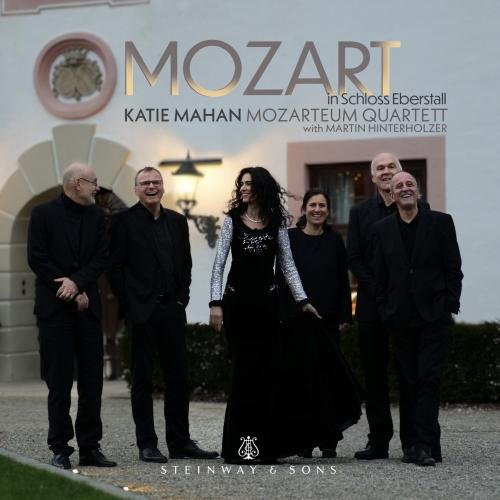
Artist: Katie Mahan, Mozarteum Quartett, Martin Hinterholzer
Title: Mozart in Schloss Eberstall
Year Of Release: 2026
Label: Steinway and Sons
Genre: Classical
Quality: flac lossless (tracks) / flac 24bits - 96.0kHz +Booklet
Total Time: 02:13:13
Total Size: 518 mb / 2.33 gb
WebSite: Album Preview
TracklistTitle: Mozart in Schloss Eberstall
Year Of Release: 2026
Label: Steinway and Sons
Genre: Classical
Quality: flac lossless (tracks) / flac 24bits - 96.0kHz +Booklet
Total Time: 02:13:13
Total Size: 518 mb / 2.33 gb
WebSite: Album Preview
CD1
01. Piano Concerto No. 20 in D Minor, K. 466 (Arr. for Piano & String Quintet by Ignaz Lachner): I. Allegro
02. Piano Concerto No. 20 in D Minor, K. 466 (Arr. for Piano & String Quintet by Ignaz Lachner): II. Romance
03. Piano Concerto No. 20 in D Minor, K. 466 (Arr. for Piano & String Quintet by Ignaz Lachner): III. Allegro assai
04. Piano Concerto No. 25 in C Major, K. 503 (Arr. for Piano & String Quintet by Ignaz Lachner): I. Allegro maestoso
05. Piano Concerto No. 25 in C Major, K. 503 (Arr. for Piano & String Quintet by Ignaz Lachner): II. Andante
06. Piano Concerto No. 25 in C Major, K. 503 (Arr. for Piano & String Quintet by Ignaz Lachner): III. Allegretto
CD2
01. Die Zauberflöte, K. 620: Overture (Arr. for Piano by Katie Mahan)
02. Fantasia in C Minor, K. 475
03. Piano Sonata No. 14 in C Minor, K. 457: I. Molto allegro
04. Piano Sonata No. 14 in C Minor, K. 457: II. Adagio
05. Piano Sonata No. 14 in C Minor, K. 457: III. Allegro assai
06. Adagio in C Major, K. 356
07. Marche funebre del Sigr Maestro Contrappunto, K. 453a
08. 12 Variations on Ah, vous dirai-je maman, K. 265
09. Piano Sonata No. 18 in D Major, K. 576 Hunt: I. Allegro
10. Piano Sonata No. 18 in D Major, K. 576 Hunt: II. Adagio
11. Piano Sonata No. 18 in D Major, K. 576 Hunt: III. Allegretto
Katie Mahan releases her newest STEINWAY & SONS album, Mozart in Schloss Eberstall. Recorded before a small audience at the historic Schloss Eberstall in Bavaria, Mahan is joined by the Mozarteum Quartett and double bassist Martin Hinterholzer in Ignaz Lachner's brilliant arrangements of Mozart's dramatic Piano Concerto in D minor, K 466 and the monumental Piano Concerto in C major, K 503.
The program is complemented by solo piano works by Mozart, including the Overture to Die Zauberflöte (in an arrangement by Mahan), the dramatic C minor Fantasie and Sonata in C minor, K 475, the ethereal Adagio for Glass Harmonica, the beloved Variations on “Ah, vous dirai-je Maman” and his final piano sonata, K 576. Katie Mahan discusses the project in the album's liner notes: “In the 18th and 19th centuries, attending a performance with full orchestra was a luxury enjoyed by very few. It was, therefore, common practice for composers to cater to the burgeoning middle class by creating chamber arrangements of their orchestral works and concerti which could be performed by small professional ensembles or amateur musicians in the drawing rooms of upper-class homes. Mozart himself arranged his piano concerti K 413-415 for piano a quattro (piano and string quartet), and had expressed interest in making similar arrangements of other piano concerti. Unfortunately he died before being able to proceed with the arrangements. However, as the practice of arranging large-scale works for small ensembles remained firmly in vogue in the first half of the 19th century, composers like Mozart's pupil Johann Nepomuk Hummel and the German composer and conductor Ignaz Lachner devoted themselves to the task. Lachner, in particular, arranged nineteen of Mozart's piano concerti for chamber ensemble. These highly effective re-imaginings - which present the piano solo part in its original, unaltered form, and adapt Mozart's rich orchestration for a string quintet – are not only enjoyable works in their own right, but also offer a unique insight as to how Mozart, and his contemporaries, may have performed such works when a full orchestra was not on hand. For this recording, we have selected Lachner's arrangements of the Concerto in D minor, K 466 and the Concerto in C major, K 503, two of Mozart's most brilliant works in the genre.
Both concerti presented on this album were composed in Vienna between 1784 and 1786, a period of remarkable creativity for Mozart in which, at the height of his popularity as a keyboard virtuoso, the piano concerto occupied prime position in his compositional output. Over the course of this two year period, Mozart completed twelve piano concerti to perform at a series of subscription concerts known as Akademien which he financed and organized himself to build his career as a freelance musician in Vienna. The Akademien were presented on Friday evenings at the Mehlgrube Casino in Vienna for an audience that included prominent members of Viennese high society. The Concerto in D minor, K 466, undisputedly one of his most intimate, intense and emotionally powerful works, was completed on February 10, 1785 and premiered, with Mozart as soloist, the following day at the the first of his Akademien that season. The work met with immediate success and remained one of Mozart's most frequently performed concerti through the 19th century. The monumental Concerto in C major, K 503, the last of the twelve concerti Mozart composed for his Akademien, was completed on December 4, 1786, a mere two days before his Prague Symphony, K 504. Although today considered to be one of his greatest concerti, the work, which is characterized by unparalleled grandeur and structural brilliance, fell into oblivion after Mozart's death and it was not until the second half of the twentieth century that it gained acceptance into the standard repertoire.
On this album, we have tried to recreate the atmosphere of an intimate 18th-century Kammermusikabend. We selected Schloss Eberstall - a historic and privately owned castle in Bavaria dating to 1602 which originally belonged to the noble Eberstall family and later to Count Schenk von Stauffenberg - as our recording location, and in keeping with the spirit of a Kammermusikabend as it would have been enjoyed in Mozart's day, performed the works before a small audience assembled in the drawing room. In between the concerto sessions, I also performed a selection of Mozart's solo piano works for our small audience. My performances were captured on recording and are presented here on a second disc. The solo program begins with my own arrangement of the Overture to Die Zauberflöte, K. 620, Mozart's final opera and a timeless masterpiece which has fascinated me since my earliest childhood.
Following the Overture is the dramatic Fantasie and Sonata in C minor, K 475/457, two works dedicated to Mozart's pupil Maria Theresa von Trattner that were published together as a set in 1785, and which have been part of my repertoire for more than two decades. Presented next are two rarely played miniatures, the ethereal Adagio for Glass Harmonica in C major K 365/617a composed in 1791 for the blind virtuoso Marianne Kirchgessner and the humorous Marche funèbre del Signor Maestro Contrapunto, K. 453a composed in 1784 as a little joke for Mozart's student Barbara Ployer. To complete the program is the delightful and ever popular Variations on Ah, vous dirai-je Maman, K 265 and the Sonata in D major, K 576, Mozart's final sonata for the piano which, although believed to have been part of a commissioned set of six easy sonatas for the Princess Friederike of Prussia, ranks among his most technically challenging and brilliant sonatas. Although all of the works presented on the present album are rightfully at home in a large concert hall, the re-adaptation to the more intimate realm of a chamber music setting leaves the expressive power, grace, freshness and eloquence of the music unchallenged while simultaneously offering an endearing glimpse into another time and its culture.” (Katie Mahan)
Katie Mahan, piano
Mozarteum Quartett
Martin Hinterholzer, conductor
![Tone Åse & Ståle Storløkken - Snu Jorda (2026) [Hi-Res]](https://www.dibpic.com/uploads/posts/2026-09/1788235204_uzsq4ovsk1e5p_600.jpg "Tone Åse & Ståle Storløkken - Snu Jorda (2026) [Hi-Res]")
![Dino Siani - Strings & Brass (2026) [Hi-Res]](https://img.israbox.com/img/2026-09/03/oy4f2kp2rpqzqo9et08d7n9tf.jpg "Dino Siani - Strings & Brass (2026) [Hi-Res]")
![Woody Shaw - Song Of Songs (Remastered 2026) (1973) [Hi-Res]](https://www.dibpic.com/uploads/posts/2026-09/1788459570_cover.jpg "Woody Shaw - Song Of Songs (Remastered 2026) (1973) [Hi-Res]")
![Kadi Vija - Tiny Hands Gathering Wonder, The World Becomes Magic (2025) [Hi-Res]](https://www.dibpic.com/uploads/posts/2026-09/1788347224_e1oowk4vhd2ob_600.jpg "Kadi Vija - Tiny Hands Gathering Wonder, The World Becomes Magic (2025) [Hi-Res]")
![Jalen Baker - RePaved (2026) [Hi-Res]](https://img.israbox.com/img/2026-09/03/d3czw7uhg1fk2u5wfz5a3j67u.jpg "Jalen Baker - RePaved (2026) [Hi-Res]")