Manuel Tomadin - The Valvasone Organ Book: Music for the 16th Century Vincenzo Colombi Organ (2026) [Hi-Res]
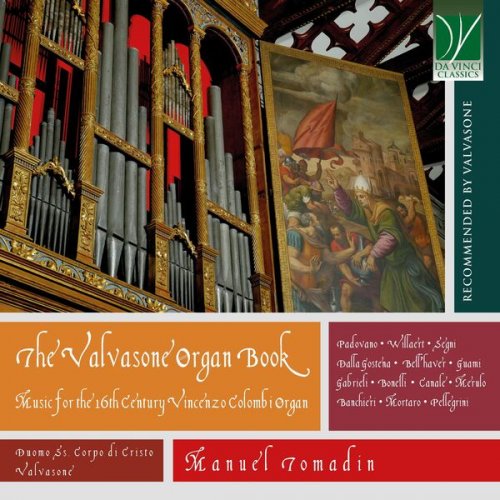
Artist: Manuel Tomadin
Title: The Valvasone Organ Book: Music for the 16th Century Vincenzo Colombi Organ
Year Of Release: 2026
Label: Da Vinci Classics
Genre: Classical Organ
Quality: flac lossless (tracks) / flac 24bits - 96.0kHz
Total Time: 01:16:36
Total Size: 364 mb / 1.35 gb
WebSite: Album Preview
TracklistTitle: The Valvasone Organ Book: Music for the 16th Century Vincenzo Colombi Organ
Year Of Release: 2026
Label: Da Vinci Classics
Genre: Classical Organ
Quality: flac lossless (tracks) / flac 24bits - 96.0kHz
Total Time: 01:16:36
Total Size: 364 mb / 1.35 gb
WebSite: Album Preview
01. Toccata d'Annibale Padovano del Ottavo Tono
02. 2 Canzoni francesi Mon coeur en vous e Vignon mignon vignette
03. Ricercare in E Minor
04. Recerchare per musica ficta in Sol per la via di G sol re ut
06. Fantasia Prima
07. Toccata
08. Fantasia Allegra del duodecimo Tono
09. Canzona Francese La Guamino
10. Toccata
11. Ricercar del primo Tuono
12. Canzon La Nuvolina
13. Canzon la Zambeccara
14. Toccata Prima dell'Undecimo detto quinto tuono
15. Canzon Undecima La organistina Bella in Echo
16. Ricercar Primo
17. Canzon La Zucchella
18. Canzon detta La capricciosa
Girolamo Diruta, in his treatise Il Transilvano (1593), speaks of a “plaintive, sad and sorrowful harmony” capable of evoking the torments of the Passion, thus making manifest how the sound of the keyboard could move the affections no less than the human voice. A few years later Emilio de Cavalieri claims a music able to pass “from the sad to the cheerful, from the fierce to the gentle”, in accordance with the mutable states of the soul. Well before seventeenth-century theory codified the “doctrine of the affections”, the organ is therefore already perceived as a veritable laboratory of emotions, and it is precisely the Venetian repertory gravitating around San Marco that emerges as one of the privileged loci of this new sensibility.
Within this horizon there stands the organ by Vincenzo Colombi in the Duomo of the Most Holy Body of Christ in Valvasone, an almost unparalleled document of the sixteenth-century Venetian organ-building school. Erected between 1532 and 1533 at the behest of the Counts of Valvasone, it was soon enclosed within the monumental wooden case overlooking the right-hand aisle of the nave. The decorative apparatus summoned some of the most eminent exponents of Friulian figurative culture: the structure was executed by master marangoni (a Venetian term for carpenters), the wooden carvings by Girolamo da Venezia, whilst the organ shutters were painted by Giovanni Antonio de’ Sacchi, known as Il Pordenone, and, following his death, completed by his son-in-law and pupil Pomponio Amalteo, to whom the panels of the organ gallery and the surrounding frescoes are likewise owed. The entire iconographic cycle is articulated around the Eucharistic mystery, in relation to the “miraculous cloth” preserved upon the high altar and to the dedication of the Duomo to Corpus Domini: the organ, set within this theatre of images, becomes the resonant instrument of a meditation upon sacrifice and the Real Presence. It is not difficult to conceive the Renaissance pieces presented here as an integral, living component of such a devotional milieu, in an intimate dialogue between music, images and liturgy.
From a technical perspective, the instrument is endowed with a single manual of 47 keys (F-F) with a permanently coupled pedalboard, low wind pressure and quarter-comma meantone temperament, together with a high pitch standard, A lying around 492 Hz. The ripieno, founded on the Tenori 12’ stop and extended up to the XXIX, is flanked by the Flauto in XV and by the characteristic Fiffaro, a channel tremulant which affords exquisitely subtle vibrating effects. The relatively low position of the organ gallery, combined with the generous yet clear acoustic of the Duomo, contributes to a direct and limpid projection of the sound, ideally suited to bringing into relief the contrapuntal designs and the finely wrought toccata-like figuration. Over the course of the centuries the instrument underwent various alterations and not a few periods of silence, eventually becoming unusable in the aftermath of the First World War. A first substantial restoration was entrusted to Alfredo Piccinelli in the 1970s; the philologically informed restoration carried out in 1999 by the firm of Francesco Zanin restored to the Colombi organ the ventilabro windchest, the Renaissance voicing and the original characteristics of the pipework. Today the organ once again occupies a central position in the liturgical and concert life of Valvasone and has become a recognised destination for courses, masterclasses and scholarly activity devoted to early organ performance practice.
A particularly precious document, preserved in the parish archive, is the so-called tabella valvasonese, which contains indications on “all the ways of playing with the organ”. Drawn up in the sixteenth century, perhaps at the instigation of Colombi himself, it enumerates combinations of stops conceived for different kinds of repertory: from “playing with the full organ” to more intimate sonorities, and finally to the use of the Octave as the foundation for “playing in the bass” in the low register. This source, unique of its kind, not only bears witness to contemporary registration practices, but today serves as a concrete and invaluable point of reference for the reconstruction of the timbral environment within which these pages came into being and were originally heard.
The programme assembled here does not simply offer a selection of Venetian masters, but rather weaves a dialogue between organists who were actually active at San Marco – Willaert, Padovano, Andrea and Giovanni Gabrieli, Merulo, Bellavere, Guami – and musicians who reached Venice by way of music printing and networks of dedicatees, such as Giulio Segni, Giovanni Battista Dalla Gostena, Aurelio Bonelli, Adriano Banchieri, Floriano Canale, Antonio Mortaro and Vincenzo Pellegrini. In a city which, thanks to the presses of Gardano, Scotto and Vincenti, ranked among the principal European centres for printed music, collections of ricercari, toccatas and canzonas intended for the organ circulated swiftly throughout the German and Italian lands, thereby contributing to the formation of a truly Venetian language of the keyboard.
A foundational figure within this world is Adriaen Willaert, maestro di cappella at San Marco for over thirty years. His French chansons on Mon cueur en vous and Vignon, mignon vignette recast models of Franco-Flemish origin within a keyboard texture of remarkable clarity: the imitative density of the chansons is lightened, the voices are reduced in number and redistributed so as to bring into prominence sharply delineated melodic profiles and cadences which accord to perfection with the meantone temperament of the Colombi organ. The Ricercare presents a more austere and contemplative aspect, in which a single subject is exposed to continuous contrapuntal scrutiny, in a gradual crescendo of dense imitations and concluding strettos.
Annibale Padovano, organist at San Marco before his move to the Habsburg court, is among the first to commit to paper the new conception of the toccata. In the Toccata dell’ottavo tono, imposing blocks of chords of pronounced rhetorical impact stand alongside diminuted passages, broken scales and almost improvisatory sections that evoke the fantasia of a great virtuoso at the keyboard. Giulio Segni da Modena, likewise active within the orbit of San Marco, brings the form of the ricercare to a notable degree of technical refinement: in the Ricercar per musica ficta in sol the systematic deployment of accidentals serves to tighten or relax the tensions of cadences, making deliberate use of the distinctive qualities and asperities of the meantone system.
A different declension of counterpoint emerges in Giovanni Battista Dalla Gostena, a Genoese composer whose organ output has come fully to light only in recent times. The Canzone francese Mais que sert la richesse à l’homme is derived from a celebrated chanson by Guillaume Costeley, whilst the Fantasia prima belongs to a group of pieces in which Dalla Gostena explores chromaticism with boldness, presenting himself as a link between the generation of Willaert and Padovano and that, fully seventeenth-century, of Frescobaldi. Aurelio Bonelli, from Bologna, concentrates his production for keyboard in the Primo libro de ricercari et canzoni (Venice, 1602): the Ricercar del primo tuono displays a complete assimilation of the Venetian idiom, with short and incisive subjects, closely wrought imitations and episodes in toccata style which momentarily interrupt the strict imitative fabric.
Shifting the centre of gravity towards the canzona da sonare, we encounter Gioseffo Guami, a pupil of Willaert and protagonist of a career that led him from the cappella at San Marco to the Hofkapelle in Munich and finally to Lucca. In the Canzon La Guamina a theme of distinctly vocal imprint becomes the object of a dense imitative play; the Toccata per organo reveals instead his freer and more virtuosic side, with scalar passages and broken figures that anticipate certain features of the toccatas by Merulo. Adriano Banchieri, an Olivetan monk, inherits from Guami a marked taste for dialogue between groups of sound: the Canzon undecima La organistina bella in echo exploits repeated figures at a distance and contrasts of registration to create echo effects which, within the space of Valvasone, assume an almost theatrical character in spite of the sobriety of the means employed.
Vincenzo Bellavere, first organist at San Marco in the 1580s, left a modest yet highly refined instrumental corpus: the Toccata per organo presented here alternates chordal blocks and diminuted passages in a compact and rigorous writing that finds in the ripieno of the Colombi organ an ideal vehicle. Andrea Gabrieli, a pupil of Willaert, transfers to the keyboard his long experience as a composer of polychoral music: in the Fantasia allegra del duodecimo tuono episodes of serene cantabilità alternate with more impetuous, almost proto-virtuosic sections, without any diminution of formal control. His nephew Giovanni, in the Ricercar primo, brings this “architectural” conception of counterpoint to its full realisation: the entries of the subject are distributed like imaginary choirs in space, and the final strettos assume the character of a grand doxology.
The path is, in the ideal sense, brought to a close by the canzonas of Floriano Canale (La Nuvolina), Antonio Mortaro (La Zucchella) and Vincenzo Pellegrini (La capricciosa), drawn from collections of canzoni da sonare printed in Venice between the end of the sixteenth century and the early years of the seventeenth. Their allusive titles often refer to noble families or to specific dedicatees; musically, these pieces mark the definitive passage from the model of the French chanson to a more idiomatic language for the keyboard, in which the initial theme becomes the material for variations, partial fugues and almost dance-like sections. On an organ such as that of Valvasone these pages reveal a strikingly theatrical character, articulated entirely through the nuances of the ripieno and the subtle gradations of colour that the instrument by Colombi is still able to offer today.
![Kosmonauci - Brudna - Bielizna (2026) [Hi-Res]](https://www.dibpic.com/uploads/posts/2026-08/1788069357_xalsyo9fro9x5_600.jpg "Kosmonauci - Brudna - Bielizna (2026) [Hi-Res]")
![Rock City Falls Trio - Signal (2026) [Hi-Res]](https://img.israbox.com/img/2026-08/29/pxew3lwqdsfly673wqn2mwrjf.jpg "Rock City Falls Trio - Signal (2026) [Hi-Res]")
![Jonas Cambien - MAN EATING TREE (2026) [Hi-Res]](https://www.dibpic.com/uploads/posts/2026-08/1788007904_kfq7k3cqpk0n9_600.jpg "Jonas Cambien - MAN EATING TREE (2026) [Hi-Res]")