Avizohar - Proof, or (2026)
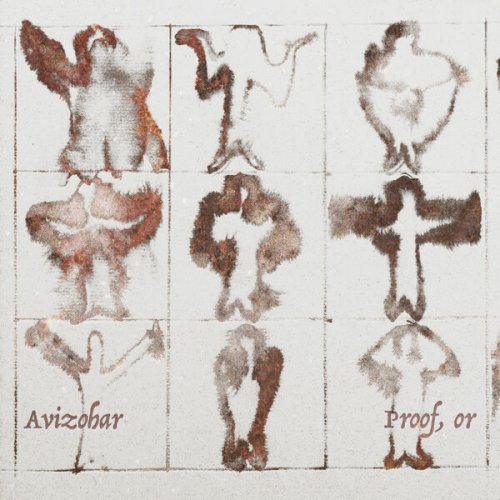
Artist: Avizohar
Title: Proof, or
Year Of Release: 2026
Label: Orthodox Records
Genre: Ambient, Electroacoustic
Quality: 16bit-44,1kHz FLAC / 24bit-48kHz FLAC
Total Time: 50:45
Total Size: 247 mb / 545 mb
WebSite: Album Preview
TracklistTitle: Proof, or
Year Of Release: 2026
Label: Orthodox Records
Genre: Ambient, Electroacoustic
Quality: 16bit-44,1kHz FLAC / 24bit-48kHz FLAC
Total Time: 50:45
Total Size: 247 mb / 545 mb
WebSite: Album Preview
1. Marked by Fragility (04:05)
2. Wind Gestures (05:37)
3. A Sea Unfilled (07:13)
4. Submerged (06:23)
5. Be Healed (07:21)
6. A Sharpened Heart (08:06)
7. Still Water (07:54)
8. Run Deep (04:04)
"Proof, or" is Avizohar’s second album, a cycle of six electro-acoustic compositions shaped around breath, fragility, and the porous boundary between presence and absence. Moving between restrained ambient passages and towering walls of sound, the music unfolds in slow, shifting layers where delicate atmospheres gradually give way to dense, shoegaze-like currents of distortion and spectralism.
Throughout the album, electronic instruments and acoustic sources shift between unstable sonic events. Concrete noises, granular textures and electronic glitches interpolate with tonal swells and emotional melodies. What begins as a quiet inhalation can suddenly expand into a vast sonic pressure, only to dissolve again into fragile condition.
The material for the album was written between 2022 and 2023, the pieces remained untouched for several years. Only in 2026 did he return to these unfinished sketches, revisiting them from a different moment in time. What had begun as a series of compositions gradually transformed into a body of sound carrying within it the temporal distance between its origin and its completion.
This album continues the trajectory of Avizohar’s debut Watershed. If water once served as the central metaphor of that work, here the element shifts toward air. Breathing becomes a perceptual anchor: the sensation of resurfacing after prolonged submersion, of oxygen returning to the body. Air unfolds not merely as a necessity for survival but as atmosphere, as spirit, as a state of consciousness.
Each piece inhabits a threshold where sound feels suspended between emergence and disappearance. Electronic tones take on an almost organic quality, as if breath had entered their circuits, while acoustic materials fragment and glitch into a virtual emancipation.
Rather than invoking nostalgia directly, or a longing to a failed future, “Proof, or” unfolds as a hauntological condition from a different prism: a work written in one moment of life and completed in another, where memory, absence, and sound quietly permeate one another.

![La sagrada Familia - La Sagrada Familia (2026) [Hi-Res]](https://www.dibpic.com/uploads/posts/2026-07/1784040263_t2ttsyk4whcys_600.jpg "La sagrada Familia - La Sagrada Familia (2026) [Hi-Res]")
![Mama Terra - Inner Space (2026) [Hi-Res]](https://www.dibpic.com/uploads/posts/2026-07/1784035441_folder.jpg "Mama Terra - Inner Space (2026) [Hi-Res]")

![Henry Solomon - Solo Woodwind (2026) [Hi-Res]](https://www.dibpic.com/uploads/posts/2026-07/1783973663_nhur1blml85xk_600.jpg "Henry Solomon - Solo Woodwind (2026) [Hi-Res]")