Süddeutsche Philharmonie, Othmar F. M. Maga, Hanspeter Gmür & Nürnberger Symphoniker - Sons Of Bach (1972) [Hi-Res]
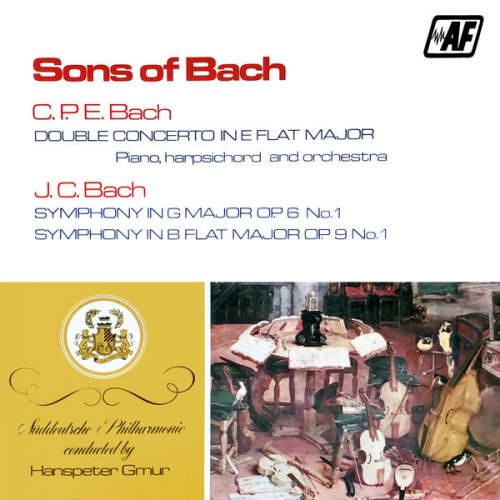
Artist: Süddeutsche Philharmonie, Othmar F. M. Maga, Hanspeter Gmür, Nürnberger Symphoniker
Title: Sons Of Bach
Year Of Release: 1972
Label: Audio Fidelity
Genre: Classical
Quality: FLAC (tracks) [96kHz/24bit]
Total Time: 40:57
Total Size: 718 / 207 MB
WebSite: Album Preview
Tracklist:Title: Sons Of Bach
Year Of Release: 1972
Label: Audio Fidelity
Genre: Classical
Quality: FLAC (tracks) [96kHz/24bit]
Total Time: 40:57
Total Size: 718 / 207 MB
WebSite: Album Preview
1. Nürnberger Symphoniker – Double Concerto in E-Flat Major, H. 479: I. Allegro di molto (08:22)
2. Nürnberger Symphoniker – Double Concerto in E-Flat Major, H. 479: II. Larghetto (06:48)
3. Nürnberger Symphoniker – Double Concerto in E-Flat Major, H. 479: III. Presto (04:38)
4. Süddeutsche Philharmonie – Symphony in G Major, Op. 6 No. 1: I. Allegro con brio (04:07)
5. Süddeutsche Philharmonie – Symphony in G Major, Op. 6 No. 1: II. Andante (03:17)
6. Süddeutsche Philharmonie – Symphony in G Major, Op. 6 No. 1: III. Allegro assai (01:46)
7. Süddeutsche Philharmonie – Symphony in B-Flat Major, Op. 9 No. 1: I. Allegro assai (04:34)
8. Süddeutsche Philharmonie – Symphony in B-Flat Major, Op. 9 No. 1: II. Andante (04:25)
9. Süddeutsche Philharmonie – Symphony in B-Flat Major, Op. 9 No. 1: III. Presto (02:56)
In addition to conventional orchestral fare, the Nuremberg Symphony Orchestra is internationally famous for its work on film soundtracks. The group was heard in two major films of the 1950s, Quo Vadis and Ben Hur, and it has remained active in the field. The Nuremberg Symphony Orchestra has recorded music by various little-known classical composers, including several in the realm of Viennese popular dances. In 2024, the orchestra was heard on volume 86 of the Hyperion label's "Romantic Piano Concerto" series, performing works by Thomas Tellefsen and Frédéric Kalkbrenner.
The Nuremberg Symphony Orchestra (in German, Nürnberger Symphoniker) was founded as the Franconia State Orchestra (Fränkisches Landesorchester) in 1946. It adopted its current name in connection with the dedication of Nuremberg's Meistersingerhalle in 1963. The orchestra's first chief conductor was Erich Kloss, who held the position from 1949 to 1968. The Nuremberg Symphony continues to perform at the Meistersingerhalle but also rehearses and plays in the 515-seat Neuer Musikhalle and offers a summer outdoor concert series at Nuremberg's Serenadenhof. Other key conductors include Klauspeter Seibel (1980-1988) and the group's first non-German leader, the Netherlands' Jac van Steen (1997-2002). An early digital recording for the group was an album of music by Max Reger, released in 1988 on the Colosseum label.
The Quo Vadis and Ben Hur soundtracks put the Nuremberg Symphony on the map internationally. The group has continued to record film music, winning a 1991 Grammy Award for Best Pop Instrumental Performance for its recording of the theme song to the Disney studio release Beauty and the Beast. Under later conductors, including Alexander Shelley (2009-2017), Kahchun Wong (2018-2022), and Jonathan Darlington (2022-), the orchestra has recorded a wide variety of music, including an album of Mexican piano concertos (2013); albums of waltzes and other dances by Josef Gung'l, Carl Millöcker, and Philipp Fahrbach; collections of operatic highlights; music by Beethoven and Chopin; and more. In 2024, the Nuremberg Symphony backed pianist Howard Shelley on a recording of music by Kalkbrenner and Tellefsen on a recording in the Hyperion label's "Romantic Piano Concerto" series, with Shelley conducting. © James Manheim
The Nuremberg Symphony Orchestra (in German, Nürnberger Symphoniker) was founded as the Franconia State Orchestra (Fränkisches Landesorchester) in 1946. It adopted its current name in connection with the dedication of Nuremberg's Meistersingerhalle in 1963. The orchestra's first chief conductor was Erich Kloss, who held the position from 1949 to 1968. The Nuremberg Symphony continues to perform at the Meistersingerhalle but also rehearses and plays in the 515-seat Neuer Musikhalle and offers a summer outdoor concert series at Nuremberg's Serenadenhof. Other key conductors include Klauspeter Seibel (1980-1988) and the group's first non-German leader, the Netherlands' Jac van Steen (1997-2002). An early digital recording for the group was an album of music by Max Reger, released in 1988 on the Colosseum label.
The Quo Vadis and Ben Hur soundtracks put the Nuremberg Symphony on the map internationally. The group has continued to record film music, winning a 1991 Grammy Award for Best Pop Instrumental Performance for its recording of the theme song to the Disney studio release Beauty and the Beast. Under later conductors, including Alexander Shelley (2009-2017), Kahchun Wong (2018-2022), and Jonathan Darlington (2022-), the orchestra has recorded a wide variety of music, including an album of Mexican piano concertos (2013); albums of waltzes and other dances by Josef Gung'l, Carl Millöcker, and Philipp Fahrbach; collections of operatic highlights; music by Beethoven and Chopin; and more. In 2024, the Nuremberg Symphony backed pianist Howard Shelley on a recording of music by Kalkbrenner and Tellefsen on a recording in the Hyperion label's "Romantic Piano Concerto" series, with Shelley conducting. © James Manheim

![Wyclef Jean - Q Theory - Quantum Leap, Vol. 2 (2026) [Hi-Res]](https://img.israbox.com/img/2026-08/31/qe5stsxpf31pb0ptahgpqaq78.jpg "Wyclef Jean - Q Theory - Quantum Leap, Vol. 2 (2026) [Hi-Res]")





![JJ Whitefield - Exotic Moods (2026) [Hi-Res]](https://img.israbox.com/img/2026-08/31/de25143ov1nbayp56q26308iw.jpg "JJ Whitefield - Exotic Moods (2026) [Hi-Res]")