Trio Bambaraoui, Christer Bothén - Toumbouctou 52 (2026) [Hi-Res]
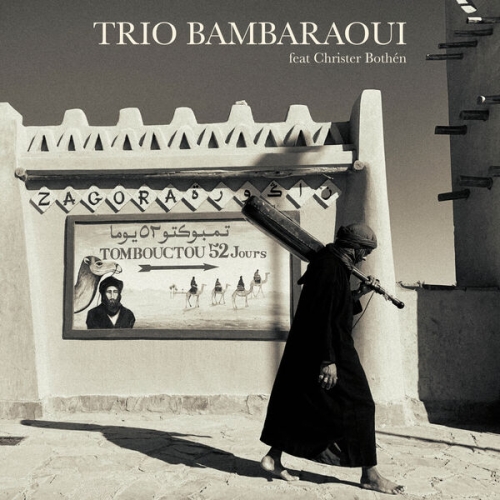
Artist: Trio Bambaraoui, Christer Bothén
Title: Toumbouctou 52
Year Of Release: 2026
Label: PRISMA MUSIC
Genre: Moroccan Traditional, Afro-Jazz, World Fusion, Spiritual Jazz
Quality: FLAC 24/48000; 16/44100
Total Time: 00:41:44
Total Size: 244; 486 MB
WebSite: Album Preview
Toumbouctou 52 is a meeting of two African traditions long separated by the Sahara, with a Swedish bridge-builder standing between them. The title invokes the historic trans-Saharan caravan route — "fifty-two days from Marrakech to Timbuktu" — along which salt and slave caravans moved for centuries. That same route is what binds Morocco's gnawa, descendants of West African slaves brought north, to their ancestral donso culture in the Wassoulou region of southern Mali. The record sounds out both ends of the road at once.Title: Toumbouctou 52
Year Of Release: 2026
Label: PRISMA MUSIC
Genre: Moroccan Traditional, Afro-Jazz, World Fusion, Spiritual Jazz
Quality: FLAC 24/48000; 16/44100
Total Time: 00:41:44
Total Size: 244; 486 MB
WebSite: Album Preview
Bambaraoui is a collective based across Marrakech, Bamako and Göteborg, founded by the Franco-Malian master Said Belhaj and operating at the crossroads of gnawa (with guimbri and qarqaba metal castanets) and donso music (built around the six-stringed hunter's harp donso n'goni). On Toumbouctou 52 the ensemble performs in a stripped-down trio configuration, joined by Christer Bothén — the 84-year-old Swedish multi-instrumentalist who studied donso n'goni in Wassoulou with Brouema Dobia in 1971-72 and later took up the guimbri in Marrakech. Bothén is the only European to have been formally granted permission by his Malian teachers to play the sacred hunter's harp both traditionally and in his own idiom; he is also the man who passed elements of that knowledge on to Don Cherry inside the Organic Music Society. For Belhaj, as he has said on stage, Bothén is "like a library" — a living repository of techniques that, in Mali itself, almost no one is alive to teach anymore.
Musically the record works the gnawa repertoire and donso vocabulary in parallel. The titles spell it out: "Bania" is one of the canonical figures of the gnawa pantheon (treated decades earlier by Hassan Hakmoun and Mahmoud Guinia); "Mimoun Sadiamou" invokes Sidi Mimoun, a central spirit of the gnawa lila ceremony; "Lil Zraq" (Arabic for "blue night") and "Zid l'Mel" were both road-tested by the band in 2025 and previewed in earlier versions on the Bambaraoui SoundCloud; "Djina Moussou" addresses a female djinn figure. The longer cuts — especially the twelve-minute "Zid l'Mel" — unfold as trance cycles, with the kind of palindromic treatment of bar-figures and gradual tempo acceleration/deceleration that Bothén himself has recently described as his core method.
The album is released by Prisma Music Group, a Stockholm-based label that works primarily within instrumental music. It is the first full-length document of Bambaraoui's trio formation with Bothén on board, and one of the most conceptually coherent statements of 2026 at the junction of gnawa, Malian donso, and the Swedish afro-jazz lineage that runs from Don Cherry through Bengt Berger to Bothén himself.
Tracklist:
1-1 Trio Bambaraoui;Christer Bothén - Djina Moussou [5:19]
1-2 Trio Bambaraoui;Christer Bothén - Bori ya Bori - Bania [6:19]
1-3 Trio Bambaraoui;Christer Bothén - Sibiri [3:58]
1-4 Trio Bambaraoui;Christer Bothén - Lil Zraq [7:34]
1-5 Trio Bambaraoui;Christer Bothén - Mimoun Sadiamou [6:25]
1-6 Trio Bambaraoui;Christer Bothén - Zid l’Mel [12:09]
![Mats Erlandsson & Gus Loxbo - Minnets Långa Kedjor (2026) [Hi-Res]](https://img.israbox.com/img/2026-10/10/vnmve4bgquxgtsvslzwiwmwc4.jpg "Mats Erlandsson & Gus Loxbo - Minnets Långa Kedjor (2026) [Hi-Res]")

![Papik - Yes I Know My Way, Vol. 2 (2026) [Hi-Res]](https://www.dibpic.com/uploads/posts/2026-10/1791640889_folder.jpg "Papik - Yes I Know My Way, Vol. 2 (2026) [Hi-Res]")