Kaveh Mirhosseini & JAM Orchestra - Christos Hatzis: Anthropomorphosis (2026)
- 06 Jun, 09:14
- change text size:
Facebook
Twitter
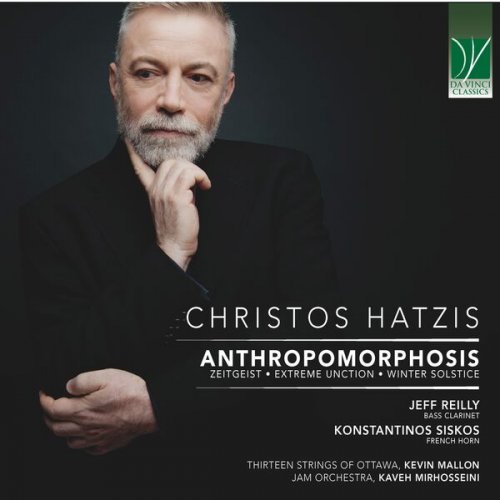
Artist: Kaveh Mirhosseini, JAM Orchestra, Thirteen Strings of Ottawa, Kevin Mallon, Jeff Reilly, Konstantinos Siskos
Title: Christos Hatzis: Anthropomorphosis
Year Of Release: 2026
Label: Da Vinci Classics
Genre: Classical
Quality: FLAC (tracks)
Total Time: 57:01
Total Size: 280 MB
WebSite: Album Preview
Tracklist:Title: Christos Hatzis: Anthropomorphosis
Year Of Release: 2026
Label: Da Vinci Classics
Genre: Classical
Quality: FLAC (tracks)
Total Time: 57:01
Total Size: 280 MB
WebSite: Album Preview
1. Kaveh Mirhosseini – Zeitgeist (17:36)
2. Jeff Reilly – Extreme Unction (In memory of Gustav Ciamaga) (11:49)
3. Konstantinos Siskos – Winter Solstice: I. The Darkest Hour (07:47)
4. Konstantinos Siskos – Winter Solstice: II. Simulacrum (09:51)
5. Konstantinos Siskos – Winter Solstice: III. Prophet of Light (09:57)
“I feel strongly that with my music, I am trying to force a tiny opening in the clouds that will allow His Light to shine through. At best, I am a follower, not a master, and my MASTER holds the patterns and patents of my being and work. So, in the best of circumstances, I can only think of myself as an imitator.” Christos Hatzis

To encounter the music of Christos Hatzis is to enter an artistic world in which technique is never an end in itself, but a means – toward memory, ethical attention, and (to use the composer’s own spiritual imagery) a kind of illumination. Hatzis has explicitly framed composition as an act of making room for “Light” to pass through the turbulence of lived experience.
This spiritual orientation does not reduce his work to pious illustration; instead, it clarifies its priorities. Hatzis is consistently described by institutions that know his output at close range as a composer who fuses intellectual rigor with emotional and psychological directness, and who moves with technical confidence across different media and idioms. In other words: the craft is serious, the message is not coy, and the audience is not treated as collateral damage.
A key signature of his language is a deliberate openness to plurality. Hatzis’s catalogue spans concert works and large-scale multimedia projects; it also engages contemporary issues with unusual frankness-climate change, migration, geopolitical diversity, Indigenous experience, human rights – while maintaining a core concern with the metaphysical question of what, exactly, sound connects us to. That concern is not merely thematic: Hatzis has even named a recent book-length project Resonance, explicitly foregrounding “connections” as both a musical and philosophical premise.
The three works on this recording – Zeitgeist (1996), Winter Solstice (2004), and Extreme Unction (2011) – make an unusually coherent triptych. All three are anchored in the world of strings (with wind instruments as soloist in two cases), yet each assigns the string body a different dramatic function: as a kaleidoscopic social space (Zeitgeist), as a historical conscience (Winter Solstice), and as a threshold between corporeality and transcendence (Extreme Unction). Taken together, they show a composer who treats tradition not as a museum label but as a living archive – usable, interruptible, and ethically charged – while still writing with a forward-facing urgency about the world we are becoming.
Listening Guide
Zeitgeist (1996) is a compact yet wide-angled work for string orchestra, conceived as a personal reflection on the character of the arts in the mid-1990s. At the centre lies an idea that is both aesthetic and philosophical: history is not a single-file procession of styles, but a multidimensional present in which musical pasts remain “functional” – available to be reactivated and re-heard when placed into new relationships. In this sense, the work is postmodern not because it trades in fashionable quotation, but because it re-situates experience itself: what once belonged to a specific era is taken out of its original frame and made to speak again, as if the past were not behind us but beside us.
The opening may feel like a deliberately composed anachronism: Baroque-leaning rhetoric, overture-like momentum, and the suggestion of inherited ceremony. Yet this “frame” is not stable. Almost immediately the music begins to behave like a mind in motion, testing different languages, walking through different rooms, refusing to settle. Hatzis describes two principal themes alternating through the work, and it is useful to hear them less as “subjects” in a textbook sense than as two modes of being. The first is a seeker: restless, insistent, propelled by short motives that recur with extraordinary persistence. One hears a small three-note figure and a dotted-rhythm gesture associated with the French overture, and, more importantly, one hears how these fragments combine into a larger, five-note idea that reappears in disguise, almost ceaselessly, as though the work were trying on successive identities without losing its core self. The surface styles can shift sharply, towards dense, Shostakovich-like polyphony, then towards the startlingly vernacular, even to playful take-offs on 1970s disco energy, but the continuity of the underlying idea keeps the piece from becoming a mere collage. It is not a parade of references; it is an argument about connectedness.
Against this kinetic, searching persona stands a second theme of markedly different character: more passive, introspective, surrendering to a neo-romantic beauty that is overlaid, with a faintly paradoxical elegance, by baroque-like scalar writing in solo violins. This music is allowed to remain itself; it does not “develop” so much as persist, and its constancy is crucial. The seeker may interrupt it the first time, but when it returns, it is finally permitted to unfold without being cut short, as though the work were granting the listener a temporary sanctuary within the restless traffic of its stylistic present.
For listening, it can be helpful to treat Zeitgeist as an encounter between surface and architecture. The surface is eclectic by design, exuberant and at times wilfully abrupt; the architecture is limited, clearly delineated, and quietly firm. One may hear the deeper structure as a stabilising gravitational field: it holds together materials that might otherwise appear chronologically incompatible. The expressive tension of the piece is born precisely there, in the friction between the erratic immediacy of the musical “now” and a more solid, underlying organisation that insists on coherence. If the work at times feels like it is moving too quickly to be “placed,” that sensation is part of its meaning: it mirrors a cultural moment in which inherited languages coexist without a guaranteed hierarchy, while still longing – restlessly – for a pattern that can make sense of them.
Extreme Unction (2011), for bass clarinet and string orchestra, moves into a darker and more intimate theatre. The title refers to the last rite of the Catholic tradition, administered to those at the threshold of death, and Hatzis approaches the subject not as a devotional tableau but as a psychologically unsparing meditation on transformation. Death is presented as a process in which the bond to the material world weakens and finally ceases; yet the work refuses any simplistic narrative of willing surrender. What emerges instead is an oscillation between two contradictory emotional states: the sense of an approaching light, with the peace and even joy that might accompany it, and the violent resistance of the body’s instinct to cling to what it already knows.
The soloist is not simply a protagonist placed in front of an ensemble: the bass clarinet becomes the work’s dramatic sensorium, capable of switching in an instant between despairing darkness and luminous calm. The instrument’s range, its ability to turn sound into grain, shadow, breath and flare, is treated as a moral vocabulary as much as a sonic one. This is not the kind of writing in which extended techniques function as exotic ornaments; they are structural, bound to the piece’s central subject: the instability of the threshold itself. The strings, for their part, form a surrounding world of signs. One hears timbres that seem to carry meaning beyond their immediate acoustical identity: pulses in the lower strings that evoke a heartbeat, microtonal spectra that feel like unstable harmonics of the body, gestures that can turn suddenly violent, and distant echoes suggestive of passing sirens, sound as the trace of urgency, and the reminder of human fragility.
A crucial element of the work’s intensity is the manner in which it was conceived. Hatzis did not simply write for an idealised bass clarinet; he built the piece through sustained workshop collaboration, recording and cataloguing the soloist’s sounds and allowing those materials, often complex, fluid, and difficult to reduce to “snapshots”, to shape the composition from within. This method matters for listening because it helps explain the peculiar sense that the solo line is simultaneously notated and alive, composed and yet volatile. At times the writing behaves like an artefact retrieved from the body’s own improvisatory intelligence; at others it feels like a sculpted, almost ritual utterance. The tension between these two modes is not a technical curiosity. It is the work’s subject made audible: the struggle between what is controlled and what is inevitable.
In approaching Extreme Unction, it is worth listening for how the piece constructs thresholds. The opening often behaves less like an “introduction” than like the first crack in a sealed space, as if air were entering a room that has long been closed. Moments of timbral brightness can appear not as triumph but as brief, clearings, openings in which sound seems lighter, less tethered. Then the resistance returns, sometimes with startling force: the music tightens, the body asserts itself, the pulse becomes inescapable. What is most affecting is that the work does not promise resolution as consolation. Its transformation is hard-won, its peace never sentimental. The result is a composition that invites the listener not to observe dying from a safe distance, but to recognise it as a human experience in which fear, tenderness, violence and serenity are bound together, inseparable.
Winter Solstice (2004), a concerto for French horn and string orchestra in three movements, broadens the scope again, but without abandoning the spiritual horizon that informs Hatzis’s imagination. Commissioned for horn virtuoso Jamie Sommerville and first performed in the Canadian Arctic around the time of the solstice, the work draws on the symbolic weight of the “longest night” as an emblem of historical and existential darkness. The composer frames the twentieth century as one of the darkest moments in human history – despite its undeniable achievements in science and technology – and the concerto unfolds as a meditation on that paradox: progress and moral catastrophe occupying the same era, the same civilisation, the same human capacity.
The first movement, The Darkest Hour, explores darkness through fragmentation and disjunction. One hears juxtaposed sound-bites of twentieth-century musical languages, sometimes organised with a serial discipline pushed close to absurdity, as if musical strategies were developing in isolation, indifferent to social interconnection. The effect is not “modernism for its own sake,” but a dramatization of disunity: melody and harmony, foreground and background, intention and consequence failing to cohere. Amid this sea of tension there is an anchoring gesture, a D minor motif described as a small island of sadness, and the music periodically returns to it, not as refuge, but as reminder: a simple human grief recurring inside a fractured world.
The second movement, Simulacrum, is more deceptive. It is luminous in surface, persuasive in gesture, and for that very reason more sinister than the overt darkness of the first movement. The title names a fabricated reality: a world of information, commodities, and media-driven “truth” that disguises itself as knowledge while hollowing out the possibility of spirit. The movement’s beauty is not straightforwardly affirmed; it is slowly exposed. A melody that seems generous and sincere is later revealed, in the horn’s own cadenza, to be related to the serial material of the first movement: disguised, rebranded, made attractive. The music’s glamour is a mask. By the end, what initially promised radiance is shown as something closer to a refined emptiness, a kind of “elevator music” that functions as parody not because it is crude, but because it is too smooth to be true.
In the finale, Prophet of Light, Hatzis turns to a predominantly nineteenth-century romantic idiom, and this turn should not be heard as nostalgia. Rather, romanticism is reclaimed as a language capable of bearing spiritual vision without cynicism. The horn assumes a prophetic role: not a militant herald, but a voice of longer time, steady and unhurried, speaking with arching lines and simple melodies that refuse to be hurried by the orchestra’s occasional impatience. The movement deliberately connects to the first: it picks up in a misleading D minor, as if refusing to grant the simulacrum the status of true “substance,” and it carries forward the earlier island of sadness into a broader horizon. The work’s hope is not naïve; it is framed as birthright claimed in full awareness of atrocity, and the prophecy it offers is tempered by humility. Even the concerto’s final gestures are cyclic rather than triumphant: the music returns to its point of origin, descending into deep registers as the soloist gradually withdraws, the horn calls receding into distance. The light is prophesied, not possessed; the cycle completes, and the listener is left with an image of time that is both historical and ritual, linear and returning.
Across these three works, one recognises a composer for whom musical language is inseparable from ethics. Zeitgeist asks how history can remain usable without becoming kitsch, and how plurality can be made meaningful rather than merely eclectic. Extreme Unction confronts the most private threshold with a sonic realism that is at once brutal and compassionate. Winter Solstice extends the inquiry to civilisation itself, mapping a passage from darkness through deception toward a hard-earned, unsentimental light. In each case, the music offers more than atmosphere: it proposes a way of listening as a way of thinking, and perhaps, at its most ambitiou, as a way of seeing.
This spiritual orientation does not reduce his work to pious illustration; instead, it clarifies its priorities. Hatzis is consistently described by institutions that know his output at close range as a composer who fuses intellectual rigor with emotional and psychological directness, and who moves with technical confidence across different media and idioms. In other words: the craft is serious, the message is not coy, and the audience is not treated as collateral damage.
A key signature of his language is a deliberate openness to plurality. Hatzis’s catalogue spans concert works and large-scale multimedia projects; it also engages contemporary issues with unusual frankness-climate change, migration, geopolitical diversity, Indigenous experience, human rights – while maintaining a core concern with the metaphysical question of what, exactly, sound connects us to. That concern is not merely thematic: Hatzis has even named a recent book-length project Resonance, explicitly foregrounding “connections” as both a musical and philosophical premise.
The three works on this recording – Zeitgeist (1996), Winter Solstice (2004), and Extreme Unction (2011) – make an unusually coherent triptych. All three are anchored in the world of strings (with wind instruments as soloist in two cases), yet each assigns the string body a different dramatic function: as a kaleidoscopic social space (Zeitgeist), as a historical conscience (Winter Solstice), and as a threshold between corporeality and transcendence (Extreme Unction). Taken together, they show a composer who treats tradition not as a museum label but as a living archive – usable, interruptible, and ethically charged – while still writing with a forward-facing urgency about the world we are becoming.
Listening Guide
Zeitgeist (1996) is a compact yet wide-angled work for string orchestra, conceived as a personal reflection on the character of the arts in the mid-1990s. At the centre lies an idea that is both aesthetic and philosophical: history is not a single-file procession of styles, but a multidimensional present in which musical pasts remain “functional” – available to be reactivated and re-heard when placed into new relationships. In this sense, the work is postmodern not because it trades in fashionable quotation, but because it re-situates experience itself: what once belonged to a specific era is taken out of its original frame and made to speak again, as if the past were not behind us but beside us.
The opening may feel like a deliberately composed anachronism: Baroque-leaning rhetoric, overture-like momentum, and the suggestion of inherited ceremony. Yet this “frame” is not stable. Almost immediately the music begins to behave like a mind in motion, testing different languages, walking through different rooms, refusing to settle. Hatzis describes two principal themes alternating through the work, and it is useful to hear them less as “subjects” in a textbook sense than as two modes of being. The first is a seeker: restless, insistent, propelled by short motives that recur with extraordinary persistence. One hears a small three-note figure and a dotted-rhythm gesture associated with the French overture, and, more importantly, one hears how these fragments combine into a larger, five-note idea that reappears in disguise, almost ceaselessly, as though the work were trying on successive identities without losing its core self. The surface styles can shift sharply, towards dense, Shostakovich-like polyphony, then towards the startlingly vernacular, even to playful take-offs on 1970s disco energy, but the continuity of the underlying idea keeps the piece from becoming a mere collage. It is not a parade of references; it is an argument about connectedness.
Against this kinetic, searching persona stands a second theme of markedly different character: more passive, introspective, surrendering to a neo-romantic beauty that is overlaid, with a faintly paradoxical elegance, by baroque-like scalar writing in solo violins. This music is allowed to remain itself; it does not “develop” so much as persist, and its constancy is crucial. The seeker may interrupt it the first time, but when it returns, it is finally permitted to unfold without being cut short, as though the work were granting the listener a temporary sanctuary within the restless traffic of its stylistic present.
For listening, it can be helpful to treat Zeitgeist as an encounter between surface and architecture. The surface is eclectic by design, exuberant and at times wilfully abrupt; the architecture is limited, clearly delineated, and quietly firm. One may hear the deeper structure as a stabilising gravitational field: it holds together materials that might otherwise appear chronologically incompatible. The expressive tension of the piece is born precisely there, in the friction between the erratic immediacy of the musical “now” and a more solid, underlying organisation that insists on coherence. If the work at times feels like it is moving too quickly to be “placed,” that sensation is part of its meaning: it mirrors a cultural moment in which inherited languages coexist without a guaranteed hierarchy, while still longing – restlessly – for a pattern that can make sense of them.
Extreme Unction (2011), for bass clarinet and string orchestra, moves into a darker and more intimate theatre. The title refers to the last rite of the Catholic tradition, administered to those at the threshold of death, and Hatzis approaches the subject not as a devotional tableau but as a psychologically unsparing meditation on transformation. Death is presented as a process in which the bond to the material world weakens and finally ceases; yet the work refuses any simplistic narrative of willing surrender. What emerges instead is an oscillation between two contradictory emotional states: the sense of an approaching light, with the peace and even joy that might accompany it, and the violent resistance of the body’s instinct to cling to what it already knows.
The soloist is not simply a protagonist placed in front of an ensemble: the bass clarinet becomes the work’s dramatic sensorium, capable of switching in an instant between despairing darkness and luminous calm. The instrument’s range, its ability to turn sound into grain, shadow, breath and flare, is treated as a moral vocabulary as much as a sonic one. This is not the kind of writing in which extended techniques function as exotic ornaments; they are structural, bound to the piece’s central subject: the instability of the threshold itself. The strings, for their part, form a surrounding world of signs. One hears timbres that seem to carry meaning beyond their immediate acoustical identity: pulses in the lower strings that evoke a heartbeat, microtonal spectra that feel like unstable harmonics of the body, gestures that can turn suddenly violent, and distant echoes suggestive of passing sirens, sound as the trace of urgency, and the reminder of human fragility.
A crucial element of the work’s intensity is the manner in which it was conceived. Hatzis did not simply write for an idealised bass clarinet; he built the piece through sustained workshop collaboration, recording and cataloguing the soloist’s sounds and allowing those materials, often complex, fluid, and difficult to reduce to “snapshots”, to shape the composition from within. This method matters for listening because it helps explain the peculiar sense that the solo line is simultaneously notated and alive, composed and yet volatile. At times the writing behaves like an artefact retrieved from the body’s own improvisatory intelligence; at others it feels like a sculpted, almost ritual utterance. The tension between these two modes is not a technical curiosity. It is the work’s subject made audible: the struggle between what is controlled and what is inevitable.
In approaching Extreme Unction, it is worth listening for how the piece constructs thresholds. The opening often behaves less like an “introduction” than like the first crack in a sealed space, as if air were entering a room that has long been closed. Moments of timbral brightness can appear not as triumph but as brief, clearings, openings in which sound seems lighter, less tethered. Then the resistance returns, sometimes with startling force: the music tightens, the body asserts itself, the pulse becomes inescapable. What is most affecting is that the work does not promise resolution as consolation. Its transformation is hard-won, its peace never sentimental. The result is a composition that invites the listener not to observe dying from a safe distance, but to recognise it as a human experience in which fear, tenderness, violence and serenity are bound together, inseparable.
Winter Solstice (2004), a concerto for French horn and string orchestra in three movements, broadens the scope again, but without abandoning the spiritual horizon that informs Hatzis’s imagination. Commissioned for horn virtuoso Jamie Sommerville and first performed in the Canadian Arctic around the time of the solstice, the work draws on the symbolic weight of the “longest night” as an emblem of historical and existential darkness. The composer frames the twentieth century as one of the darkest moments in human history – despite its undeniable achievements in science and technology – and the concerto unfolds as a meditation on that paradox: progress and moral catastrophe occupying the same era, the same civilisation, the same human capacity.
The first movement, The Darkest Hour, explores darkness through fragmentation and disjunction. One hears juxtaposed sound-bites of twentieth-century musical languages, sometimes organised with a serial discipline pushed close to absurdity, as if musical strategies were developing in isolation, indifferent to social interconnection. The effect is not “modernism for its own sake,” but a dramatization of disunity: melody and harmony, foreground and background, intention and consequence failing to cohere. Amid this sea of tension there is an anchoring gesture, a D minor motif described as a small island of sadness, and the music periodically returns to it, not as refuge, but as reminder: a simple human grief recurring inside a fractured world.
The second movement, Simulacrum, is more deceptive. It is luminous in surface, persuasive in gesture, and for that very reason more sinister than the overt darkness of the first movement. The title names a fabricated reality: a world of information, commodities, and media-driven “truth” that disguises itself as knowledge while hollowing out the possibility of spirit. The movement’s beauty is not straightforwardly affirmed; it is slowly exposed. A melody that seems generous and sincere is later revealed, in the horn’s own cadenza, to be related to the serial material of the first movement: disguised, rebranded, made attractive. The music’s glamour is a mask. By the end, what initially promised radiance is shown as something closer to a refined emptiness, a kind of “elevator music” that functions as parody not because it is crude, but because it is too smooth to be true.
In the finale, Prophet of Light, Hatzis turns to a predominantly nineteenth-century romantic idiom, and this turn should not be heard as nostalgia. Rather, romanticism is reclaimed as a language capable of bearing spiritual vision without cynicism. The horn assumes a prophetic role: not a militant herald, but a voice of longer time, steady and unhurried, speaking with arching lines and simple melodies that refuse to be hurried by the orchestra’s occasional impatience. The movement deliberately connects to the first: it picks up in a misleading D minor, as if refusing to grant the simulacrum the status of true “substance,” and it carries forward the earlier island of sadness into a broader horizon. The work’s hope is not naïve; it is framed as birthright claimed in full awareness of atrocity, and the prophecy it offers is tempered by humility. Even the concerto’s final gestures are cyclic rather than triumphant: the music returns to its point of origin, descending into deep registers as the soloist gradually withdraws, the horn calls receding into distance. The light is prophesied, not possessed; the cycle completes, and the listener is left with an image of time that is both historical and ritual, linear and returning.
Across these three works, one recognises a composer for whom musical language is inseparable from ethics. Zeitgeist asks how history can remain usable without becoming kitsch, and how plurality can be made meaningful rather than merely eclectic. Extreme Unction confronts the most private threshold with a sonic realism that is at once brutal and compassionate. Winter Solstice extends the inquiry to civilisation itself, mapping a passage from darkness through deception toward a hard-earned, unsentimental light. In each case, the music offers more than atmosphere: it proposes a way of listening as a way of thinking, and perhaps, at its most ambitiou, as a way of seeing.
![Chico Matada - Kuya Kaya (2026) [Hi-Res]](https://img.israbox.com/img/2026-09/03/o0h242h9h1db6a9zyrm1xhbcu.jpg "Chico Matada - Kuya Kaya (2026) [Hi-Res]")
![David Caswell - Serendipity (2026) [Hi-Res]](https://img.israbox.com/img/2026-08/31/b478zdr27nscj76ac3i5r26y8.jpg "David Caswell - Serendipity (2026) [Hi-Res]")
![Fania All Stars - Fania All Stars Live In Japan 1976 (Remastered 2026) (2026) [Hi-Res]](https://img.israbox.com/img/2026-08/30/fx6f4l5motbsy457ouy6qnxft.jpg "Fania All Stars - Fania All Stars Live In Japan 1976 (Remastered 2026) (2026) [Hi-Res]")
![Dino Siani - Strings & Brass (2026) [Hi-Res]](https://img.israbox.com/img/2026-09/03/oy4f2kp2rpqzqo9et08d7n9tf.jpg "Dino Siani - Strings & Brass (2026) [Hi-Res]")
![Fredrik Kronkvist - Worlds Unseen (2026) [Hi-Res]](https://www.dibpic.com/uploads/posts/2026-09/1788235294_fkqndok3o9vzu_600.jpg "Fredrik Kronkvist - Worlds Unseen (2026) [Hi-Res]")
![Future Bubblers - Future Bubblers 9.0 (2026) [Hi-Res]](https://img.israbox.com/img/2026-09/03/azlhfpmpj74x7p6famt7uyxrn.jpg "Future Bubblers - Future Bubblers 9.0 (2026) [Hi-Res]")

![Asaf Yuria - In Light of a New Moon (2026) [Hi-Res]](https://img.israbox.com/img/2026-09/03/hz3xecsw41w3x7lirx0ozela2.jpg "Asaf Yuria - In Light of a New Moon (2026) [Hi-Res]")