Andrea Mogavero - Johann Sebastian Bach: Suites Nos. 1, 3 & 5 (Arranged for Flute) (2026)
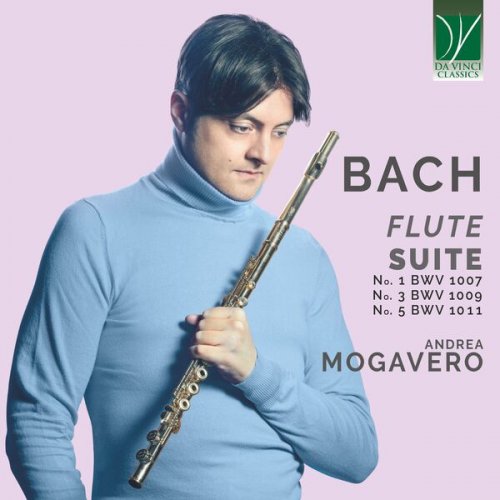
Artist: Andrea Mogavero
Title: Johann Sebastian Bach: Suites Nos. 1, 3 & 5 (Arranged for Flute)
Year Of Release: 2026
Label: Da Vinci Classics
Genre: Classical Flute
Quality: flac lossless (tracks)
Total Time: 00:59:01
Total Size: 302 mb
WebSite: Album Preview
TracklistTitle: Johann Sebastian Bach: Suites Nos. 1, 3 & 5 (Arranged for Flute)
Year Of Release: 2026
Label: Da Vinci Classics
Genre: Classical Flute
Quality: flac lossless (tracks)
Total Time: 00:59:01
Total Size: 302 mb
WebSite: Album Preview
01. Suite No. 1, BWV 1007: Prélude
02. Suite No. 1, BWV 1007: Allemande
03. Suite No. 1, BWV 1007: Courante
04. Suite No. 1, BWV 1007: Sarabande
05. Suite No. 1, BWV 1007: Menuet I & II
06. Suite No. 1, BWV 1007: Gigue
07. Suite No. 3, BWV 1009: Prélude
08. Suite No. 3, BWV 1009: Allemande
09. Suite No. 3 BWV 1009, BWV 1009: Courante
10. Suite No. 3 BWV 1009, BWV 1009: Sarabande
11. Suite No. 3 BWV 1009, BWV 1009: Bourrée I & II
12. Suite No. 3 BWV 1009, BWV 1009: Gigue
13. Suite No. 5, BWV 1011: Prélude
14. Suite No. 5, BWV 1011: Allemande
15. Suite No. 5, BWV 1011: Courante
16. Suite No. 5, BWV 1011: Sarabande
17. Suite No. 5, BWV 1011: Gavotte I & II
Few instrumental cycles possess, to the same degree as the Six Suites for solo cello, the force of a canon and the allure of an enigma. Belonging to the Cöthen period and transmitted without an autograph, through copies that have imposed upon performers a true philology of detail, they occupy a central place in the work of Johann Sebastian Bach and in the entire history of instrumental writing. In these pages the cello attains full poetic autonomy. Bach removes it from the sphere of the basso continuo and entrusts to it, at once, harmonic foundation, song and contrapuntal fabric. From this arises that distinctive implicit polyphony which constitutes one of the miracles of the collection: a single line generates space, depth, vertical tension, the memory of chords and even the illusion of several voices in dialogue. The model of the dance suite, inherited from the French tradition, is adopted with absolute lucidity and transformed into a large-scale construction, within which Prélude, Allemande, Courante, Sarabande, the pair of dances and Gigue cease to be juxtaposed episodes and assume the significance of an organic itinerary. The tradition of the sources also contributes to their aura. The copies by Anna Magdalena Bach and Johann Peter Kellner, with their divergences, have made these pages a permanent laboratory of interpretative responsibility, where every slur, every chord and every articulation invites reflection upon the relationship between notation and sound.
The history of reception has given these works an almost novelistic physiognomy. For a long time the Suites remained more present in pedagogical practice and in the memory of players than in concert life. Their full entry into the public repertory is bound to the name of Pablo Casals, whose action carried the weight of a refoundation. Since then their authority has grown without interruption, and with it the geography of transcriptions has widened. Music so intensely harmonic and so firmly constructed invited other instruments to measure themselves against it. The nineteenth century often felt the need to make explicit what Bach leaves implied, and the season of rewritings, from Schumann and Mendelssohn to Busoni, bears witness to a constant desire to interrogate these pages from new vantage points of listening. In the case of the flute, however, the transfer assumes a special significance, because it brings a writing born of the contact between bow and string into the realm of breath, articulation and continuity entrusted to the air column.
The introductory note to the printed edition from which this programme is drawn identifies the essential issue with admirable clarity. Bach himself offers an ideal premise for such a transfer. The Partita in A minor for solo flute shows, indeed, how his imagination could conceive for a wind instrument a writing of exceptional density, often stretched beyond ordinary respiratory conventions. Moreover, Suite No. 5 enjoyed a second life in the lute version BWV 995, an eloquent sign of the inner mobility of this repertory. The transcription for flute is therefore situated within a possibility inscribed in Bach’s own workshop. It demands a particular discipline. Breath shapes the phrase, determines the points of support, regulates the span of the imagined bow-strokes and establishes a hierarchy of accents. Dynamics, in such a context, call for measure and concentration. A restrained palette throws into relief the modulating design, the interplay of appoggiaturas, the weight of pedals and the quality of attack consonants. Even the rendering of double-stops becomes a matter of musical thought before it is one of technique. The transcription set out in the score pursues with consistency the preservation of the original rhythm and carefully distinguishes the harmonic value of the supporting notes from their ornamental function. The editorial note itself insists upon the didactic function of this perspective. In the indications of dynamics, slurs and breaths there emerges an ideal of sobriety that leads the performer back to the heart of the Bachian problem: to perceive the modulations, to grade the articulations, to sustain the continuity of the phrase and to give prominence to the pedals without stiffening the line. What emerges is a reading that regards transcription as an exegetical act, a form of interpretation of the writing.
Suite No. 1 in G major BWV 1007 opens the journey with an almost primordial self-evidence. Its Prélude belongs to that small number of pages in which apparent simplicity coincides with the highest compositional wisdom. The unfolding of the arpeggios, the insistent return of G as a resonant pivot, the gradual expansion of the harmonic field produce the impression of music arising from its own breath. On the cello this page also lives through the sounding matter of the open strings and their persistence; on the flute continuity is entrusted to a different form of mental legato, to the quality of emission and to the capacity to differentiate in timbre the pedal-note from the moving line. The edition itself suggests, at certain points, alternative fingerings designed to render that duality perceptible. The dances confirm the inaugurating character of the Suite. The Allemande unfolds an ordered and supple eloquence; the Courante introduces a more nervous mobility, always held within a profile of limpid elegance; the Sarabande concentrates the discourse in a gathered gravity; the two Menuets restore to the form its social and choreutic origin; the Gigue closes with lucid impetus and with a disciplined joy, wholly contained within Bachian measure. At this first stage the flute brings to light the transparency of the line and makes its architecture almost visible.
Suite No. 3 in C major BWV 1009 enlarges the gesture and projects it into a more open space. C major bestows upon it a luminous firmness, almost monumental. The Prélude announces this quality at once with a broad descending scale that seems to encompass the original instrument in its entirety, before establishing the long axis of G, the fulcrum of the central tension. Here continuity of motion is joined to a strong vertical awareness. The successions of semiquavers always preserve a vivid sense of harmonic direction and impart to the page an energetic nobility, austere and radiant. The Allemande retains a broad, composed and earthy gait; the Courante runs with tightly reined impetus; the Sarabande opens a space of more intense concentration; the two Bourrées graft upon the brightness of C major the shadowed relief of C minor, creating one of the most memorable contrasts in the whole group. The position of the Third Suite, at the centre of this programme, thus assumes a precise symbolic meaning. It represents the full expansion of the idea of the suite, the moment at which the equilibrium between dance, architecture and song reaches an almost classical fullness. Transferred to the flute, it demands a superior control of breath and a phrasing capable of making every pause felt as a formal event. When this necessity is governed with rigour, the page acquires an almost architectural clarity and offers to listening its solid internal framework.
With Suite No. 5 in C minor BWV 1011 the climate changes profoundly. Already in the original it is distinguished by the scordatura, which lowers the highest string and alters the system of resonances, colours and chordal dispositions. Its Prélude adopts the model of the French overture. The opening section, solemn and dotted, introduces an air of ceremonial gravity; the ensuing fugal episode densifies the discourse within a movement of intense concentration, where implicit polyphony attains an extraordinary clarity. The entire Suite stands beneath the sign of an introverted severity. The Allemande weighs every gesture with austere eloquence; the Courante channels energy into a harsher course; the Sarabande touches one of the spiritual summits of Bach’s art, entrusting to a bare and dolorous line the task of evoking on its own its harmonic foundation; the two Gavottes reintroduce a more earthly step without dissolving the prevailing shadow; the Gigue preserves in its dotted rhythm a French memory and an almost theatrical tension. On the flute the Fifth Suite requires a work of timbral interiorisation. The scordatura survives as a mental colour, as density of sound, as gravity of phrasing. The result can attain a rare force, because the disappearance of the materiality of the string accentuates the nakedness of the line and places its essential eloquence in the foreground.
Heard in this succession, the First, Third and Fifth Suites delineate an arc of striking clarity. The first affirms origin and confidence in motion, the third unfolds its luminous fullness, the fifth leads towards a more inward and meditative territory. The passage to the flute renders this itinerary especially legible. Bach’s writing appears here as harmony in act, conceived dance, virtual polyphony, formal energy transcending the sounding body for which it was born. Precisely here lies the deepest legitimacy of every successful transcription. It reveals the capacity of these pages to preserve identity and necessity through different timbres. In their new guise, the Suites continue to speak with unmistakable accent. Intact remains their great lesson, uniting discipline and imagination, constructive rigour and poetic breath. Intact remains, above all, that Bachian truth by which a single line, when conceived with absolute fullness, contains a world.

![Poor Isa - Poor Isa + Evan Parker/Ingar Zach (2025) [Hi-Res]](https://img.israbox.com/img/2026-08/26/wcem3e7mytczij5kharhfuhjs.jpg "Poor Isa - Poor Isa + Evan Parker/Ingar Zach (2025) [Hi-Res]")