Mario Hossen, Piero Barbareschi - Bach: Sonatas and Partitas I - with Piano Accompaniments by Robert Schumann (2026)
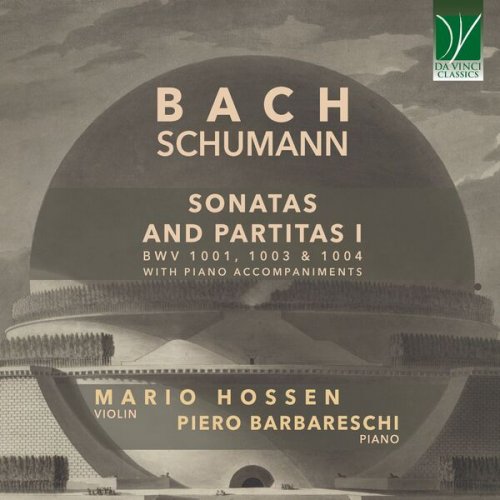
Artist: Mario Hossen, Piero Barbareschi
Title: Bach: Sonatas and Partitas I - with Piano Accompaniments by Robert Schumann
Year Of Release: 2026
Label: Da Vinci Classics
Genre: Classical
Quality: flac lossless (tracks)
Total Time: 00:59:57
Total Size: 281 mb
WebSite: Album Preview
TracklistTitle: Bach: Sonatas and Partitas I - with Piano Accompaniments by Robert Schumann
Year Of Release: 2026
Label: Da Vinci Classics
Genre: Classical
Quality: flac lossless (tracks)
Total Time: 00:59:57
Total Size: 281 mb
WebSite: Album Preview
01. Sonata No. 1 in G Minor, BWV 1001: I. Adagio
02. Sonata No. 1 in G Minor, BWV 1001: II. Fuga: Allegro
03. Sonata No. 1 in G Minor, BWV 1001: III. Siciliana
04. Sonata No. 1 in G Minor, BWV 1001: IV. Presto
05. Sonata No. 2 in A Minor, BWV 1003: I. Grave
06. Sonata No. 2 in A Minor, BWV 1003: II. Fuga
07. Sonata No. 2 in A Minor, BWV 1003: III. Andante
08. Sonata No. 2 in A Minor, BWV 1003: IV. Allegro
09. Partita No. 2 in D Minor, BWV 1004: No. 1, Allemanda
10. Partita No. 2 in D Minor, BWV 1004: No. 2, Corrente
11. Partita No. 2 in D Minor, BWV 1004: No. 3, Sarabanda
12. Partita No. 2 in D Minor, BWV 1004: No. 4, Giga
Within the vast archipelago of violin literature, few works have assumed, with the same force as the Sei Solo a Violino senza Basso accompagnato, the dual nature of monument and interrogation. In the autograph manuscript Bach presents them as a unitary book for solo violin, and precisely that declared absence of a bass constitutes the poetic fulcrum of the enterprise. Polyphony is recreated within the limits of a monodic instrument. The programme of this disc, devoted to Sonata no. 1 in G minor BWV 1001, Sonata no. 2 in A minor BWV 1003 and Partita no. 2 in D minor BWV 1004, concentrates listening within the most severe and introspective region of the cycle, since it places side by side two church sonatas and a partita, all in minor keys, ordered as an itinerary of increasing spiritual intensity. The presence of the piano accompaniments composed by Robert Schumann at the outset of his final creative period opens, upon this Bachian edifice, a further perspective, at once historical and aesthetic.
The radicality of these pages also springs from the profound knowledge that Bach possessed of the instrument. Eighteenth-century sources insist upon his stature as a violinist, and the entire cycle reveals a mastery uniting practical gesture and constructive imagination. Every broken chord, every double-stop, every arpeggiated succession is conceived in the service of a possible polyphony, never mechanical, always intimated as the memory of an inward counterpoint. A detail reported by Johann Friedrich Agricola acquires, in this context, particular significance. Bach is said often to have played these Soli at the keyboard, adding the quantity of harmony that he deemed necessary. Such testimony does not attenuate the absolute character of the solo violin. It confirms, rather, its virtual richness. Those lines already contain within themselves a conceived bass, an imagined support, a verticality ready to emerge. Schumann enters this long history with respect and awareness, like a late reader hearing in the text what the text itself preserves.
Schumann’s decision belongs fully to the great Bach revival of nineteenth-century Germany. After hearing Ferdinand David perform movements from Bach’s soli with accompaniment improvised or written by Mendelssohn, Schumann understood that those pages might also be reheard as a field for harmonic commentary. In the Düsseldorf months during which his imagination turned insistently towards fugues, masses, requiems and older forms, Bach occupied the centre of domestic musical life, and it was then that the accompaniments for the Sonatas and Partitas for violin were born and, shortly afterwards, those for the cello Suites. The edition was subsequently associated with the name of Joseph Joachim, the violinist who more than any other would restore Bach’s solo works to the concert stage in their original nakedness. Hence arises the specific fascination of these additions. They document a nineteenth-century manner of hearing Bach. Schumann leaves the violin part untouched and assigns to the piano the task of rendering audible what the violin merely suggests, the weight of the bass, the articulation of cadences, the breathing of the measure, the chiaroscuro of episodes. More than a completion, it is a historically situated reading.
Sonata no. 1 in G minor BWV 1001 sets forth, in almost exemplary form, the Bachian model of the church sonata, with its sequence slow, fast, slow, fast. The opening Adagio rises from a full and grave chord, as from a cornerstone. Around that nucleus the line unfolds in richly ornamented eloquence, poised between improvisation and architecture. The Fuga possesses memorable compactness. The subject is brief, lucid, incisive, and precisely that concision allows Bach to multiply its appearances with an almost miraculous sense of continuity. The Siciliana, placed in the relative major, introduces a pastoral tempo of supreme sweetness, in which the illusion of several voices becomes particularly subtle and the violin seems to recall the texture of a trio sonata. The concluding Presto finally releases a continuous energy, a race of semiquavers that at every moment preserves an implicit polyphonic articulation. Under Schumann’s hand this sonata acquires a second light. Its harmonic foundations emerge with greater relief, yet the prevailing impression remains that of an eloquent, thinking, sovereign solitude.
More ample and more dramatic is Sonata no. 2 in A minor BWV 1003. The opening Grave, dense with ornaments and declamatory tension, gathers listening into a sphere of austere concentration. The Fuga constitutes its centre of gravity. The subject, of the same extent as that of the first sonata yet far more irregular in profile, generates a construction of vast breath, traversed by leaps, chromatic descents and flowing sections that separate and at the same time connect the more properly fugal expositions. The Andante offers one of Bach’s highest proofs of inward cantabile. Above the bass of repeated notes the violin sings with absorbed stillness, as though meditation had at last discovered a point of equilibrium. The final Allegro, by contrast, introduces an almost concertante, almost theatrical element, with an Italianate virtuosity recalling the language of the concerto grosso and of its echoing responses. In such a context Schumann’s intervention proves particularly persuasive, since it furthers qualities already latent in the page, the contrast between song and foundation, the dialogic vocation of the finale, the force of a design that always looks beyond the merely violinistic surface.
With Partita no. 2 in D minor BWV 1004 the discourse changes nature and the territory of the suite opens out. Allemanda, Corrente, Sarabanda and Giga succeed one another as forms of a single recollected inwardness. The Allemanda proceeds with the measured tread of a danced meditation; the Corrente animates the rhythm through the interplay of triplets and dotted figures; the Sarabanda concentrates affective weight in a severe slowness and prolongs itself with a brief coda, a rare event in Bach; the Giga carries the gesture towards a more cutting mobility. Everything, however, converges in the Ciaccona, the fifth and final section, a summit that has generated an exegetical and transcriptive tradition almost without parallel. Bach constructs there an immense variation form upon a recurring harmonic design, articulated in broad regions of minor, major, and once again minor. The central section in D major opens a space of elevation that transforms the initial darkness from within, while the return of D minor leads listening back to a more earthly dimension, by now transfigured through the memory of that luminous passage. Brahms, writing to Clara Schumann, discerned in this page an entire world of profound thoughts and mighty passions enclosed upon a single stave. The formulation remains among the most exact ever devoted to the Ciaccona.
The arrangement chosen for the disc likewise possesses a powerful dramaturgical value. Sonata no. 1 affirms the principle of order, the possibility of deriving from a single instrument a complete edifice of prelude, fugue, song and final motion. Sonata no. 2 deepens that principle and drives it towards a region more dolorous, more expansive, more unstable. Partita no. 2 ultimately leads the dance form to the threshold at which it generates its own transfiguration. The four opening sections prepare the Ciaccona as a slow concentration of energies, and the entire programme assumes the profile of an ascent towards the concluding movement, which in European culture has become almost an emblem of musical memory itself. In this perspective Schumann intervenes neither as restorer nor as antagonist. His piano acts as a second consciousness of the text, a Romantic consciousness that senses, behind the violin line, a world of invisible supports and tacit harmonies.
In a programme such as this, Schumann’s piano thus acquires a value surpassing the simple category of accompaniment. It belongs to the history of Bach reception, to an age in which the modern idea of the inviolable text had not yet solidified and fidelity often passed through reinvention, editorial mediation and sonic commentary. At the same time, Bach’s authority prevents any intervention from imposing itself as a full rewriting. The result is a singular equilibrium. The violin continues to bear the entire responsibility of the discourse, while the piano illuminates its contours, historicises them, and places them within a Romantic sensibility seeking harmonic foundation and breadth of breath. The listener thus enters a double temporality. On the one hand, one encounters Bach in his vertiginous capacity to make a world arise from a single line. On the other, one observes Schumann listening to Bach and leaving behind the trace of that listening. Few programmes show with equal clarity that the history of interpretation is itself a form of composition. In these pages the solitude of the violin remains intact, yet it is enveloped in a harmonic penumbra belonging to the memory of the nineteenth century.
![Dario Carnovale, Alfred Kramer & Lorenzo Conte - I Remember You (2019) [SACD]](https://www.dibpic.com/uploads/posts/2019-07/1563390392_front_small.jpg "Dario Carnovale, Alfred Kramer & Lorenzo Conte - I Remember You (2019) [SACD]")
![Martin Fredebeul - Search (Remaster 2026) (2026) [Hi-Res]](https://www.dibpic.com/uploads/posts/2026-08/1787862913_obvwt58243vt1_600.jpg "Martin Fredebeul - Search (Remaster 2026) (2026) [Hi-Res]")