Arnold Rosé - Arnold Rosé (Remastered 2026) (2026) [Hi-Res]
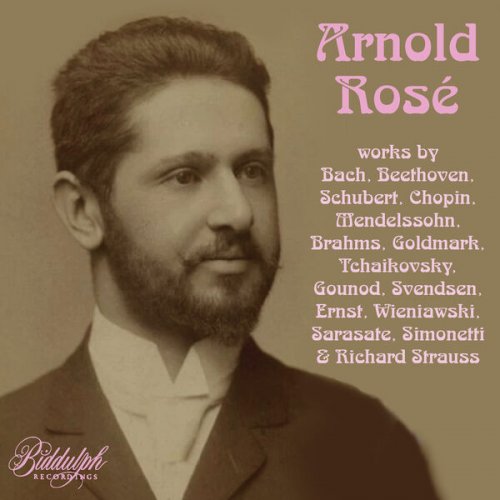
Artist: Arnold Rosé
Title: Arnold Rosé (Remastered 2026)
Year Of Release: 1902/2026
Label: Biddulph Recordings
Genre: Classical
Quality: flac lossless (tracks) / flac 24bits - 44.1kHz +Booklet
Total Time: 01:16:16
Total Size: 285 / 427 mb
WebSite: Album Preview
TracklistTitle: Arnold Rosé (Remastered 2026)
Year Of Release: 1902/2026
Label: Biddulph Recordings
Genre: Classical
Quality: flac lossless (tracks) / flac 24bits - 44.1kHz +Booklet
Total Time: 01:16:16
Total Size: 285 / 427 mb
WebSite: Album Preview
01. Air on the G string (arr. Wilhelmj)
02. Romance No.2 in F, op.50
03. Andante from Concerto in E minor, op.64
04. Nocturne, op.9 no.2 (arr. Wilhelmj)
05. Romance from Piano Concerto No.1 (arr. Wilhelmj)
06. Hungarian Dance No.5 in G minor (arr. Joachim)
07. Violin Concerto in A minor, op.28 - I Allegro moderato
08. Violin Concerto in A minor, op.28 - II Air: Andante
09. Romance in G, Op.26 (1st Recording)
10. Romance in G major, Op.26 (2nd Recording)
11. Fantasy on Rossini’s ‘Otello’, op.11 – part 1
12. Fantasy on Rossini’s ‘Otello’, op.11 – part 2
13. Polonaise brillante 1 in D, Op.4
14. Waltz from Gounod’s ‘Faust’, op.13
15. Zigeunerweisen, op.20 (1902)
16. Zigeunerweisen, op.20 (1909)
17. Spanish Dance No.8, op.26, no.2 (1902)
18. Spanish Dance No.8, op.26, no.2 (1909)
19. Nocturne, Op.32, No.1 (arr. Sauret)
20. Madrigale (arr. Saenger)
21. Scherzo from Quartet No.14 in D minor, 'Death and the Maiden'
22. Scherzo from Quartet No.1 in D major, op.11
23. Adagio from Violin Sonata No.1 in G minor
24. R. Strauss: Der Rosenkavalier - Ochs Walzer (arr. Taubmann)
Arnold Rosé was at the hub of musical life in Vienna for more than half a century – and it took the Anschluss of 1938 to shift him. His destiny was intimately bound up with the two most controversial men in Viennese music at the turn of the century, Gustav Mahler and Arnold Schoenberg; and he represented the final flourish of the 19th-century Viennese string style.
Rosé was appointed Concertmaster of the Vienna Philharmonic by Hans Richter in 1881 and took part in the premières of many staples of today’s repertoire. Rosé worked closely with such conductors as Richard Strauss, Arturo Toscanini, Franz Schalk, Felix Weingartner, Clemens Krauss, Hans Knappertsbusch and Wilhelm Furtwängler. Most significantly, Rosé performed under Gustav Mahler who was appointed Director in 1896 (Rosé became the brother-in-law of the composer/conductor in 1902).
Sir Adrian Boult simply declared Rosé to be ‘Europe’s greatest orchestral leader of his time’. In and remained in that distinguished post for 57 years until the Anschluss forced him to leave in 1938. As well as establishing the Rosé String Quartet, which was which was considered – not least by Brahms – a major advance on the quar-tet ensembles that had preceded it, Rosé was also a scintillating soloist in his prime. As the records made from 1900 to 1910 on this release testify, he had a fluid technique, pristine vibrato sparingly, and refined taste.
![JazzPreacher & Juhani Aaltonen - Sacred Movements: Poems Spiritual & Political (2026) [Hi-Res]](https://img.israbox.com/img/2026-10/18/786if7mln36tezqlh8fbn0lvk.jpg "JazzPreacher & Juhani Aaltonen - Sacred Movements: Poems Spiritual & Political (2026) [Hi-Res]")
![Matt Carmichael featuring Fergus McCreadie, Chris Amer and Ali Watson - Held in the Dark (2026) [Hi-Res]](https://img.israbox.com/img/2026-10/15/nrwyb4ofua4da8z5exbt0p4wn.jpg "Matt Carmichael featuring Fergus McCreadie, Chris Amer and Ali Watson - Held in the Dark (2026) [Hi-Res]")
![Roberto Negro - Pärt & Songs (2026) [Hi-Res]](https://img.israbox.com/img/2026-10/15/q18sovdxgmd2uzlo9hdft3d2e.jpg "Roberto Negro - Pärt & Songs (2026) [Hi-Res]")
![David Champagne - Come Before Winter (2026) [Hi-Res]](https://img.israbox.com/img/2026-10/15/m2fyz4ydrktx40yl47863sgw9.jpg "David Champagne - Come Before Winter (2026) [Hi-Res]")

![Fiona Monbet, Ensemble Miroirs Etendus - Chassol-Reich (2026) [Hi-Res]](https://img.israbox.com/img/2026-10/15/yn170ls98q0ovxmny9lx5uw6l.jpg "Fiona Monbet, Ensemble Miroirs Etendus - Chassol-Reich (2026) [Hi-Res]")