Duo Eleriya - Glière & Rachmaninov (2026) [Hi-Res]
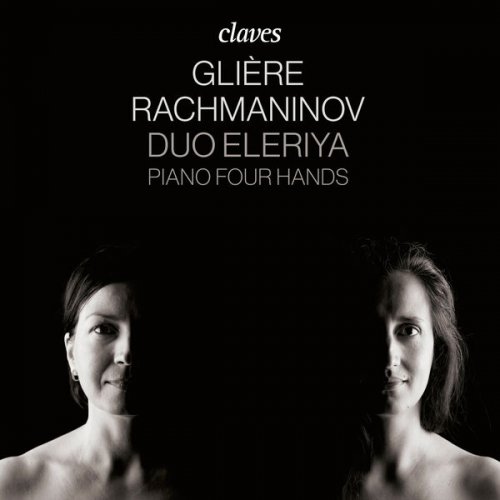
Artist: Duo Eleriya
Title: Glière & Rachmaninov
Year Of Release: 2026
Label: Claves Records
Genre: Classical Piano
Quality: flac lossless (tracks) / flac 24bits - 96.0kHz
Total Time: 00:45:24
Total Size: 174 / 757 mb
WebSite: Album Preview
TracklistTitle: Glière & Rachmaninov
Year Of Release: 2026
Label: Claves Records
Genre: Classical Piano
Quality: flac lossless (tracks) / flac 24bits - 96.0kHz
Total Time: 00:45:24
Total Size: 174 / 757 mb
WebSite: Album Preview
01. 12 Morceaux, Op. 48: I. Prelude
02. 12 Morceaux, Op. 48: II. Valse
03. 12 Morceaux, Op. 48: III. Esquisse
04. 12 Morceaux, Op. 48: IV. Plainte
05. 12 Morceaux, Op. 48: V. Etude
06. 12 Morceaux, Op. 48: VI. Chanson Bergère
07. 12 Morceaux, Op. 48: VII. Arabesque
08. 12 Morceaux, Op. 48: VIII. En Rêve
09. 12 Morceaux, Op. 48: IX. Mazurka
10. 12 Morceaux, Op. 48: X. Fughetta
11. 12 Morceaux, Op. 48: XI. Scherzo
12. 12 Morceaux, Op. 48: XII. Orientale
13. 6 Pièces, Op. 11: I. Barcarolle
14. 6 Pièces, Op. 11: II. Scherzo
15. 6 Pièces, Op. 11: III. Thème Russe
16. 6 Pièces, Op. 11: IV. Waltz (Valse)
17. 6 Pièces, Op. 11: V. Romance
18. 6 Pièces, Op. 11: VI. Slava (Glory)
This program brings together two cycles for piano four hands from the Russian tradition of the late nineteenth and early twentieth centuries: the Six Pieces, Op. 11 by Sergueï Rachmaninov (1873–1943) and the Twelve Pieces, Op. 48 by Reinhold Glière (1875– 1956). The release of this CD also coincides with the 70th anniversary of Reinhold Glière’s death and provides an opportunity to present, for the first time in its entirety, this deeply poetic cycle.
Composed in 1909, Reinhold Glière’s Twelve Pieces, Op. 48 belongs to a period of full artistic maturity. At the age of 34, the composer had developed a musical language deeply rooted in the Romantic heritage, favoring clarity of form and balanced pianistic writing. Respected throughout his career under both the Tsarist and Soviet regimes, Glière occupies a singular place in Russian musical history, remaining faithful to a traditional aesthetic during a time of profound artistic transformation.
This cycle for piano four hands consists of twelve pieces of varied character, alternating dances, lyrical pages, and folk-inspired evocations. The writing is often lucid, at times close in spirit to pedagogical repertoire, yet always refined. The dialogue between the two pianists plays a central role, although the balance between primo and secondo remains flexible, allowing for subtle interplay of textures and colors. Despite its qualities, this opus has never before been recorded in its entirety.
Written in 1894, when Sergueï Rachmaninov was only 21 years old, the Six Pieces, Op. 11 already reveal a strongly defined musical personality. The cycle displays a keen sense of lyricism, remarkable harmonic richness, and pianistic writing of great breadth. Here, the piano four hands medium is conceived as a true orchestral space, unfolding a dense and highly contrasted sonic palette.
Each piece asserts its own distinctive character: from the dreamlike fluidity of the Barcarolle to the virtuosic brilliance of Slava, passing through more introspective or dance-like pages. The writing, often generous and expansive, stands out for its bold modulations, expressive intensity, and virtuosity that transcends mere technical display to attain genuine emotional depth.
Having been trained within the same musical environment, notably under Sergueï Taneïev and Anton Arenski, Glière and Rachmaninov shared a profound attachment to the Russian Romantic tradition: the primacy of melody, tonal grounding, and a taste for atmospheres inspired by folklore. Both composers explore the possibilities of piano four hands with remarkable inventiveness, drawing on rich textures, dialogic effects, and rhythmic layering.
Yet their aesthetics remain markedly distinct. Where Rachmaninov develops a passionate, at times dramatic style with an almost orchestral density, Glière favors a more measured expression characterized by clarity, balance, and a certain poetic restraint. One explores the tensions and surges of late Romanticism in all their intensity; the other offers a more serene interpretation, faithful to forms inherited from tradition.
The meeting of these two cycles thus highlights two complementary faces of a shared heritage. Rachmaninov’s ardor and expressive depth are answered by Glière’s elegance and transparency. Within this dialogue, Op. 48 emerges as an intimate and delicate space, while Op. 11 unfolds a more expansive and contrasted energy.
This pairing sheds light not only on the aesthetic affinities of two composers shaped by the same school, but also on the singularity of their respective voices. By restoring the Op. 48 cycle of Glière—rarely heard in its entirety—to its rightful place, this recording contributes to a deeper appreciation of a still little-known repertoire alongside one of the major works of the Russian piano four hands tradition.

![Big Mama Society - Big Mama Society (2026) [Hi-Res]](https://www.dibpic.com/uploads/posts/2026-10/1792306731_hbmi0wrusz4bj_600.jpg "Big Mama Society - Big Mama Society (2026) [Hi-Res]")
![David Axelrod - David Axelrod (2001) [Hi-Res]](https://img.israbox.com/img/2026-10/15/l5bioy69wqdeaqkxyz9gkf0fq.jpg "David Axelrod - David Axelrod (2001) [Hi-Res]")
![Eugene Ball - Continuum: Jazztrack at 50 (2026) [Hi-Res]](https://img.israbox.com/img/2026-10/16/x1psx57x1jaqhedf60ox2u5ce.jpg "Eugene Ball - Continuum: Jazztrack at 50 (2026) [Hi-Res]")
![Gabriel Palatchi - Give Me the Beat (2026) [Hi-Res]](https://img.israbox.com/img/2026-10/18/606eq9qel1z8irs9yv6q7g5l5.jpg "Gabriel Palatchi - Give Me the Beat (2026) [Hi-Res]")