Trio Diaghilev - Béla Bartók: The Miracolous Mandarin, Sonata for Two Pianos and Percussion (2020)
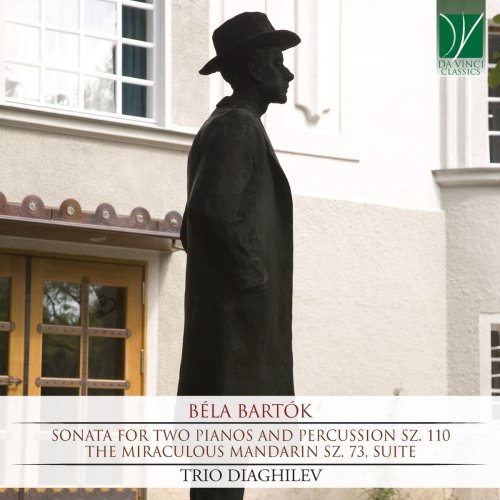
Artist: Trio Diaghilev
Title: Béla Bartók: The Miracolous Mandarin, Sonata for Two Pianos and Percussion
Year Of Release: 2020
Label: Da Vinci Classics
Genre: Classical
Quality: FLAC (tracks)
Total Time: 43:27 min
Total Size: 137 MB
WebSite: Album Preview
Title: Béla Bartók: The Miracolous Mandarin, Sonata for Two Pianos and Percussion
Year Of Release: 2020
Label: Da Vinci Classics
Genre: Classical
Quality: FLAC (tracks)
Total Time: 43:27 min
Total Size: 137 MB
WebSite: Album Preview
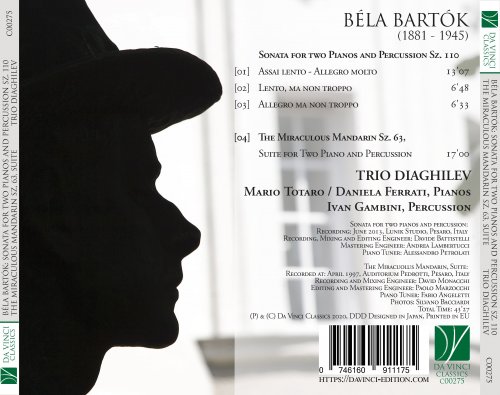
Tracklist:
01. Sonata for Two Pianos and Percussion, Sz.110: I. Assai lento - Allegro molto
02. Sonata for Two Pianos and Percussion, Sz.110: II. Lento, ma non troppo
03. Sonata for Two Pianos and Percussion, Sz.110: III. Allegro non troppo
04. The Miraculous Mandarin, Op. 19, Sz. 73
Great polemics and harsh tumults marked the first representation of “Der Wunderbare Mandarin”, which occurred in 1925 at Cologne. This work, composed in 1918/19, has been often compared with the “Rite of Spring” because of its piercing expressiveness, even though the relationship between the two ballets is quite superficial. The Mandarin, indeed, shows the influence which the German expressionism and the “Neuer Wiener Schule” exerted on Bartók. The scandalous subject stopped the integral performance of the work for seventeen years. The story: three bandits obliged a young woman to allure the passers-by for robbing them. Among these is a Chinese mandarin who looks dreadful: the woman is forced to seduce him, till stirring him up an uncontrollable passion. At that moment the three delinquents intervened. After having robbed the mandarin, they tried to kill him, at first suffocating him, then running him through with a sword, and finally hanging him from a hook. But all their efforts are ineffective: the mandarin could only die, when the woman would decide to give him herself, satisfying his desire. The extreme violence of the images and the crude and explicit eroticism seemed absolutely intolerable to the spectator of this period. Bartók inwardly lives the great crisis of musical language at the beginning of 1900 with an exemplary awareness, looking desperately for new expressive resolutions. Disquieting, exasperated, haunted sounds arise from such a feverish search: these sounds are so radical in regard to their experimentalism and originality and at the same time so expressive, involving and effective to describe minutely every gesture, every psychological nuance of the drama. Thanks also to its great rhythmic vitality, the Mandarin today is one of the most famous and appreciated works of the great Hungarian Maestro.
Notes by Mario Totaro
Notes by Mario Totaro






![Adam Rose, Mountain Jazz Quartet - Holler Serenade (2026) [Hi-Res]](https://www.dibpic.com/uploads/posts/2026-08/1787640003_g047p1rsxuc8r_600.jpg "Adam Rose, Mountain Jazz Quartet - Holler Serenade (2026) [Hi-Res]")