Rudolf Koelman, Sinfonietta Schaffhausen & Paul K. Haug - Violin Concertos (2023) [Hi-Res]
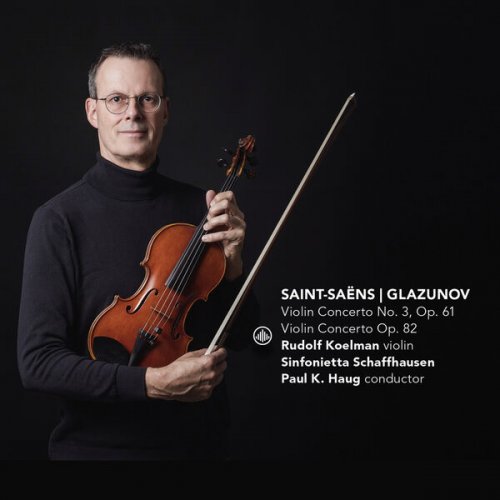
Artist: Rudolf Koelman, Sinfonietta Schaffhausen, Paul K. Haug
Title: Violin Concertos
Year Of Release: 2023
Label: Challenge Classics
Genre: Classical
Quality: FLAC (tracks) / 24bit-96kHz FLAC (tracks)
Total Time: 45:48
Total Size: 204 / 812 MB
WebSite: Album Preview
Tracklist:Title: Violin Concertos
Year Of Release: 2023
Label: Challenge Classics
Genre: Classical
Quality: FLAC (tracks) / 24bit-96kHz FLAC (tracks)
Total Time: 45:48
Total Size: 204 / 812 MB
WebSite: Album Preview
1. Violin Concerto No. 3 in B Minor, Op. 61: I. Allegro non troppo (8:33)
2. Violin Concerto No. 3 in B Minor, Op. 61: II. Andantino quasi Allegretto (7:34)
3. Violin Concerto No. 3 in B Minor, Op. 61: III. Molto moderato e maestoso - Allegro non troppo (11:00)
4. Violin Concerto in A Minor, Op. 82: I. Moderato (3:52)
5. Violin Concerto in A Minor, Op. 82: II. Andante (6:52)
6. Violin Concerto in A Minor, Op. 82: III. Cadenza (2:03)
7. Violin Concerto in A Minor, Op. 82: IV. Animando - Allegro (5:59)
These two splendid violin concertos breathe the air of Late Romanticism. Well orchestrated and skilfully written for the soloist, they have retained their footholds in the repertoire, even though their respective composers have gone out of fashion. Camille Saint-Saëns’ Third Violin Concerto in B minor had the absolute certainty and conviction of a masterpiece. Saint-Saëns wrote it early in 1880 for the popular Spanish virtuoso Pablo de Sarasate.
Although Alexander Glazunov (1865-1936) was a pupil and lifelong friend of Nikolai Rimsky-Korsakov, he can be seen as heir to Tchaikovsky’s Romantic, heart-on-sleeve approach to composition.
The A minor Violin Concerto of 1904 is perhaps Glazunov’s most striking work, in fact the sole criticism one might make is that it takes only 20 minutes to play, which means it fits awkwardly into today’s stereotyped classical concert programmes. Like the Saint-Saëns B minor, it was written for a great fiddler, in this case the Hungarian Leopold Auer who was the leading player on the Russian scene.
Rudolf Koelman’s teacher Jascha Heifetz learnt the Concerto directly from Auer. At the St Petersburg Conservatory on 18 January 1914 Heifetz and Glazunov got together to present the Concerto; and the story goes that the almost-13-year-old’s fee was a bicycle.
Heifetz told Rudolf Koelman that he would have liked to record the Saint-Saëns B minor as well, but somehow it did not happen.
Rudolf Koelman, violin
Sinfonietta Schaffhausen
Paul K. Haug, conductor
Although Alexander Glazunov (1865-1936) was a pupil and lifelong friend of Nikolai Rimsky-Korsakov, he can be seen as heir to Tchaikovsky’s Romantic, heart-on-sleeve approach to composition.
The A minor Violin Concerto of 1904 is perhaps Glazunov’s most striking work, in fact the sole criticism one might make is that it takes only 20 minutes to play, which means it fits awkwardly into today’s stereotyped classical concert programmes. Like the Saint-Saëns B minor, it was written for a great fiddler, in this case the Hungarian Leopold Auer who was the leading player on the Russian scene.
Rudolf Koelman’s teacher Jascha Heifetz learnt the Concerto directly from Auer. At the St Petersburg Conservatory on 18 January 1914 Heifetz and Glazunov got together to present the Concerto; and the story goes that the almost-13-year-old’s fee was a bicycle.
Heifetz told Rudolf Koelman that he would have liked to record the Saint-Saëns B minor as well, but somehow it did not happen.
Rudolf Koelman, violin
Sinfonietta Schaffhausen
Paul K. Haug, conductor
![NAAMU - TAMAZGHA (2026) [Hi-Res]](https://img.israbox.com/img/2026-10/08/4721xwplvgxydjf82dm6ozifn.jpg "NAAMU - TAMAZGHA (2026) [Hi-Res]")
![Solveig Slettahjell - Det er vi (2026) [Hi-Res]](https://img.israbox.com/img/2026-10/09/xmqre7a7s0ijly51stls4qrnk.jpg "Solveig Slettahjell - Det er vi (2026) [Hi-Res]")
![Mirna Bogdanović - Glimmerence (2026) [Hi-Res]](https://img.israbox.com/img/2026-10/09/9eo9iyrdand68wdfbao7fecp6.jpg "Mirna Bogdanović - Glimmerence (2026) [Hi-Res]")
![Tyler Henderson - The Long Game (2026) [Hi-Res]](https://www.dibpic.com/uploads/posts/2026-10/1791389805_1.jpg "Tyler Henderson - The Long Game (2026) [Hi-Res]")