Carlo Mazzone - Vierne: 24 Pièces en style libre, Op. 31 (2026) [Hi-Res]
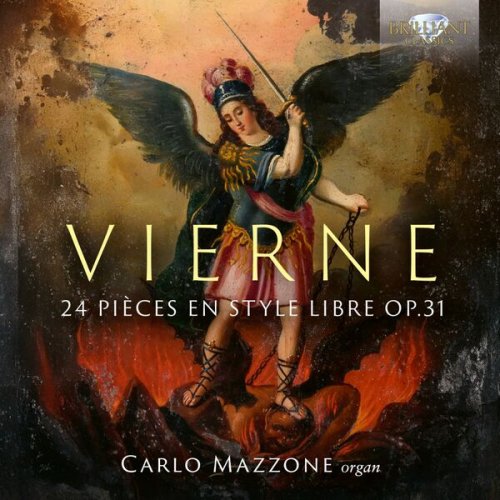
Artist: Carlo Mazzone
Title: Vierne: 24 Pièces en style libre, Op. 31
Year Of Release: 2026
Label: Brilliant Classics
Genre: Classical Organ
Quality: flac lossless (tracks) / flac 24bits - 96.0kHz
Total Time: 01:44:50
Total Size: 380 mb / 1.58 gb
WebSite: Album Preview
TracklistTitle: Vierne: 24 Pièces en style libre, Op. 31
Year Of Release: 2026
Label: Brilliant Classics
Genre: Classical Organ
Quality: flac lossless (tracks) / flac 24bits - 96.0kHz
Total Time: 01:44:50
Total Size: 380 mb / 1.58 gb
WebSite: Album Preview
01. 24 Pièces en style libre, Op. 31, livre I: I. Préambule
02. 24 Pièces en style libre, Op. 31, livre I: II. Cortège
03. 24 Pièces en style libre, Op. 31, livre I: III. Complainte
04. 24 Pièces en style libre, Op. 31, livre I: IV. Épitaphe
05. 24 Pièces en style libre, Op. 31, livre I: V. Prélude
06. 24 Pièces en style libre, Op. 31, livre I: Vi. Canon
07. 24 Pièces en style libre, Op. 31, livre I: VII. Méditation
08. 24 Pièces en style libre, Op. 31, livre I: VIII. Idylle mélancolique
09. 24 Pièces en style libre, Op. 31, livre I: IX. Madrigal
10. 24 Pièces en style libre, Op. 31, livre I: X. Rêverie
11. 24 Pièces en style libre, Op. 31, livre I: XI. Divertissement
12. 24 Pièces en style libre, Op. 31, livre I: XII. Canzona
13. 24 Pièces en style libre, Op. 31, livre II: I. Légende
14. 24 Pièces en style libre, Op. 31, livre II: II. Scherzetto
15. 24 Pièces en style libre, Op. 31, livre II: III. Arabesque
16. 24 Pièces en style libre, Op. 31, livre II: IV. Choral
17. 24 Pièces en style libre, Op. 31, livre II: V. Lied
18. 24 Pièces en style libre, Op. 31, livre II: Vi. Marche funèbre
19. 24 Pièces en style libre, Op. 31, livre II: VII. Berceuse
20. 24 Pièces en style libre, Op. 31, livre II: VIII. Pastorale
21. 24 Pièces en style libre, Op. 31, livre II: IX. Carillon
22. 24 Pièces en style libre, Op. 31, livre II: X. Élégie
23. 24 Pièces en style libre, Op. 31, livre II: XI. Épithalame
24. 24 Pièces en style libre, Op. 31, livre II: XII. Postlude
The name of Louis Vierne (1870-1937) will be associated with organ music immediately. Like a few other 19th century organists/composers he used the instrument as a means to perform ‘symphonic’ music. The scope in this respect was greatly enhanced by the new organs built at the time, for instance by Aristide Cavaillé-Coll.
The blend of styles in this music for organ is unique. It contains aspects of Romanticism combined with an impressionistic ‘pastel-like’ quality. Like many of his contemporary colleagues Vierne felt a strong fascination with Wagnerian chromaticism.
An admirer and pupil of César Franck at thirty, the virtually blind Vierne was appointed organist at the Paris Notre Dame. Among many other pieces for organ he wrote six (five movement) symphonies, which became standard organ repertoire. Franck inspired him in the use of cyclical elements and harmonic refinement, whereas Widor’s influence is clear in the use of the organ and the classical forms.
Louis Vierne’s 24 Pièces en style libre Op.31 (1913), is a landmark collection in the French organ repertoire. Written for either organ or harmonium, these pieces demonstrate Vierne’s gift for expressive lyricism and refined harmonic color. Unlike his larger symphonic works, the Pièces en style libre are concise, intimate, and accessible, designed for both liturgical use and concert performance. Each piece explores a distinct mood or character, from serene meditations like “Communion” and “Élévation” to more animated works such as “Cortège” and “Postlude.” Vierne’s rich harmonic language, rooted in late Romanticism yet tinged with Impressionist nuance, reveals his deep sensitivity to tonal atmosphere.
Played by Carlo Mazzone on the magnificent 1999 Andrea Zeni organ of the Parish Church of San Michele Arcangelo, Salgarede (TV), Italy. This instrument aimed to create a fully suited instrument for the performance of the organ repertoire of the second half of the 19th century in France. It is inspired by late-Romantic aesthetics, and endowed with all the stylistic and sonic prerequisites essential to the organ literature of the period.
![Mitsuru Araya - Natura' Rhythm (2004) [2007 SACD]](https://www.dibpic.com/uploads/posts/2026-07/1784442640_folder.jpg "Mitsuru Araya - Natura' Rhythm (2004) [2007 SACD]")
![Kemuel Roig - 3discovery, Vol. 1 (2026) [Hi-Res]](https://img.israbox.com/img/2026-07/18/g8yh5k83k7bl618jhfp4mnu6s.jpg "Kemuel Roig - 3discovery, Vol. 1 (2026) [Hi-Res]")
![Jean-Baptiste Rousseaux - Kaveriot Korridor (2026) [Hi-Res]](https://www.dibpic.com/uploads/posts/2026-07/1784717051_g51adctrfhr29_600.jpg "Jean-Baptiste Rousseaux - Kaveriot Korridor (2026) [Hi-Res]")