Myra Melford & Satoko Fujii - かたらひ = Katarahi (2026)
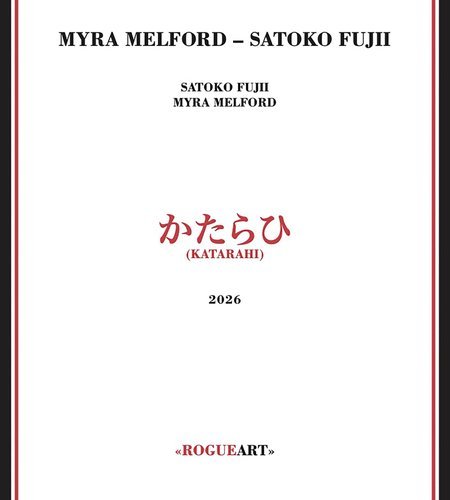
Artist: Myra Melford, Satoko Fujii - Katarahi
Title: かたらひ = Katarahi
Year Of Release: 2026
Label: RogueArt
Genre: Jazz
Quality: FLAC (tracks+.cue,log,scans)
Total Time: 00:51:38
Total Size: 220 mb
WebSite: Album Preview
Tracklist:Title: かたらひ = Katarahi
Year Of Release: 2026
Label: RogueArt
Genre: Jazz
Quality: FLAC (tracks+.cue,log,scans)
Total Time: 00:51:38
Total Size: 220 mb
WebSite: Album Preview
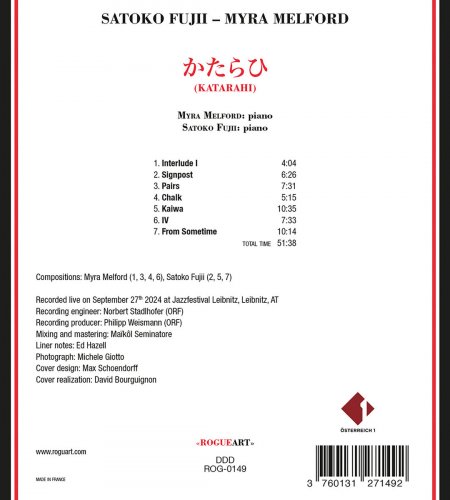
01. Interlude I (Melford) - 4:04
02. Signpost (Fujii) - 6:26
03. Pairs (Melford) - 7:31
04. Chalk (Melford) - 5:15
05. Kaiwa (Fujii) - 10:35
06. IV (Melford) - 7:33
07. From Sometime (Fujii) - 10:14
Myra Melford, Satoko Fujii - piano
Recorded live at Jazzfestival Leibnitz, Leibnitz, AT on September 27, 2024.
Review by Doug Collette
The connection(s) between pianist-composers Satoko Fujii and Myra Melford transcend the usual truisms. Not kindred spirits in creativity or even mirror images in technique, the pair are more like twin sisters of different artistic mothers, distinctly their own individuals in style yet complementary as such in almost ineffable ways. Hence this album title, a Japanese term referring to a heart-to-heart conversation between intimate friends, fittingly suggests a deep, meaningful dialogue.
Katarahi is the duo's second collaboration, but as noted by discerning essayist Ed Hazell, it has been two decades since the performance captured on Under The Water (Libra, 2009). Unlike the wholly improvised predecessor, the second enterprise consists of the two playing each other's original compositions, having mutually agreed designated material furthers the instrumental vocabulary they can bring into play.
"Interlude I" thus acts as a gateway into this slightly more than 51 minutes from a September 2024 performance at Jazzfestival Liebnitz, Austria. As recorded by Norbert Stadlhofer, then mixed and mastered by Maikol Seminatore, the music ebbs and flows from ghostly rounds of notes to ringing lines, then back again, during which developments none touch in overlay (much less collide). Approaching each extremely cautiously, Fujii and Melford consciously or unconsciously reveal the magnificent potential of the piano as a musical instrument; in so doing, they stipulate its attraction to such great minds as theirs to devote a life's work to its exploration.
Perhaps that is why a piece of Fujii's titled "Signpost" shows up early in the song sequence. Or, more appropriately, why temperance and patience earmarks both musicians' approach throughout: on "Pairs," rumbles from deep within echo around strings plucked and tweaked amidst emphatic strikes to the keys. And the track immediately following, "Chalk," reiterates the reality these two are utilizing a percussion device, as the roiling swirls of impacted notes span the dynamic register.
The slow motion conclusion of that piece suggests the instinctual pacing Fujii and Melford apply during Katarahi. The selection to follow, "Kaiwa," is the longest of the seven at 10 minutes, 35 seconds, its placement ratifying that the pair are all warmed up and ready for some rollicking fun. Indeed, there is a palpable joy emanating from this dual action proceeding up and down the ivories before more contemplative interludes commence.
Here is where the dialogue redefines the vaunted trope about telepathy between like-minded musicians deep in the midst of performance, particularly when it is occurring on the stage. The rise and fall in intensity there turns into a microcosm of this entire program as it enters the homestretch via "IV"; repetition such as this has its purpose, arising only from elliptical afterthoughts to exchanges seconds prior. In this nuanced approach, Fujii and Melford are, in effect, tying together the loose ends from the otherwise densely embroidered threads they have sewn together to this point.
It is a supreme statement of the logic inherent in this collaboration, thus rendering "From Sometime" an objective observation on the chemistry these musicians have just demonstrated so fully. The exultation Fujii and Melford display in the rousing finish compels the audience to respond in kind and rightly so.
The connection(s) between pianist-composers Satoko Fujii and Myra Melford transcend the usual truisms. Not kindred spirits in creativity or even mirror images in technique, the pair are more like twin sisters of different artistic mothers, distinctly their own individuals in style yet complementary as such in almost ineffable ways. Hence this album title, a Japanese term referring to a heart-to-heart conversation between intimate friends, fittingly suggests a deep, meaningful dialogue.
Katarahi is the duo's second collaboration, but as noted by discerning essayist Ed Hazell, it has been two decades since the performance captured on Under The Water (Libra, 2009). Unlike the wholly improvised predecessor, the second enterprise consists of the two playing each other's original compositions, having mutually agreed designated material furthers the instrumental vocabulary they can bring into play.
"Interlude I" thus acts as a gateway into this slightly more than 51 minutes from a September 2024 performance at Jazzfestival Liebnitz, Austria. As recorded by Norbert Stadlhofer, then mixed and mastered by Maikol Seminatore, the music ebbs and flows from ghostly rounds of notes to ringing lines, then back again, during which developments none touch in overlay (much less collide). Approaching each extremely cautiously, Fujii and Melford consciously or unconsciously reveal the magnificent potential of the piano as a musical instrument; in so doing, they stipulate its attraction to such great minds as theirs to devote a life's work to its exploration.
Perhaps that is why a piece of Fujii's titled "Signpost" shows up early in the song sequence. Or, more appropriately, why temperance and patience earmarks both musicians' approach throughout: on "Pairs," rumbles from deep within echo around strings plucked and tweaked amidst emphatic strikes to the keys. And the track immediately following, "Chalk," reiterates the reality these two are utilizing a percussion device, as the roiling swirls of impacted notes span the dynamic register.
The slow motion conclusion of that piece suggests the instinctual pacing Fujii and Melford apply during Katarahi. The selection to follow, "Kaiwa," is the longest of the seven at 10 minutes, 35 seconds, its placement ratifying that the pair are all warmed up and ready for some rollicking fun. Indeed, there is a palpable joy emanating from this dual action proceeding up and down the ivories before more contemplative interludes commence.
Here is where the dialogue redefines the vaunted trope about telepathy between like-minded musicians deep in the midst of performance, particularly when it is occurring on the stage. The rise and fall in intensity there turns into a microcosm of this entire program as it enters the homestretch via "IV"; repetition such as this has its purpose, arising only from elliptical afterthoughts to exchanges seconds prior. In this nuanced approach, Fujii and Melford are, in effect, tying together the loose ends from the otherwise densely embroidered threads they have sewn together to this point.
It is a supreme statement of the logic inherent in this collaboration, thus rendering "From Sometime" an objective observation on the chemistry these musicians have just demonstrated so fully. The exultation Fujii and Melford display in the rousing finish compels the audience to respond in kind and rightly so.
![Patrones - Patrones (2026) [Hi-Res]](https://img.israbox.com/img/2026-10/10/yagqh782ulmz3fc3wrcpx6mpz.jpg "Patrones - Patrones (2026) [Hi-Res]")


![Karate Boogaloo - Access All Areas (2026) [Hi-Res]](https://www.dibpic.com/uploads/posts/2026-10/1791384435_1.jpg "Karate Boogaloo - Access All Areas (2026) [Hi-Res]")
![Talaqpo - LIVE Akropo (2026) [Hi-Res]](https://www.dibpic.com/uploads/posts/2026-10/1791635047_cover.jpg "Talaqpo - LIVE Akropo (2026) [Hi-Res]")