Dan Barrett & Dominique Lemaitre - La cétoine qui dort dans le cœur de la rose: Solo & Chamber Works for/with Cello (2026) Hi-Res
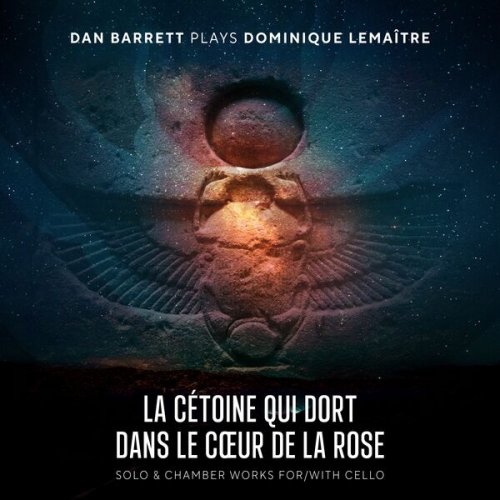
Artist: Dan Barrett, Dominique Lemaitre
Title: La cétoine qui dort dans le cœur de la rose: Solo & Chamber Works for/with Cello
Year Of Release: 2026
Label: New Focus Recordings
Genre: Classical
Quality: FLAC (tracks) / FLAC 24 Bit (44,1 KHz / tracks)
Total Time: 50:05 min
Total Size: 164 / 411 MB
WebSite: Album Preview
Tracklist:Title: La cétoine qui dort dans le cœur de la rose: Solo & Chamber Works for/with Cello
Year Of Release: 2026
Label: New Focus Recordings
Genre: Classical
Quality: FLAC (tracks) / FLAC 24 Bit (44,1 KHz / tracks)
Total Time: 50:05 min
Total Size: 164 / 411 MB
WebSite: Album Preview
01. Instants d’espace
02. Imago
03. Helix
04. Et le soleil comme désir
05. Presque bleu
Cellist Dan Barrett releases his second recording with New Focus celebrating the lush and lyrical chamber music of French composer Dominique Lemaître. Lemaître's compositions are temporally expansive, grounded in spectral approaches to harmony, and inspired by diverse phenomenon, from synesthesia to Greek mythology.
Cellist Dan Barrett curates his second recording on New Focus of the music of French composer Dominique Lemaître, La cétoine qui dort dans le cœur de la rose. These thoughtful works take inspiration from various sources, including natural processes, mythological concepts, sensations, and perceptions of time. Lemaître’s music strikes a powerful balance — it is atmospheric and ethereal, but remains focused and cohesive. He achieves this through his disciplined treatment of compositional material, reaching broadly for liberated gestures but always retaining a strong link to the initial seed from which he is building his compositions. Barrett is joined by clarinetist Michiyo Suzuki, pianist Taka Kigawa, violinist Suliman Tekalli, pianist Jed Distler, and violinist/violist Nikita Yermak. Barrett and his colleagues approach Lemaître’s works, all but one written in the 2020s, with sensitivity, channeling their expansive gravitas in deeply felt performances.
Instants d’espace (2024) for solo cello opens the program with poignant intimacy, carving out a spatial footprint for the work through fine gradations of dynamics within elegiac lines. Lemaître establishes an internal dialogue between implied voices of the cello, spinning out fluid phrases and oblique, echoed responses. Earthy, pathos laden sustains are interrupted by gruff passages of moving notes. Throughout contrasting material, Instants d’espace explores the listener’s perception of time in a free, rhapsodic context.
The title Imago is taken from the term referring to an adult form of an insect that undergoes metamorphosis. Lemaître’s 2022 work for clarinet, cello, and piano encapsulates this emergent, completed stage of being; the piece expresses a state of arrival after ultimate transformation. Watery, fluid voicings and arpeggiations in the piano support swelled sustains in the clarinet and cello, while ascending arpeggios in the melodic instruments are punctuated by mechanical high register figures on the keyboard. Formally, Imago functions a bit like an extended klangfarben melody, articulating static harmonies and expanding and contracting them through subtle orchestral adjustments rather than harmonic movement.
Helix (2021) for viola and cello explores the word’s Greek origins, meaning “spiral.” Lemaître particularly focuses on the spiral’s unique path of evolution, as it ascends while it circles in a cyclical fashion. As such, imitation is at the heart of the interaction between the two instruments in this work, but it is imitation with growth, extending and developing the material as it spirals back upon itself. A pointed pizzicato section after the five minute mark pauses the work’s forward/upward movement, suspending it temporarily in a brief, hypnotic loop. Lemaître closes the work with wave-like swells that flow gracefully between the two instruments, a metaphor for the ebb and flow of symbiotic evolution.
Et le soleil comme désir (2007) for violin, cello, and piano anchors itself on two alternating pitches from its opening, A and Bflat. Through glimmering trills, pointillistic accents, chordal splashes, and melodic emphasis, Lemaître extrapolates on the drama inherent in the relationship between these two pitches through variants in orchestration and musical ideas. He has an uncanny sense for building tension, even with the most elemental of gestures like an ascending or descending scale or an oscillating 1/2 step figure. Throughout the piece, the trio is treated as an amoeba like composite organism, with gestural material seeping out in all directions.
Presque bleu (2024) for string trio closes the recording with an invocation of the phenomenon of synesthesia, the perception of music through the prism of color. Specifically, Lemaître infuses this work with the spirit of the color blue, inhabiting its mystery and depth. Lush, sensual harmonies undulate between the three instruments, painting the sonic canvas in shades of cerulean and azure. Lemaître builds harmonium-like textures, as achieved as instrument articulates new notes that add to sustained harmonies, snaking up in register. Ephemeral scalar bursts briefly illuminate the soundscape with brilliance. Lemaître is a master painter, gracefully immersing the listener in the many faces and perspectives of one prevailing color.
- Dan Lippel
Cellist Dan Barrett curates his second recording on New Focus of the music of French composer Dominique Lemaître, La cétoine qui dort dans le cœur de la rose. These thoughtful works take inspiration from various sources, including natural processes, mythological concepts, sensations, and perceptions of time. Lemaître’s music strikes a powerful balance — it is atmospheric and ethereal, but remains focused and cohesive. He achieves this through his disciplined treatment of compositional material, reaching broadly for liberated gestures but always retaining a strong link to the initial seed from which he is building his compositions. Barrett is joined by clarinetist Michiyo Suzuki, pianist Taka Kigawa, violinist Suliman Tekalli, pianist Jed Distler, and violinist/violist Nikita Yermak. Barrett and his colleagues approach Lemaître’s works, all but one written in the 2020s, with sensitivity, channeling their expansive gravitas in deeply felt performances.
Instants d’espace (2024) for solo cello opens the program with poignant intimacy, carving out a spatial footprint for the work through fine gradations of dynamics within elegiac lines. Lemaître establishes an internal dialogue between implied voices of the cello, spinning out fluid phrases and oblique, echoed responses. Earthy, pathos laden sustains are interrupted by gruff passages of moving notes. Throughout contrasting material, Instants d’espace explores the listener’s perception of time in a free, rhapsodic context.
The title Imago is taken from the term referring to an adult form of an insect that undergoes metamorphosis. Lemaître’s 2022 work for clarinet, cello, and piano encapsulates this emergent, completed stage of being; the piece expresses a state of arrival after ultimate transformation. Watery, fluid voicings and arpeggiations in the piano support swelled sustains in the clarinet and cello, while ascending arpeggios in the melodic instruments are punctuated by mechanical high register figures on the keyboard. Formally, Imago functions a bit like an extended klangfarben melody, articulating static harmonies and expanding and contracting them through subtle orchestral adjustments rather than harmonic movement.
Helix (2021) for viola and cello explores the word’s Greek origins, meaning “spiral.” Lemaître particularly focuses on the spiral’s unique path of evolution, as it ascends while it circles in a cyclical fashion. As such, imitation is at the heart of the interaction between the two instruments in this work, but it is imitation with growth, extending and developing the material as it spirals back upon itself. A pointed pizzicato section after the five minute mark pauses the work’s forward/upward movement, suspending it temporarily in a brief, hypnotic loop. Lemaître closes the work with wave-like swells that flow gracefully between the two instruments, a metaphor for the ebb and flow of symbiotic evolution.
Et le soleil comme désir (2007) for violin, cello, and piano anchors itself on two alternating pitches from its opening, A and Bflat. Through glimmering trills, pointillistic accents, chordal splashes, and melodic emphasis, Lemaître extrapolates on the drama inherent in the relationship between these two pitches through variants in orchestration and musical ideas. He has an uncanny sense for building tension, even with the most elemental of gestures like an ascending or descending scale or an oscillating 1/2 step figure. Throughout the piece, the trio is treated as an amoeba like composite organism, with gestural material seeping out in all directions.
Presque bleu (2024) for string trio closes the recording with an invocation of the phenomenon of synesthesia, the perception of music through the prism of color. Specifically, Lemaître infuses this work with the spirit of the color blue, inhabiting its mystery and depth. Lush, sensual harmonies undulate between the three instruments, painting the sonic canvas in shades of cerulean and azure. Lemaître builds harmonium-like textures, as achieved as instrument articulates new notes that add to sustained harmonies, snaking up in register. Ephemeral scalar bursts briefly illuminate the soundscape with brilliance. Lemaître is a master painter, gracefully immersing the listener in the many faces and perspectives of one prevailing color.
- Dan Lippel
![Magulo - Magulo (2026) [Hi-Res]](https://img.israbox.com/img/2026-10/09/mrnmsxk0jrnxf5r023sj7bm9a.jpg "Magulo - Magulo (2026) [Hi-Res]")


![Peter O´Mara - Symmetry (1995) [Hi-Res]](https://www.dibpic.com/uploads/posts/2026-10/1791881074_rvpnh0rxo13tc_600.jpg "Peter O´Mara - Symmetry (1995) [Hi-Res]")