The Estonian Philharmonic Chamber Choir, Paul Hillier - Baltic Voices 3 (2005)
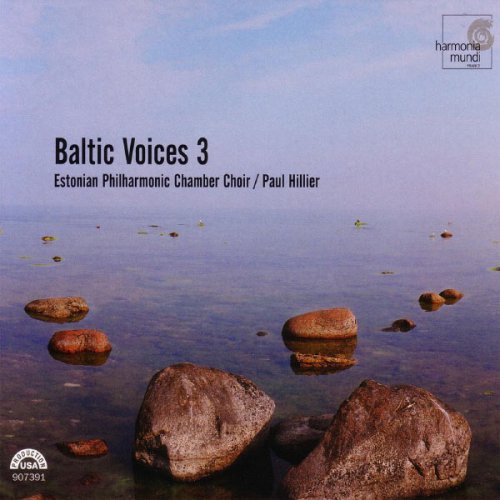
Artist: The Estonian Philharmonic Chamber Choir, Paul Hillier
Title: Baltic Voices 3
Year Of Release: 2005
Label: harmonia mundi
Genre: Classical
Quality: FLAC (tracks)
Total Time: 01:18:19
Total Size: 309 mb
WebSite: Album Preview
Tracklist:Title: Baltic Voices 3
Year Of Release: 2005
Label: harmonia mundi
Genre: Classical
Quality: FLAC (tracks)
Total Time: 01:18:19
Total Size: 309 mb
WebSite: Album Preview
01. The Stomping Bride (1994) (00:04:23)
02. Statements (1969) (00:05:54)
03. Nuits, adieux (1991, 1996) (00:11:33)
04. The dazzled eye lost its speech (1992) (00:04:53)
05. Vier Galgenlieder, Op.51b (1960): Das grosse Lalula (00:01:20)
06. Vier Galgenlieder, Op.51b (1960): Tapetenblume (00:01:04)
07. Vier Galgenlieder, Op.51b (1960): Igel und Agel (00:02:07)
08. Vier Galgenlieder, Op.51b (1960): Unter Zeiten (00:01:47)
09. Alleluia (1996) (00:04:01)
10. Meditatio (2003) (00:17:55)
11. 5 Kurpian Songs, Op.75 (1999): Hej, z góry, z góry! (00:03:53)
12. 5 Kurpian Songs, Op.75 (1999): Ciamna nocka, ciamna (00:03:07)
13. 5 Kurpian Songs, Op.75 (1999): Wcoraj, dziwcyno, nie dzisiaj (00:04:50)
14. 5 Kurpian Songs, Op.75 (1999): Z Torunia ja parobecek (00:02:24)
15. 5 Kurpian Songs, Op.75 (1999): Wysla burzycka, bandzie desc (00:09:08)
Total length: 01:18:19
Label: harmonia mundi
Performers:
with Raschèr Saxophone QuartetThe Estonian Philharmonic Chamber Choir
Paul Hillier
Paul Hillier continues his top–class 'Baltic Voices' series with a compilation that embraces Denmark, Finland, Estonia, Lithuania and Poland. It is an attractive, stylistically wide– ranging programme, one that carefully avoids the obvious in its choice of pieces. The styles range from pseudo–medievalism (Augustinas) through 'sculptural minimalism' (Gudmundsen– Holmgreen) to modernism (Saariaho, with a version of Nuits, adieux that transfers its original electronic effects to the choir), by way of 'spiral canon' (MaOulis), elaborated Sprechstimme (Bergman), new spirituality (Martinaitis), ascetic ritualism (Tüür, whose Meditatio strikes me as the intellectually toughest yet most rewarding music on the disc and least deserves having a label pinned on it), and straightforward folksiness (Górecki, in soft–grained but undeniably memorable form).
Not all of the works are on an especially exalted level but they are well chosen as vehicles for displaying the versatility and polish of Hillier's fine Estonian singers. Harmonia Mundi's recording is unimpeachable and the disc comes with a thoughtful background essay as well as notes on composers and works, all by Hillier, plus texts and translations presented with scrupulous care. A quality issue this, then, and a high priority, surely, for anyone interested in the contemporary choral repertoire.
Not all of the works are on an especially exalted level but they are well chosen as vehicles for displaying the versatility and polish of Hillier's fine Estonian singers. Harmonia Mundi's recording is unimpeachable and the disc comes with a thoughtful background essay as well as notes on composers and works, all by Hillier, plus texts and translations presented with scrupulous care. A quality issue this, then, and a high priority, surely, for anyone interested in the contemporary choral repertoire.
DOWNLOAD FROM ISRA.CLOUD
Estonian Philharmonic Chamber Choir Paul Hillier - Baltic Voices 3 (2005) FLAC.rar - 309.3 MB
Estonian Philharmonic Chamber Choir Paul Hillier - Baltic Voices 3 (2005) FLAC.rar - 309.3 MB
![Elipsis, Michael League, Pedrito Martinez, Antonio Sánchez - Elipsis (2026) [Hi-Res]](https://www.dibpic.com/uploads/posts/2026-08/1787636927_u117d6w7oejvc_600.jpg "Elipsis, Michael League, Pedrito Martinez, Antonio Sánchez - Elipsis (2026) [Hi-Res]")

![Seigen Tokuzawa & Masaki Hayashi - B (2026) [Hi-Res]](https://www.dibpic.com/uploads/posts/2026-08/1787714230_jionhssbrm07c_600.jpg "Seigen Tokuzawa & Masaki Hayashi - B (2026) [Hi-Res]")
![Sulida & Axel Dörner - Etiwe (2026) [Hi-Res]](https://www.dibpic.com/uploads/posts/2026-08/1787474322_rstwnu1e3tjoj_600.jpg "Sulida & Axel Dörner - Etiwe (2026) [Hi-Res]")
![Ben Wilcock, John Rae - March Of The Octopus (2025) [Hi-Res]](https://www.dibpic.com/uploads/posts/2026-08/1787738284_ben-wilcock-john-rae-march-of-the-octopus-2025.jpg "Ben Wilcock, John Rae - March Of The Octopus (2025) [Hi-Res]")

![Duesund - Under overflaten (2026) [Hi-Res]](https://img.israbox.com/img/2026-08/23/k02uc3gso89jmrqasrcueuwpa.jpg "Duesund - Under overflaten (2026) [Hi-Res]")