Yevgeni Galanov - Sergei Prokofiev: Piano Sonatas II (2026)
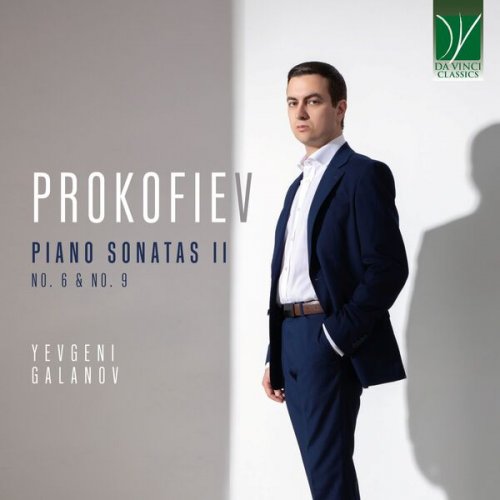
Artist: Yevgeni Galanov
Title: Sergei Prokofiev: Piano Sonatas II
Year Of Release: 2026
Label: Da Vinci Classics
Genre: Classical Piano
Quality: flac lossless (tracks)
Total Time: 00:52:09
Total Size: 157 mb
WebSite: Album Preview
TracklistTitle: Sergei Prokofiev: Piano Sonatas II
Year Of Release: 2026
Label: Da Vinci Classics
Genre: Classical Piano
Quality: flac lossless (tracks)
Total Time: 00:52:09
Total Size: 157 mb
WebSite: Album Preview
01. Piano Sonata No. 6 in A Major, Op. 82: I. Allegro moderato
02. Piano Sonata No. 6 in A Major, Op. 82: II. Allegretto
03. Piano Sonata No. 6 in A Major, Op. 82: III. Tempo di valzer lentissimo
04. Piano Sonata No. 6 in A Major, Op. 82: IV. Vivace
05. Piano Sonata No. 9 in C Major, Op. 103: I. Allegretto
06. Piano Sonata No. 9 in C Major, Op. 103: II. Allegro strepitoso
07. Piano Sonata No. 9 in C Major, Op. 103: III. Andante tranquillo
08. Piano Sonata No. 9 in C Major, Op. 103: IV. Allegro con brio, ma non troppo presto
During the 1930s, Prokofiev gravitated increasingly towards large-scale symphonic and stage works, developing a particular affinity for ballet. It was a genre to which he was ideally suited: few composers possessed his gift for fixing a musical character in the listener’s mind through a single motif in the opening bars. The rhythmic vitality inherent in his music animates many of its most energetic and aggressive pages, while the more lyrical figures in his ballets draw on an incomparable melodic imagination, whose lines seem to spring directly from the supple plasticity of the human body. When, on the eve of 1936, Prokofiev returned permanently to Russia, despite the efforts of friends both in the West and at home to dissuade him, his decision sparked a debate whose echoes have by no means died away. Those who, like Stravinsky, believed he was seeking financial security, or those who, like Shostakovich, thought he had fallen into the trap of Soviet politics, certainly grasped part of the truth. Yet, from a more strictly artistic perspective, it is equally true that this return coincided with his growing interest in ballet—arguably the Russian genre par excellence—and with the composition of his masterpiece Romeo and Juliet in 1935–36. This decisive reclaiming of the body’s physical presence within his musical language would prove fundamental to everything he wrote thereafter.
Seen in retrospect, of course, the timing of his return could scarcely have been more unfortunate. The Pravda editorial “Muddle Instead of Music,” which attacked Shostakovich’s Lady Macbeth of Mtsensk, appeared in 1936; the following two years, 1937–38, were the years of the Stalinist purges.
Within this complex historical and personal landscape, in the years immediately preceding the Great Patriotic War, Prokofiev nevertheless reached his creative summit: the full realisation of his gifts, and the creation of his most ambitious works.
The Piano Sonatas Nos. 6, Op. 82, 7, Op. 83 and 8, Op. 84 are universally regarded as Prokofiev’s greatest contribution to the piano repertoire. Known as the “War Sonatas,” they are often described as expressions of wartime upheaval. Yet we know for certain that the ten movements across the three works were all begun simultaneously in 1938, and that Sonata No. 6 was completed in 1940—before the war reached the Soviet Union in 1941.
The tense atmosphere of the outer movements of Sonata No. 6, with their dramatic collision of energetic and lyrical elements, may therefore reflect anxiety at events unfolding in Western Europe, or just as plausibly the looming threat of Stalinist oppression within Russia itself. Like Shostakovich’s Symphony No. 7, the “Leningrad”—music that later became a symbol of wartime shock—it seems to have been generated less by war itself than by the pre-war climate and by internal repression.
Prokofiev gave the world première himself in a radio broadcast, and later performed the Sonata in a public concert in Leningrad. This was the last occasion on which he would personally introduce a new piano work of his own to the public. Shortly afterwards, Sviatoslav Richter gave the Moscow première and described the work in these terms: “With savage boldness, the composer breaks with the ideals of Romanticism and admits into his music the terrifying impulse of twentieth-century music. Classically balanced despite all its asperities, the Sixth Sonata is a truly magnificent work.”
Although Richter understandably saw the work as anti-Romantic, among Prokofiev’s piano sonatas it is far more emotionally compelling than those that preceded it. One might even say that here Prokofiev looks back towards the Romantic sonata model: the opening movement is laid out in a clearly articulated sonata form, with its traditional exploration of the conflict between the individual and fate, announced from the very first unsettling theme, which returns repeatedly as a motto-theme for the entire work.
The second movement is a witty Scherzo, its dance and march impulses alternating and interweaving in an atmosphere of harmonic instability. The third movement, in waltz tempo, recalls the warmth of Prokofiev’s two principal ballets, Romeo and Juliet and Cinderella, both of which were closely connected with his work on this Sonata. Romeo and Juliet, composed as early as 1935–36, was staged in Leningrad in January 1940; for that occasion Prokofiev wrote additional numbers and made various revisions to the score. Later that same year he began work on Cinderella. The link with these two major scores helps explain a piano writing that so vividly evokes a wide range of orchestral timbres. The finale is a large-scale sonata-rondo, driven by inexhaustible energy; the return of the principal themes in the recapitulation and coda gives the whole musical narrative an epic and unified character. The violent, abrupt ending leaves us as though petrified before the opening motto, now gigantic and unleashed, as it reasserts, in a cry, the rending force of its dissonance.
Sonata No. 9 inhabits an entirely different and wholly unexpected world.
Composed in 1947, it was not performed until 1951 and was published only after Prokofiev’s death. These delays, already unusual in the performance and publication history of his earlier works, point clearly to a changed political climate. In the campaign against formalism launched by Communist Party officials in the early months of 1948, Prokofiev—together with Shostakovich—was singled out as one of the principal offenders.
Sonata No. 9 in C major is distinguished by the simplicity of its style, as well as by the concision and clarity of its structure. It has none of the dramatic conflicts that mark the preceding group of “War Sonatas,” and this change of stance may certainly reflect the pressure of the political circumstances. Yet it may also be related, as many commentators have observed, to the dramatic deterioration of Prokofiev’s health, mirrored in the reduced kinetic vitality of his music. From the beginning of 1945, the composer suffered from health problems that would torment him for the remaining eight years of his life. Another reason may have been personal: he left his first wife to live with a younger woman, Mira Mendelson, who would later become his wife, confidante, secretary, devoted admirer, and one of the most attentive interlocutors of his genius. The change in the man, even before the change in the composer, was evident to many of his friends, who noted with astonishment his new gentleness of manner and restored tranquillity of spirit.
His music, too, became warmer and more direct. Some of the most memorable lyrical moments in his entire output belong to this period.
Mira Mendelson-Prokofieva recorded her impressions of Sonata No. 9 in her diary, in an entry dated 29 September 1947: “This Sonata is very different from the three preceding ones. It is calm and profound. When I told Prokofiev that my first impression was that it was both Russian and Beethovenian, he replied that he too had found both these qualities in it.”
Richter, to whom the work was dedicated, described it with particular insight: “In some respects it is a sonata of the home. The more one hears it, the more one loves it and senses its magnetism. (…) Although the musical language of the Sonata is more conservative than that of the preceding ones, we find in it the new features of a more intimate lyricism and a deeper introspection.”
Prokofiev introduced several structural innovations into the Sonata. The most evident is the systematic use of foreshadowing: towards the end of each movement, material belonging to the next is subtly introduced. The second movement, for example, is a brilliant scherzo with an unexpected meditation at its centre, and it ends with a poetic upward suspension that anticipates the following slow movement. There, the melodious opening theme is one of the noblest lyrical inspirations of late Prokofiev, unfolding through successive interruptions and variations. The finale is carefree and radiant in character, yet infused with a grace and depth that prevent the music from lapsing into the Socialist-Realist rhetoric of Young Pioneer optimism.
In the conscious simplicity of this final Sonata, there is a decisive return to the world of childhood, a strand that runs through Prokofiev’s entire output from the very beginning. The bodily dimension of his music here reaches a state of repose: a poetic synthesis of maturity—and perhaps, with it, of frailty and illness—with the emotional qualities associated with the earliest years of life: carefreeness, purity, and play. After the anxious, strained, and tormented body of the “War Sonatas,” we encounter a body once more at ease, in music that is at once an innocent opening onto the world and a mature premonition of death. Nothing in the radiant, intimate C major of Sonata No. 9 is simply positive or simply negative; its final, metaphysical bars are like an enigmatic smile before the mystery of existence.
Faced with a personal and historical synthesis of such force, we remain uncertain about the questions raised by Prokofiev’s late style. Was the softening of his final works imposed by political pressure, while also coinciding with a natural process of maturation and a retreat from modernist idioms? Or, conversely, did his return to the Soviet Union prevent further experiments that might have renewed and revitalised his style? Or were the experiments of his youth themselves motivated by opportunism, and therefore not truly reflective of his authentic musical nature, rooted as it was in more traditional idioms?