The Sauter-Finegan Orchestra - New Directions In Music (2024) [Hi-Res]
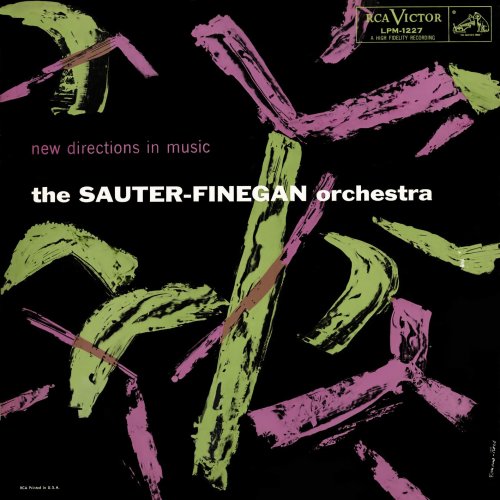
Artist: The Sauter-Finegan Orchestra
Title: New Directions In Music
Year Of Release: 1956 / 2024
Label: RCA - Legacy
Genre: Jazz
Quality: FLAC (tracks) [192kHz/24bit]
Total Time: 36:06
Total Size: 752 / 124 MB
WebSite: Album Preview
Tracklist:Title: New Directions In Music
Year Of Release: 1956 / 2024
Label: RCA - Legacy
Genre: Jazz
Quality: FLAC (tracks) [192kHz/24bit]
Total Time: 36:06
Total Size: 752 / 124 MB
WebSite: Album Preview
01. Doodletown Fifers
02. April In Paris
03. Midnight Sleighride (From "The Lieutenant Kije Suite")
04. Rain
05. Camptown Races
06. A Doodletown Yankee
07. Azure-Te (Paris Blues)
08. Stop! Sit Down! Relax! Think!
09. Moonlight on The Ganges
10. When Hearts Are Young
11. It's Mutual
12. Exactly Like You
The Sauter-Finegan Orchestra was one of the more unusual bands associated with the Swing Era, not least because it did not even come into existence until after the Swing Era was over. The outfit's two leaders, Edward Ernest (Eddie) Sauter (b. Dec 2, 1914, in New York [Brooklyn], NY; d. Apr 21, 1981, in West Nyack, NY) and William J. (Bill) Finegan (b. Apr 3, 1917, in Newark, NJ), were each prominent big band arrangers. Sauter, who played mellophone, trumpet, and drums, was educated at Columbia University and the Juilliard School of Music. During the 1930s and '40s, he played, arranged, and wrote tunes for bands led by Archie Bleyer, Charlie Barnet, Red Norvo, Benny Goodman, Artie Shaw, Tommy Dorsey, Woody Herman, and Ray McKinley. At the same time, Finegan was an arranger for Tommy Dorsey, Glenn Miller, Horace Heidt, and Les Elgart. With the decline of the Swing Era, he went to study at the Paris Conservatory in the late 1940s and early '50s, corresponding with his friend Sauter, who was staying in a sanatorium recovering from a bout of tuberculosis. The two decided to unite to create arrangements that would make full use of their creativity, without regard to commercial considerations. That meant a willingness to try unusual things, including such instruments as piccolo, flute, oboe, bass clarinet, harp, English horn, recorder, tuba, glockenspiel, tympani, and kazoo. (Finegan even beat on his chest to imitate the sound of horses' hooves in "Midnight Sleighride"). As a result, while the band was hailed by some for its imaginativeness, it reminded others of the style of musical humorist Spike Jones. Some jazz fans also complained that the arrangements left little room for improvisation. The original idea was to form a studio-only unit, and the two arrangers signed the Sauter-Finegan Orchestra to RCA Victor, which released the debut single "Doodletown Fifers" (an adaptation of the Civil War song "Kingdom Coming and the Year of Jubilo") and saw it rise into the charts in August of 1952. "Nina Never Knew," with Joe Mooney on vocals, did the same thing in December, and "The Moon Is Blue," a movie theme song with Sally Sweetland on vocals, charted in August of 1953. The same year, the band released its first 10" LP, boldly titled New Directions in Music (the album was reissued in an expanded form as a 12" LP in 1956.)

![Larry Manteca - Erotica 70 (2026) [Hi-Res]](https://img.israbox.com/img/2026-10/15/gpjzcn1v23143t3r4sqe4zsle.jpg "Larry Manteca - Erotica 70 (2026) [Hi-Res]")
![Eric Dolphy - Far Cry (1960) [1988]](https://www.dibpic.com/uploads/posts/2026-10/1792088015_front.jpg "Eric Dolphy - Far Cry (1960) [1988]")
![Cicci Santucci - Immagini Di Guerra (2026) [Hi-Res]](https://img.israbox.com/img/2026-10/15/k8zuno6splp13jyepkp1gdqhg.jpg "Cicci Santucci - Immagini Di Guerra (2026) [Hi-Res]")
![Antoni O'Breskey - A Wild Inhabitation (2026) [Hi-Res]](https://img.israbox.com/img/2026-10/15/1n68497pgbvjh8a05s7lr4ng4.jpg "Antoni O'Breskey - A Wild Inhabitation (2026) [Hi-Res]")

![Roberto Negro - Pärt & Songs (2026) [Hi-Res]](https://img.israbox.com/img/2026-10/15/q18sovdxgmd2uzlo9hdft3d2e.jpg "Roberto Negro - Pärt & Songs (2026) [Hi-Res]")