01. Caravan 2:12
02. Ain't Misbehavin' 3:18
03. Birth of the Blues 3:26
04. Take the 'A' Train 4:53
05. When I Grow Too Old to Dream 3:24
06. Intermezzo 4:28
07. Blue Prelude 3:25
08. Battle Royal 2:43
09. Goodbye 3:29
10. Pagan Love Song 2:45
11. Black Coffee 3:30
12. Blues for Beverly 4:06
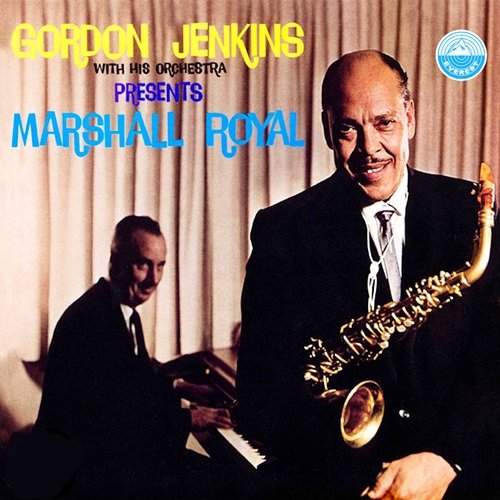
Marshall Royal:
For close to 20 years -- from the early '50s until 1970 -- the characteristic sax sound of Count Basie's big band was topped by the clear, vibrating lead alto of Marshall Royal. Royal was, by all accounts, a competent swing-based soloist, but his strength was first and foremost as a team player. Royal's style became the prototype for swinging a sax section; his slightly behind-the-beat phrasing, pronounced vibrato, and aggressive leadership influenced a subsequent generation of ensemble players.
As a child, Royal learned to play violin, guitar, and various reed instruments; trumpeter Ernie Royal was his brother. He began performing in public at the age of 13. Royal spent much of the '30s with Les Hite's band; he also recorded with Art Tatum around that time. Royal joined Lionel Hampton's band in 1940, staying two years. During the war, Royal served in a Navy band. In 1946, he played with Eddie Heywood before moving to Los Angeles. Royal worked in the studios for a time, and then, in 1951, he joined the septet Count Basie had formed following the demise of his big band. Basie reorganized the big band the next year, with Royal ensconced as lead altoist and music director -- dual roles he would occupy until 1970. After leaving Basie, Royal settled for good in Los Angeles. Royal played and recorded with Bill Berry's big band and the Frankie Capp-Nat Pierce Juggernaut. In 1977, he recorded as a soloist with Dave Frishberg, and in 1978 with Warren Vache. In the late '70s and early '80s, Royal recorded with a band he co-led with Snooky Young, as well as under his own name. Royal kept busy during the '80s; among his activities was a 1982 record date with Ella Fitzgerald and a 1987 Concord Jazz Festival Basie tribute led by Gene Harris. Royal stayed in touch with his ex-Basie colleagues as well, recording with the big bands of Ernie Wilkins and Frank Wess in 1990.~Chris Kelsey
Gordon Jenkins:
Composer, arranger, and orchestra leader Gordon Jenkins was a mainstay in the popular music world of the 1930s through the 1970s; he remains best known for his arranging for Frank Sinatra and Nat "King" Cole. Although more readily associated with "easy listening"-styled lush string arrangements and his haunting, nostalgic popular songs, Jenkins did try his hand at a few ambitious projects of extended length. Jenkins initially made his name in 1933 with Blue Prelude; in 1935 bandleader Benny Goodman chose Jenkins' Goodbye as his closing theme on radio, and kept it forever after as his sign off tune, even in live performances. After conducting The Show is On (1936) on Broadway, composing for Hollywood films, and working with Dick Haymes as his bandleader, Jenkins signed a contract with Decca Records in 1945 as an arranger and music director.
Early in Jenkins' recording contract, he produced a risky and highly ambitious project, Manhattan Tower, a suite for orchestra set in a New York skyscraper and embellished with narration, chorus, and sound effects. It was widely acclaimed at the time as a major achievement in popular music, as it sustained its concept over four sides of 78s and told close to a complete story, making Manhattan Tower perhaps the first "concept album" ever issued. Jenkins revisited Manhattan Tower at least three times more, creating two versions for television and expanding it into near musical show length for a Capitol LP edition in 1956, adding a romantic component to the story. In 1949, Jenkins created his California Suite as an LP companion to Manhattan Tower, and in 1953 followed it with his last extended suite, Seven Dreams, which portrayed the subconscious goings-on of a number of characters. One episode from Seven Dreams is said to have inspired Johnny Cash to write "Folsom Prison Blues."
After his move to Capitol in 1955, the reconstituted Manhattan Tower was the only extended work that Jenkins recorded under his own name. Jenkins' later work with Nat "King" Cole, such as the album Love Is the Thing, and in particular Frank Sinatra ("No One Cares," "September of My Years," and "Ol' Blue Eyes is Back") demonstrates a seriousness of purpose that stands apart from most vocal pop of the era. These albums are thematically linked, and the programs contain material that interacts with some aspect of each singer's personality and history; "September of My Years" earned Jenkins a Grammy Award in 1967. The 1979 three-LP Frank Sinatra set Trilogy, though artistically less than successful, contains a disc called The Future, which is a continuous narrative from Sinatra punctuated by musical cues and sound effects where he sings of his love of opera, gambling, and other pursuits -- the only instance on records where Ol' Blue Eyes breaks the fourth wall. Sinatra and Jenkins' final collaboration, "She Shot Me Down" (1981), is widely acknowledged as the finest post-1980 work of either performer; Jenkins succumbed to Amytropic Lateral Sclerosis not long afterward at age 73.


![Anders Mogensen - Appreciation (2026) [Hi-Res]](https://www.dibpic.com/uploads/posts/2026-10/1792689571_cover.jpg "Anders Mogensen - Appreciation (2026) [Hi-Res]")
![Danny Green - Let the Music Happen (2026) [Hi-Res]](https://img.israbox.com/img/2026-10/22/mdm41zc1afaeopu7ne8yr2rf3.jpg "Danny Green - Let the Music Happen (2026) [Hi-Res]")
![Charles Overton - Reflections (2026) [Hi-Res]](https://img.israbox.com/img/2026-10/23/s72rtl7esq6ajhbhsqij9obuk.jpg "Charles Overton - Reflections (2026) [Hi-Res]")