Wunderkammer, Mira Lange, Martin Seemann - Cello Sonatas of the Romantic Period (2026) [Hi-Res]
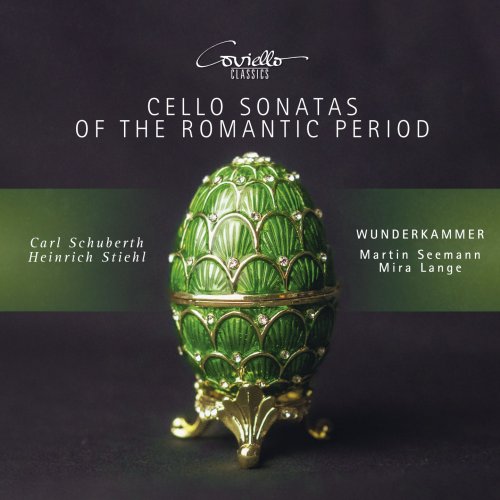
Artist: Wunderkammer, Mira Lange, Martin Seemann
Title: Cello Sonatas of the Romantic Period
Year Of Release: 2026
Label: Coviello Classics
Genre: Classical
Quality: flac lossless (tracks) / flac 24bits - 96.0kHz +Booklet
Total Time: 01:03:31
Total Size: 308 mb / 1.22 gb
WebSite: Album Preview
TracklistTitle: Cello Sonatas of the Romantic Period
Year Of Release: 2026
Label: Coviello Classics
Genre: Classical
Quality: flac lossless (tracks) / flac 24bits - 96.0kHz +Booklet
Total Time: 01:03:31
Total Size: 308 mb / 1.22 gb
WebSite: Album Preview
01. Prize-Sonata for Pianoforte and Violoncello in A Minor, Op. 37: I. Allegro appassionato
02. Prize-Sonata for Pianoforte and Violoncello in A Minor, Op. 37: II. Scherzo - Allegro vivace
03. Prize-Sonata for Pianoforte and Violoncello in A Minor, Op. 37: III. „Lass o Welt, o lass mich sein“ - Andante sostenuto
04. Prize-Sonata for Pianoforte and Violoncello in A Minor, Op. 37: IV. Finale - Allegro molto
05. Grand Nocturne élégiaque for Two Cellos and Piano, Op. 6 L‘ Adieu
06. Grande Sonata for Pianoforte and Violoncello in D Major, Op. 43: I. Allegro moderato
07. Grande Sonata for Pianoforte and Violoncello in D Major, Op. 43: II. Intermezzo - Andante e Scherzo
08. Grande Sonata for Pianoforte and Violoncello in D Major, Op. 43: III. Finale - Allegro vivace
This recording brings to light two almost forgotten figures of German Romanticism: Heinrich Stiehl (1829–1886) and Carl Schuberth (1811–1863). Both composers were highly respected musicians of their time — Stiehl as an organist, pedagogue, and composer active between Leipzig, St Petersburg, and the Baltic region; Schuberth as one of the leading cello virtuosi of the 19th century. Their works exemplify a rich musical culture beyond the narrow canon of “genius” composers, revealing the artistic level that sustained and shaped Romantic musical life.
At the heart of the programme is Heinrich Stiehl’s Sonata for Pianoforte and Violoncello in A minor, Op. 37, awarded a prize by the German Tonhalle in Mannheim in 1860. The sonata combines Romantic expressiveness with learned craftsmanship and reveals its most poetic qualities in the inner movements. The third movement, marked by Eduard Mörike’s poem “Lass, o Welt, o lass mich sein” (“Let, O world, O let me be”), unfolds an intimate, song-like character, while the finale, with its fugato, demonstrates Stiehl’s command of contrapuntal writing.
Carl Schuberth is represented by two works that vividly display both his melodic imagination and his idiomatic, virtuosic approach to the cello. The Grand Nocturne élégiaque, Op. 6, for two cellos and piano, creates a lyrical, almost vocal dialogue between the instruments, exploring the cello’s cantabile potential in depth. Schuberth’s Grande Sonata for Cello and Piano in D major, Op. 43, a late work published posthumously, combines expansive formal design with a balladesque tone and places demanding technical and expressive requirements on both performers.
The recording features Martin Seemann (cello), Bettina Messerschmidt (second cello in the Nocturne), and Mira Lange on a historical Streicher & Söhne fortepiano (Vienna, 1864). Performed on period instruments and informed by historical performance practice, the music gains transparency, colour, and expressive nuance, allowing the Romantic sound world of these works to emerge with striking immediacy.
This album is an invitation to rediscovery — not of misunderstood geniuses, but of compelling, finely crafted music that once formed the backbone of 19th-century musical culture: eloquent, ambitious, and full of narrative power.

![PAKT - Live Montreal / Toronto 2025 (2025) [Hi-Res]](https://www.dibpic.com/uploads/posts/2026-08/1788202009_o1mffwt7aafev_600.jpg "PAKT - Live Montreal / Toronto 2025 (2025) [Hi-Res]")
![Arnaud Roulin - Voyage Pentatonique (2026) [Hi-Res]](https://img.israbox.com/img/2026-08/31/phpyil5fgr16h6y5ogk9ompcg.jpg "Arnaud Roulin - Voyage Pentatonique (2026) [Hi-Res]")

![Tone Åse & Ståle Storløkken - Snu Jorda (2026) [Hi-Res]](https://www.dibpic.com/uploads/posts/2026-09/1788235204_uzsq4ovsk1e5p_600.jpg "Tone Åse & Ståle Storløkken - Snu Jorda (2026) [Hi-Res]")
![Fredrik Kronkvist - Worlds Unseen (2026) [Hi-Res]](https://www.dibpic.com/uploads/posts/2026-09/1788235294_fkqndok3o9vzu_600.jpg "Fredrik Kronkvist - Worlds Unseen (2026) [Hi-Res]")